





















HS Code Lookup for Heading 6103
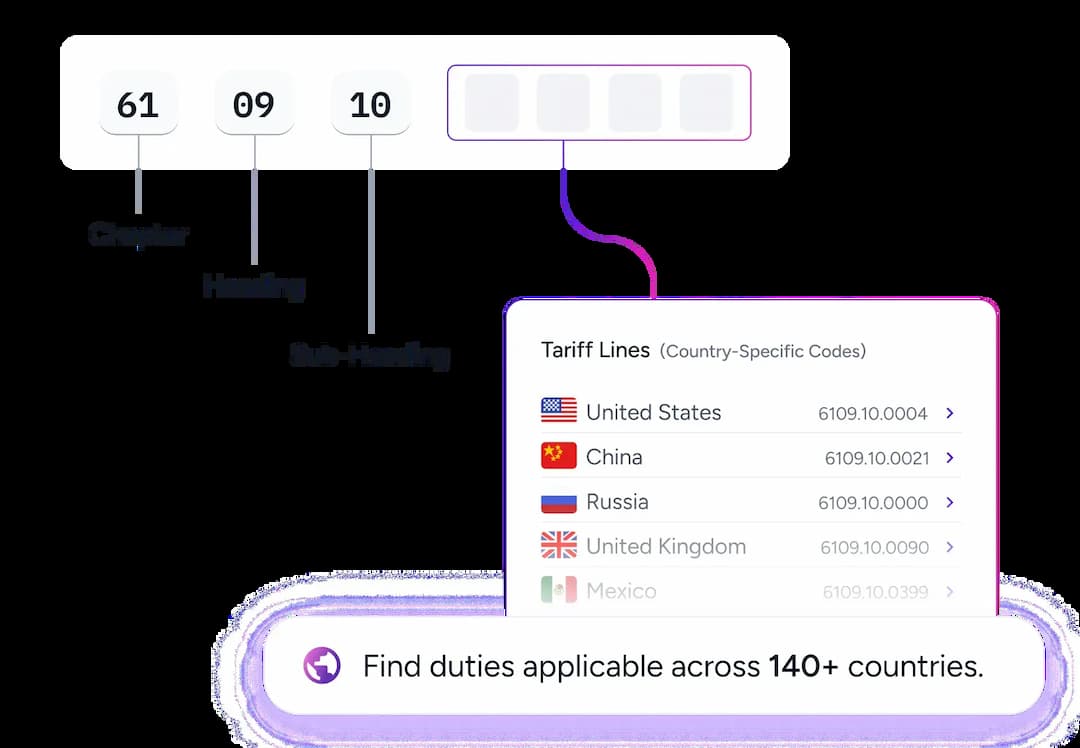
HS Code Lookup helps classify products under appropriate HS code and find duties applicable across 140+ countries. Find and discover HS classification, tariffs, taxes, controls, rulings, ECCNs, and default and preferential duties for HS code 6103.

WCO Notes for Heading 6103
61.03 ‑ Men's or boys' suits, ensembles, jackets, blazers, trousers, bib and brace overalls, breeches and shorts (other than swimwear), knitted or crocheted.
6103.10 ‑ Suits
‑ Ensembles :
6103.22 ‑ ‑ Of cotton
6103.23 ‑ ‑ Of synthetic fibres
6103.29 ‑ ‑ Of other textile materials
‑ Jackets and blazers :
6103.31 ‑ ‑ Of wool or fine animal hair
6103.32 ‑ ‑ Of cotton
6103.33 ‑ ‑ Of synthetic fibres
6103.39 ‑ ‑ Of other textile materials
‑ Trousers, bib and brace overalls, breeches and shorts :
6103.41 ‑ ‑ Of wool or fine animal hair
6103.42 ‑ ‑ Of cotton
6103.43 ‑ ‑ Of synthetic fibres
6103.49 ‑ ‑ Of other textile materials
This heading covers only men’s or boy’s knitted or crocheted suits and ensembles, jackets, blazers, trousers, breeches and shorts (other than swimwear) and bib and brace type overalls.
(A) For the purposes of Chapter Note 3 (a), it should be noted that :
(a) the “suit coat or jacket” designed to cover the upper part of the body has a full front opening without a closure or with a closure other than a slide fastener (zipper). It does not extend below the mid-thigh area and is not for wear over another coat, jacket or blazer;
(b) the “panels” (at least two in front and two at the back) making up the outer shell of the suit coat or jacket must be sewn together lengthwise. For this purpose the term “panels” does not include sleeves, facings or collar, if any;
(c) a “tailored waistcoat”, whose front is made from the same fabric as the outer surface of the other components of the set and whose back is made from the same fabric as the lining of the suit coat or jacket, may also be included in the set.
All of the components of a “suit” must be of the same fabric construction, colour and composition; they must also be of the same style and of corresponding or compatible size. However, these components may have piping (a strip of fabric sewn into the seam) in a different fabric.
If several separate components to cover the lower part of the body are presented together (e.g., two pairs of trousers or trousers and shorts), the constituent lower part shall be one pair of trousers, the other garments being considered separately.
For the purposes of Chapter Note 3 (a), the expression “identical fabric” means a single identical fabric, i.e., the fabric must be :
- of the same construction, i.e., it must be obtained by the same yarn-bonding technique (having the same stitch size) and the structure and measurement (e.g., the decitex number) of the yarns used must also be the same;
- of the same colour (even the same shade and pattern of colour); this includes fabrics of different-coloured yarns and printed fabrics;
- of thesame composition, i.e., the percentage of the textile materials used (e.g., 100 % by weight of wool, 51 % by weight of synthetic fibres, 49 % by weight of cotton) must be the same.
(B) The term “men’s or boys’ ensemble” means a set of garments (other than suits and articles of heading 61.07, 61.08 or 61.09), composed of several pieces made up in identical fabric, put up for retail sale, and comprising :
‑ one garment designed to cover the upper part of the body, with the exception of pullovers which may form a second upper garment in the sole context of twin sets, and of waistcoats which may also form a second upper garment, and
‑ one or two different garments, designed to cover the lower part of the body and consisting of trousers, bib and brace overalls, breeches or shorts (other than swimwear).
All of the components of an ensemble must be of the same fabric construction, style, colour and composition; they also must be of corresponding or compatible size. The term “ensemble” does not apply to track suits and ski suits, of heading 61.12 (see Chapter Note 3 (b)).
In addition :
(C) The “jackets or blazers” have the same characteristics as the suit coats and suit jackets described in Chapter Note 3 (a) and in Part (A) above, except that the outer shell (exclusive of sleeves, and facings or collar, if any) may consist of three or more panels (of which two are at the front) sewn together lengthwise. The heading does not, however, include anoraks, wind-cheaters, ski-jackets and similar garments of heading 61.01 or 61.02.
(D) “Trousers” means garments which envelop each leg separately, covering the knees and usually reaching down to or below the ankles; these garments usually stop at the waist; the presence of braces does not cause these garments to lose the essential character of trousers.
(E) “Bib and brace overalls” means garments of the type illustrated below in figures 1 to 5 and similar garments which do not cover the knee.


(F) “Shorts” means “trousers” which do not cover the knee.
The heading does not include :
(a) Tailored waistcoats presented separately (heading 61.10).
(b) Track suits, ski suits and swimwear (heading 61.12).

What is HS code 6103?

How many sub-headings are there in HS code 6103?
International Trade Compliance Simplified
Stay Ahead of Regulatory Changes with Extensive Trade Compliance Content