





















HS Code Lookup for Heading 6104
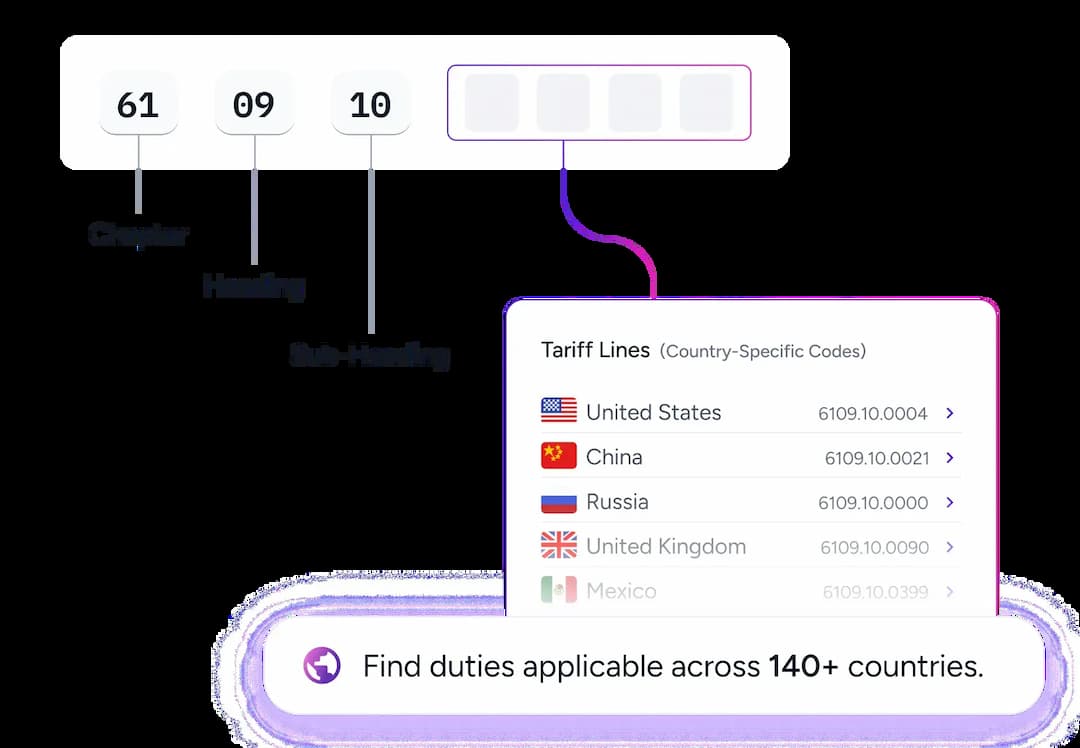
HS Code Lookup helps classify products under appropriate HS code and find duties applicable across 140+ countries. Find and discover HS classification, tariffs, taxes, controls, rulings, ECCNs, and default and preferential duties for HS code 6104.

WCO Notes for Heading 6104
61.04 ‑ Women's or girls' suits, ensembles, jackets, blazers, dresses, skirts, divided skirts, trousers, bib and brace overalls, breeches and shorts (other than swimwear), knitted or crocheted.
‑ Suits :
6104.13 ‑ ‑ Of synthetic fibres
6104.19 ‑ ‑ Of other textile materials
‑ Ensembles :
6104.22 ‑ ‑ Of cotton
6104.23 ‑ ‑ Of synthetic fibres
6104.29 ‑ ‑ Of other textile materials
‑ Jackets and blazers :
6104.31 ‑ ‑ Of wool or fine animal hair
6104.32 ‑ ‑ Of cotton
6104.33 ‑ ‑ Of synthetic fibres
6104.39 ‑ ‑ Of other textile materials
‑ Dresses :
6104.41 ‑ ‑ Of wool or fine animal hair
6104.42 ‑ ‑ Of cotton
6104.43 ‑ ‑ Of synthetic fibres
6104.44 ‑ ‑ Of artificial fibres
6104.49 ‑ ‑ Of other textile materials
‑ Skirts and divided skirts :
6104.51 ‑ ‑ Of wool or fine animal hair
6104.52 ‑ ‑ Of cotton
6104.53 ‑ ‑ Of synthetic fibres
6104.59 ‑ ‑ Of other textile materials
‑ Trousers, bib and brace overalls, breeches and shorts :
6104.61 ‑ ‑ Of wool or fine animal hair
6104.62 ‑ ‑ Of cotton
6104.63 ‑ ‑ Of synthetic fibres
6104.69 ‑ ‑ Of other textile materials
The provisions of the Explanatory Note to heading 61.03 apply mutatis mutandis to the articles of this heading.
All of the components of a women's or girls’ “suit” must be of the same fabric construction, colour and composition; they must also be of the same style and of corresponding or compatible size. However, these components may have piping (a strip of fabric sewn into the seam) in a different fabric.
If several separate components to cover the lower part of the body are presented together (e.g., a skirt or divided skirt and trousers), the constituent lower part shall be the skirt or divided skirt, the other garments being considered separately.
However, for the purposes of this heading, the term “women’s or girls’ ensemble” means a set of garments (other than suits and articles of heading 61.07, 61.08 or 61.09), composed of several pieces made up in identical fabric, put up for retail sale, and comprising :
‑ one garment designed to cover the upper part of the body, with the exception of pullovers which may form a second upper garment in the sole context of twin sets, and of waistcoats which may also form a second upper garment, and
‑ one or two different garments, designed to cover the lower part of the body and consisting of trousers, bib and brace overalls, breeches, shorts (other than swimwear), a skirt or a divided skirt, with or without braces or a bib.
All of the components of an ensemble must be of the same fabric construction, style, colour and composition; they also must be of corresponding or compatible size. The term “ensemble” does not apply to track suits or ski suits, of heading 61.12 (see Chapter Note 3 (b)).
Furthermore, the heading excludes petticoats and slips of heading 61.08.

What is HS code 6104?

How many sub-headings are there in HS code 6104?
International Trade Compliance Simplified
Stay Ahead of Regulatory Changes with Extensive Trade Compliance Content