





















HS Code Lookup for Heading 6115
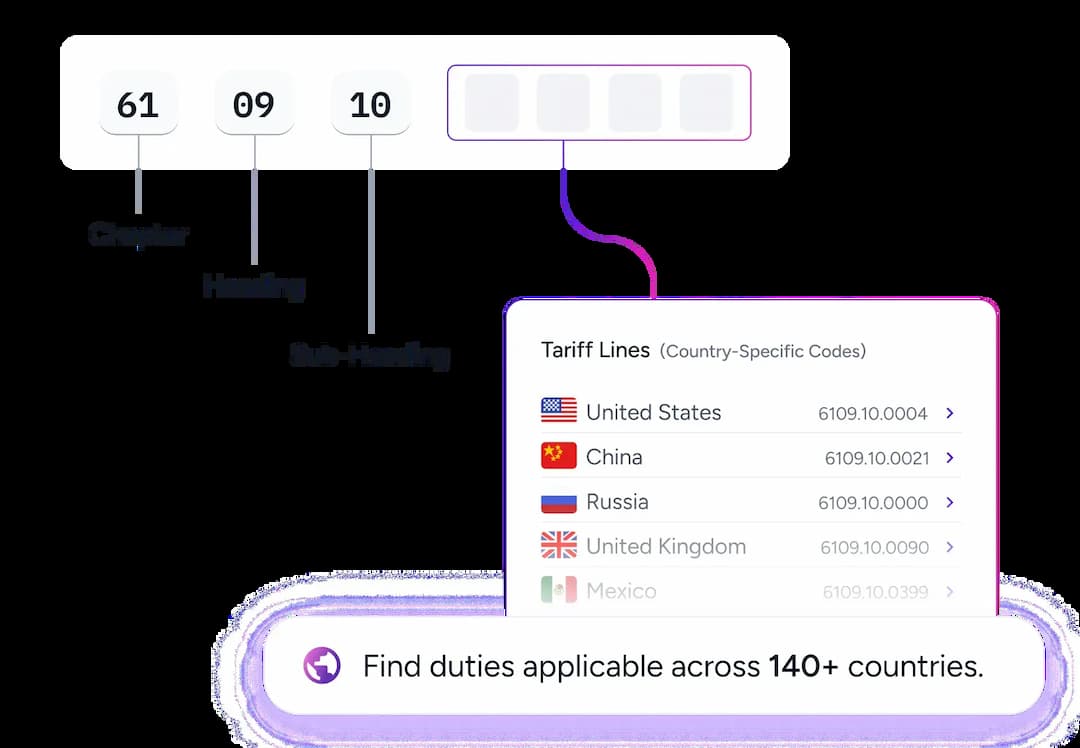
HS Code Lookup helps classify products under appropriate HS code and find duties applicable across 140+ countries. Find and discover HS classification, tariffs, taxes, controls, rulings, ECCNs, and default and preferential duties for HS code 6115.

WCO Notes for Heading 6115
61.15 ‑ Panty hose, tights, stockings, socks and other hosiery, including graduated compression hosiery (for example, stockings for varicose veins) and footwear without applied soles, knitted or crocheted (+).
6115.10 - Graduated compression hosiery (for example, stockings for varicose veins)
- Other panty hose and tights :
6115.21 - - Of synthetic fibres, measuring per single yarn less than 67 decitex
6115.22 - - Of synthetic fibres, measuring per single yarn 67 decitex or more
6115.29 - - Of other textile materials
6115.30 - Other women's full-length or knee-length hosiery, measuring per single yarn less than 67 decitex
‑ Other :
6115.94 ‑ ‑ Of wool or fine animal hair
6115.95 ‑ ‑ Of cotton
6115.96 ‑ ‑ Of synthetic fibres
6115.99 ‑ ‑ Of other textile materials
This heading covers the following knitted or crocheted goods, without distinction between those for women or girls and those for men or boys :
(1) Panty hose and tights designed to cover the feet and legs (hose) and the lower part of the body up to the waist (panty), including those without feet.
(2) Stockings and socks (including ankle‑socks).
(3) Under stockings, used mainly as a protection against the cold.
(4) Graduated compression hosiery, e.g., stockings for varicose veins.
(5) Sockettes intended to protect the feet or toes of stockings from friction or wear.
(6) Footwear without an outer sole glued, sewn or otherwise affixed or applied to the upper, other than babies’ bootees.
The heading also covers unfinished stockings, socks, etc., of knitted or crocheted fabric, provided they have the essential character of the finished article.
The heading excludes :
(a) Stockings, socks and bootees without an outer sole glued, sewn or otherwise affixed or applied to the upper, for babies (heading 61.11).
(b) Stockings, socks, etc., other than knitted or crocheted (usually heading 62.17).
(c) Knitted footwear with an outer sole glued, sewn or otherwise affixed or applied to the upper (Chapter 64).
(d) Leggings and gaiters (including “mountain stockings” without feet) (heading 64.06).
°
° °
Subheading Explanatory Note.
Subheading 6115.10
For the purposes of subheading 6115.10, “graduated compression hosiery” means hosiery in which the compression is greatest at the ankle and reduces gradually along its length up the leg, so that blood flow is encouraged.

What is HS code 6115?

How many sub-headings are there in HS code 6115?
International Trade Compliance Simplified
Stay Ahead of Regulatory Changes with Extensive Trade Compliance Content