





















HS Code Lookup for Heading 6117
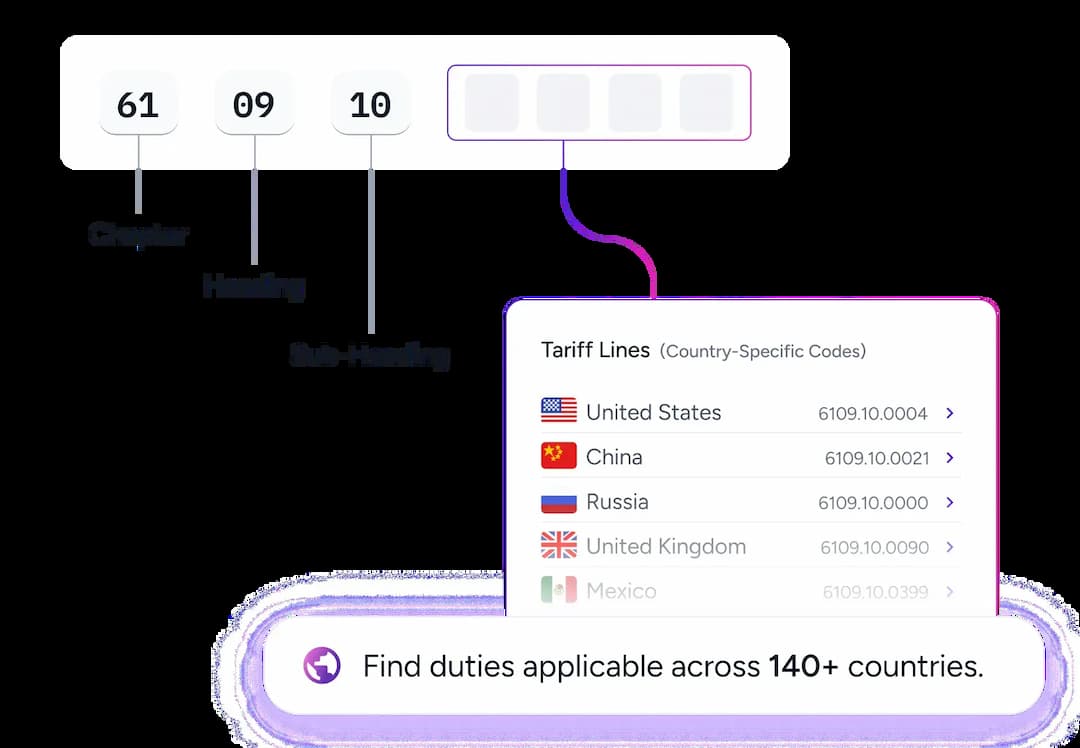
HS Code Lookup helps classify products under appropriate HS code and find duties applicable across 140+ countries. Find and discover HS classification, tariffs, taxes, controls, rulings, ECCNs, and default and preferential duties for HS code 6117.

WCO Notes for Heading 6117
61.17 - Other made up clothing accessories, knitted or crocheted; knitted or crocheted parts of garments or of clothing accessories.
6117.10 ‑ Shawls, scarves, mufflers, mantillas, veils and the like
6117.80 ‑ Other accessories
6117.90 ‑ Parts
This heading covers made up knitted or crocheted clothing accessories, not specified or included in the preceding headings of this Chapter or elsewhere in the Nomenclature. The heading also covers knitted or crocheted parts of garments or of clothing accessories, (other than parts of articles of heading 62.12).
The heading covers, inter alia :
(1) Shawls, scarves, mufflers, mantillas, veils and the like.
(2) Ties, bow ties and cravats.
(3) Dress shields, shoulder or other pads.
(4) Belts of all kinds (including bandoliers) and sashes (e.g., military or ecclesiastical), whether or not elastic. These articles are included here even if they incorporate buckles or other fittings of precious metal or are decorated with pearls, precious or semi‑precious stones (natural, synthetic or reconstructed).
(5) Muffs, including muffs with mere trimmings of furskin or artificial fur on the outside.
(6) Sleeve protectors.
(7) Kneebands, other than those of heading 95.06 used for sport.
(8) Labels, badges, emblems, “flashes” and the like (excluding embroidered motifs of heading 58.10) made up otherwise than by cutting to shape or size. (When made up only by cutting to shape or size these articles are excluded - heading 58.07.)
(9) Separately presented removable linings for raincoats or similar garments.
(10) Pockets, sleeves, collars, collarettes, wimples, fallals of various kinds (such as rosettes, bows, ruches, frills and flounces), bodice‑fronts, jabots, cuffs, yokes, lapels and similar articles.
(11) Handkerchiefs.
(12) Headbands, used as protection against the cold, to hold the hair in place, etc.
The heading does not include :
(a) Clothing accessories for babies, knitted or crocheted, of heading 61.11.
(b) Brassières, girdles, corsets, braces, suspenders, garters and similar articles, and parts thereof (heading 62.12).
(c) Belts for occupational use (e.g., window‑cleaners’ or electricians’ belts) or rosettes not for garments (heading 63.07).
(d) Knitted or crocheted headgear (heading 65.05) and fittings for headgear (heading 65.07).
(e) Feather trimmings (heading 67.01).
(f) Trimmings of artificial flowers, foliage or fruit of heading 67.02.
(g) Strips of press fasteners and hooks and eyes on knitted tape (heading 60.01, 60.02, 60.03, 83.08 or 96.06, as the case may be).
(h) Slide fasteners (zippers) (heading 96.07).
______________________

What is HS code 6117?

How many sub-headings are there in HS code 6117?
International Trade Compliance Simplified
Stay Ahead of Regulatory Changes with Extensive Trade Compliance Content