




Podcasts
Watch videos featuring supply chain experts




End-to-end compliance automation across classification, screening, and duties.








India has once again shocked global bullion markets with a sudden and steep increase in import duties on gold and silver. In one of the most significant tariff revisions in recent years, the effective import tax on gold surged from 6% to 15% overnight, immediately reshaping landed costs, trade flows, and sourcing decisions across the supply chain. Gold now attracts 10% Basic Customs Duty (BCD) and 5% Agriculture Infrastructure and Development Cess (AIDC), up from 5% and 1% earlier, a sharp reversal just 22 months after cutting duties to historically low levels. The move is sending shockwaves through India's precious metals market and raising critical questions about tariff strategy in a volatile global economy. This represents far more than a routine tax adjustment, it's a dramatic policy swing that exposes the complex interplay between currency defense, external finance management, and the unintended consequences of tariff barriers. But beyond the price shock lies a deeper question that every trade compliance team needs to answer: Are your systems, classifications, and counterparty screens updated to reflect the world that exists today?
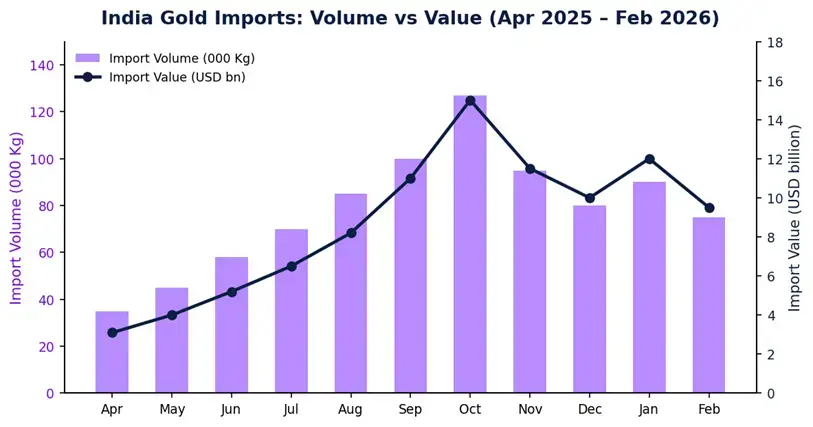
Source - Directorate General of Commercial Intelligence & Statistics – ITC Trade Map
The chart shows that India’s gold imports between April 2025 and February 2026 were driven by both rising demand and strong price effects. While import volume increased from 35,000 Kg in April to 127,000 Kg in October 2025, import value rose much faster from USD 3.1 billion to USD 15 billion, indicating that higher global gold prices significantly amplified the import bill. The price effect is further evident in January 2026, when import value rebounded to USD 12 billion despite volumes remaining below the October peak, highlighting the impact of elevated per-unit gold prices alongside seasonal demand.
The duty hike did not happen in isolation. It is the product of at least four compounding pressures that had been building across India's external account throughout FY2025-26.
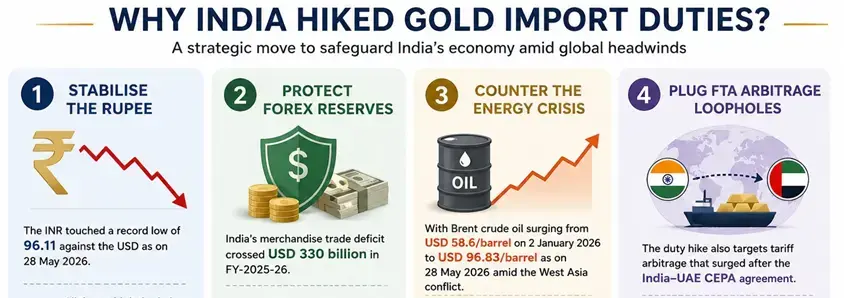
India’s sharp increase in gold import duties appears to be driven by mounting pressure on the country’s external accounts. With the INR touching a record low of 96.11 against the USD as on 28 May 2026 and India’s merchandise trade deficit crossing USD 330 billion in FY 2025-26, the government is attempting to reduce non-essential imports that accelerate dollar outflows and strain forex reserves. The move also comes amid a sharp rise in Brent crude oil prices from USD 58.6/barrel in January 2026 to nearly USD 96.83/barrel by May 2026, which further intensified external account stress during the West Asia conflict.
At the same time, the duty hike also targets tariff arbitrage concerns that emerged after the India-UAE CEPA agreement. Analysis of recent trade patterns indicates that preferential tariff arrangements can significantly influence sourcing decisions and trade flows within the bullion market. The sharp increase in duties reflects the government's broader effort to discourage import-led demand, limit potential arbitrage opportunities, and manage external account pressures during a period of heightened economic and geopolitical uncertainty.
India’s gold duty moves show a clear pattern: higher duties can suppress official imports, but they also push part of demand into informal channels. The 2022 hike was followed by a rise in smuggled gold, while the 2024 cut to 6% helped legal trade recover. The 2026 hike may repeat the same pressure, especially as traders look for more opaque routing.
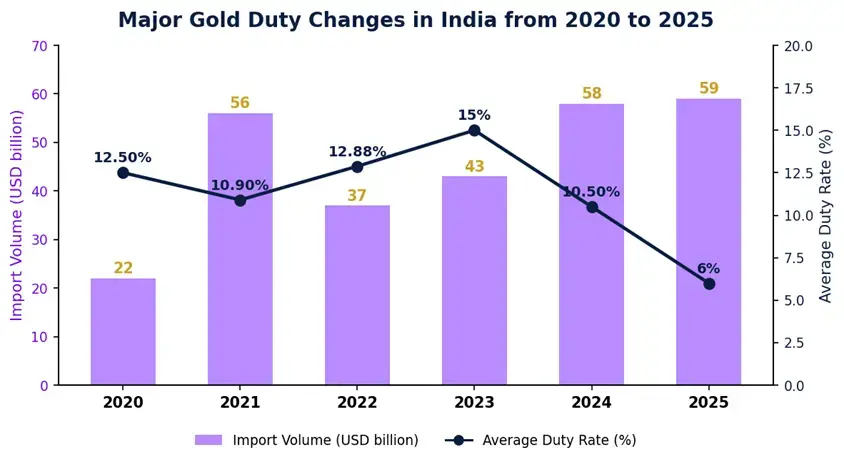
Source – Directorate General of Commercial Intelligence & Statistics - ITC Trade Map and World Gold Council
Frequent and abrupt tariff revisions create significant uncertainty across the supply chain.
For importers and refiners: ● Landed cost calculations become volatile ● Hedging strategies become difficult ● Working capital requirements increase
For Jewellers: ● Inventory planning becomes unpredictable ● Margin pressures intensify ● Consumer demand fluctuates sharply after policy announcements
For policymakers: ● Excessive tariff dependence can unintentionally incentivize informal trade routes and smuggling networks.
India’s gold duty shocks highlight the growing use of tariffs as a strategic macroeconomic policy instrument. While sudden duty hikes can temporarily reduce import pressure and protect forex reserves, they also immediately impact landed costs, procurement strategies, supplier relationships, and shipment planning. As geopolitical tensions and economic uncertainty continue to intensify globally, companies can no longer rely on static sourcing models or delayed market intelligence.
Going forward, India may need a more balanced framework that combines moderate tariffs with stronger traceability, import monitoring, and domestic gold monetization initiatives rather than relying solely on abrupt duty interventions. For businesses operating in global trade and commodities, these developments underscore the importance of real-time tariff intelligence, trade visibility, and supply chain risk monitoring.