Controlled Execution: How SIBOS 2026 Redefined AI in Trade Finance & Financial Crime
















HS Code Lookup
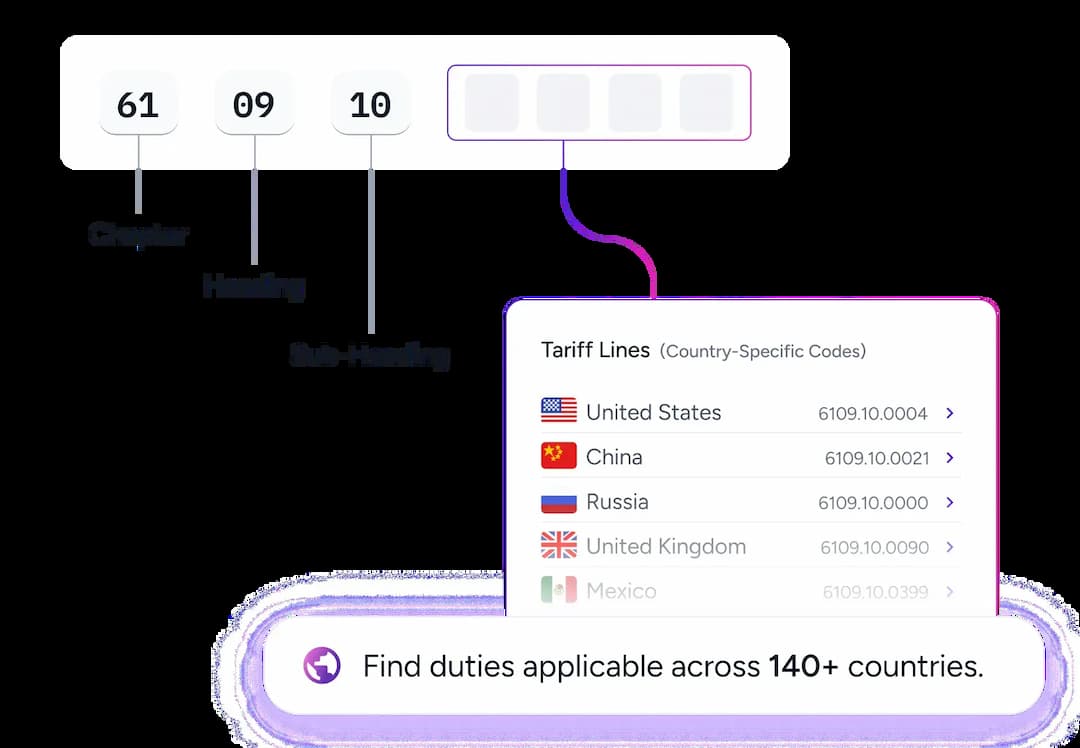
HS Code Lookup helps classify products under appropriate HS code and find duties applicable across 140+ countries. Find and discover HS classification, tariffs, taxes, controls, rulings, ECCNs, and default and preferential duties for HS code.

Harmonized System (HS) Classification — Sections & Chapters (01–98)
Sections
Descriptions
Section ILIVE ANIMALS; ANIMAL PRODUCTS
Chapters & Description
Section IIVEGETABLE PRODUCTS
Section IIIANIMAL, VEGETABLE OR MICROBIAL FATS AND OILS AND THEIR CLEAVAGE PRODUCTS; PREPARED EDIBLE FATS; ANIMAL OR VEGETABLE WAXES
Section IVPREPARED FOODSTUFFS; BEVERAGES, SPIRITS AND VINEGAR; TOBACCO AND MANUFACTURED TOBACCO SUBSTITUTES; PRODUCTS, WHETHER OR NOT CONTAINING NICOTINE, INTENDED FOR INHALATION WITHOUT COMBUSTION; OTHER NICOTINE CONTAINING PRODUCTS INTENDED FOR THE INTAKE OF NICOTINE INTO THE HUMAN BODY
Section VMINERAL PRODUCTS
Section VIPRODUCTS OF THE CHEMICAL OR ALLIED INDUSTRIES
Section VIIPLASTICS AND ARTICLES THEREOF; RUBBER AND ARTICLES THEREOF
Section VIIIRAW HIDES AND SKINS, LEATHER, FURSKINS AND ARTICLES THEREOF; SADDLERY AND HARNESS; TRAVEL GOODS, HANDBAGS AND SIMILAR CONTAINERS; ARTICLES OF ANIMAL GUT (OTHER THAN SILK-WORM GUT)
Section IXWOOD AND ARTICLES OF WOOD; WOOD CHARCOAL; CORK AND ARTICLES OF CORK; MANUFACTURES OF STRAW, OF ESPARTO OR OF OTHER PLAITING MATERIALS; BASKETWARE AND WICKERWORK
Section XPULP OF WOOD OR OF OTHER FIBROUS CELLULOSIC MATERIAL; RECOVERED (WASTE AND SCRAP) PAPER OR PAPERBOARD; PAPER AND PAPERBOARD AND ARTICLES THEREOF
Section XITEXTILES AND TEXTILE ARTICLES
Section XIIFOOTWEAR, HEADGEAR, UMBRELLAS, SUN UMBRELLAS, WALKING-STICKS, SEAT-STICKS, WHIPS, RIDING-CROPS AND PARTSTHEREOF; PREPARED FEATHERS AND ARTICLES MADE THEREWITH; ARTIFICIAL FLOWERS; ARTICLES OF HUMAN HAIR
Section XIIIARTICLES OF STONE, PLASTER, CEMENT, ASBESTOS, MICA OR SIMILAR MATERIALS; CERAMIC PRODUCTS; GLASS AND GLASSWARE
Section XIVNATURAL OR CULTURED PEARLS, PRECIOUS OR SEMI-PRECIOUS STONES, PRECIOUS METALS, METALS CLAD WITH PRECIOUS METAL, AND ARTICLES THEREOF; IMITATION JEWELLERY; COIN
Section XVBASE METALS AND ARTICLES OF BASE METAL
Section XVIMACHINERY AND MECHANICAL APPLIANCES; ELECTRICAL EQUIPMENT; PARTS THEREOF; SOUND RECORDERS AND REPRODUCERS, TELEVISION IMAGE AND SOUND RECORDERS AND REPRODUCERS, AND PARTS AND ACCESSORIES OF SUCH ARTICLES
Section XVIIVEHICLES, AIRCRAFT, VESSELS AND ASSOCIATED TRANSPORT EQUIPMENT
Section XVIIIOPTICAL, PHOTOGRAPHIC, CINEMATOGRAPHIC, MEASURING, CHECKING, PRECISION, MEDICAL OR SURGICAL INSTRUMENTS AND APPARATUS; CLOCKS AND WATCHES; MUSICAL INSTRUMENTS; PARTS AND ACCESSORIES THEREOF
Section XIXARMS AND AMMUNITION; PARTS AND ACCESSORIES THEREOF
Section XXMISCELLANEOUS MANUFACTURED ARTICLES
Section XXIWORKS OF ART, COLLECTORS' PIECES AND ANTIQUES
What is an HS Code and Why Does it Hold For Cross-Border Trade?
HS code is a standardized six-digit numerical classification system developed by the World Customs Organization (WCO) and acts as a universal language for simplifying the process of identifying and classifying traded products. They ensure consistent customs clearance, enable accurate duty calculation, and help identify relevant trade regulations. This simplifies the process for businesses, saving time, reducing risk, and promoting informed decision-making.
What are Controls and Why should Businesses Focus on Them?
In global trade, controls refer to a set of regulations and policies implemented by governments to manage the import and export of goods and services. These controls can take various forms, including tariffs, quotas, embargoes, export controls, and licensing requirements. Companies should prioritize understanding and adhering to them for compliance, reduced risk of legal issues, mitigating reputational damage, staying competitive, and building trust with governments.
What are Tariffs in Global Trade and Why should Businesses Focus on Them?
In global trade, tariffs are a type of tax levied by a government on imported goods. They act as a financial barrier to entry, increasing the overall cost of the imported product for domestic consumers and businesses. By understanding how tariffs work and their potential impact, companies can make informed decisions about pricing, sourcing, and market expansion, ultimately ensuring their competitiveness in the global marketplace.
What are FTAs in Global Trade and Why should Businesses Focus on Them?
In global trade, Free Trade Agreements (FTAs) are legally binding agreements between two or more countries aimed at reducing or eliminating barriers to trade between them. By understanding the terms of relevant FTAs and strategically incorporating them into their business plans, companies can enjoy reduced costs, expanded market access, and a more competitive edge in international trade.
International Trade Compliance Simplified
140+
Countries Covered
440+
Government Authorities
300+
FTAs Monitored
500K+
Customs Rulings
880K+
Import & Export Compliance Data Entities
APIs
Data License
Plans
Directories
Company
Location
United States
3000 El Camino Real, Building 4, Suite 200, Palo Alto, California 94306
India
2nd Floor, Plot No. 136, Sector 44, Gurugram, Haryana 122003





All rights reserved | Terms of use Copyright ©2025 Trademo Technologies Inc.