


Podcasts
Watch videos featuring supply chain experts




End-to-end compliance automation across classification, screening, and duties.







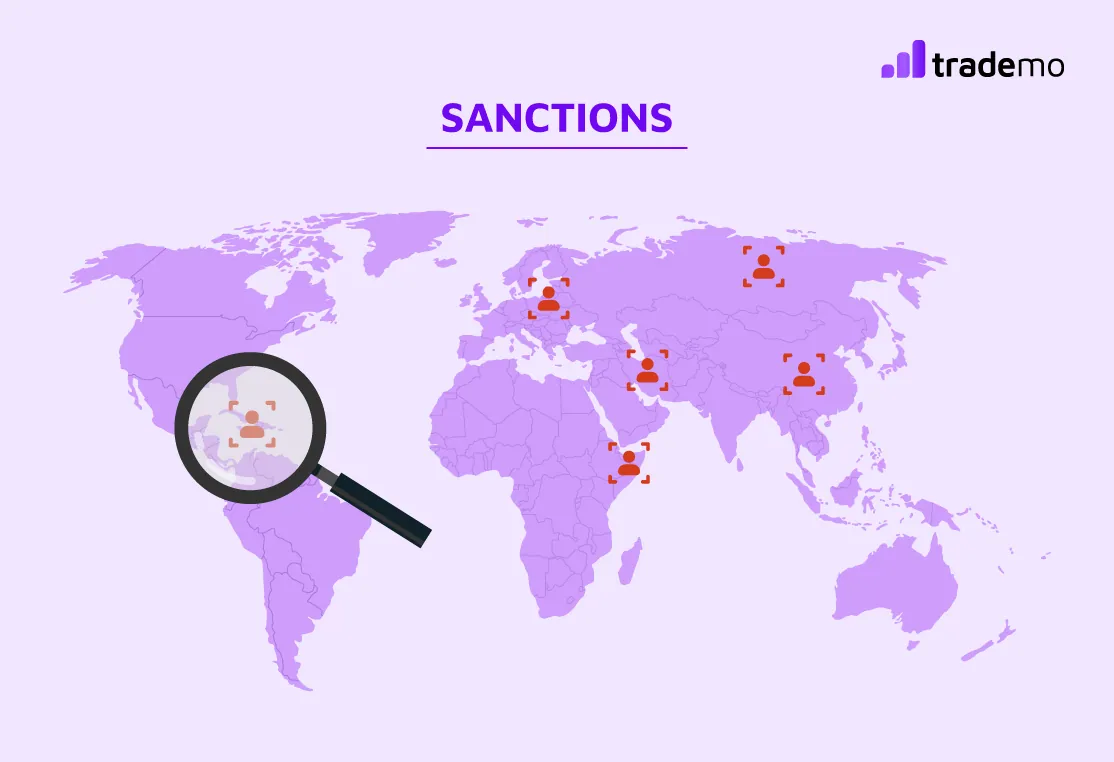


If you’re involved in international trade, it's important for you to understand what trade sanctions are and how they can impact your business. Sanctions, whether imposed by individual nations or through multinational agreements, bring significant influence on economies, businesses, and diplomatic interactions across the world. It is imperative for businesses, policymakers, and individuals engaged in global trade to understand the complexities of sanctions, their implications, and their alignment with complex regulatory frameworks. In this blog, we will explore the meaning, significance, and diverse forms of sanctions alongwith their impacts on various sectors, and strategies to navigate and comply with these ever-evolving regulatory measures.
Sanctions are essentially trade restrictions or prohibitions that make it a criminal offence for businesses or individuals in the issuing country to do business with persons that fall under their scope. These sanctions can target individuals, entities, companies, or even entire nations, to fulfill various purposes - from blocking the trade of certain commodities to complying with international obligations. In other words, sanctions are restrictions on trade with specific entities and individuals, either through export or import limitations. Let's dive deeper into understanding sanctions.
While sanctions may target specific trading activities or individuals, embargoes are applied in a broader way. An embargo can be defined as the most severe trade sanction. In general, embargoes often prohibit trade comprehensively with a target country, or imports from, or exports to, that country. These are used to restrict commerce or trade with a specified person, entity or country, usually as a result of political or economic problems.
In simple words, a trade embargo is a partial or complete ban on trade with a particular country or state which can last for many years. For example, The United States has had a trade embargo with Cuba since 1958. The reason behind this embargo is the political situation in Cuba which is not supported by the US government. This embargo will only be lifted by the US when the political situation in Cuba changes.
Countries and international authorities implement sanctions for various reasons. Some of the reasons or motivations behind imposing sanctions are:
These sanctions seek to ensure accountability for actions like torture, extrajudicial killings, or mass atrocities, associated with severe human rights violations. Hence these sanctions are aimed at addressing widespread human rights abuses and discouraging such violations by targeting individuals, businesses, and governments responsible.
These sanctions focus on countries breaching global non-proliferation regulations or engaging in actions that raise suspicions regarding their nuclear intentions. Sanctions concerning nuclear proliferation are crafted to limit the proliferation of nuclear weapons and dissuade nations or entities from pursuing or obtaining nuclear capabilities. They encompass trade limitations on sensitive entities, technologies or equipments, along with financial measures aimed at impeding transactions associated with nuclear activities.
These sanctions are aimed to counter terrorist financing and concentrate on disrupting the financial structures that sustain terrorist groups. They aim at individuals, entities, or nations implicated in offering financial aid, resources, or backing for terrorist endeavors.
Such sanctions involve imposing financial constraints, freezing assets, and halting financial transactions, these sanctions seek to dismantle the financial support of terrorist communities and organizations. Their purpose is to discourage their operations and hinder access to funds crucial for plotting and executing acts of terrorism.
This question often arises what is sanctions screening? In simple terms, it is the process of checking whether a person or an entity is listed on a sanctions list or watch list. Governments and recognized international authorities compile these lists in order to identify individuals or entities that are subjected to financial sanctions or other restrictions. Working with individuals or businesses that appear on a sanctions list or watchlist can result in significant fines, customs hurdles, and other penalties.
An efficient sanctions screening process involves implementing thorough measures to detect and identify individuals and entities under sanctions. It covers cross-referencing individuals, entities, and organizations with diverse sanctions lists to identify potential matches or resemblances.
The sanctions screening process involves the following steps: Data Collection: Businesses gather relevant customer details, such as name, address, date of birth, and other crucial information, acquired during onboarding or periodic reviews.
Watchlist Databases: Some businesses maintain their own sanctions database while some others subscribe to these databases, try Trademo’s Sanctions Screener Solution, containing names and other identifiable information of individuals or entities associated with illicit activities. To ensure accuracy, these databases are regularly updated with new entries linked to unlawful activities across hundreds of sanctions lists worldwide.
Name Matching: The collected customer, vendor, employee names are scrutinized against entries in the watchlist databases using advanced name matching screening algorithms.
Risk Assessment: Each potential match is assigned a risk score based on similarity and relevance to the institution's risk profile. Higher scores indicate stronger match against the sanctioned entities.
Investigation and Review: When a potential match is detected, compliance professionals conduct a thorough review to assess and analyze the match's validity and associated risk.
Decision-Making: Based on investigation findings, businesses or institutions make informed decisions. If suspicion of illicit activity arises, they may escalate the case for further scrutiny, report to respective regulatory bodies, or take appropriate actions following internal policies and legal obligations.
While onboarding new customers or handling transactions, businesses involved in global trade must ensure that they adhere to compliance with trade sanctions. This implies that they should implement a sanctions screening software as part of their AML/CFT (Anti Money Laundering/ Countering the Financing of Terrorism which refers to a set of policies, procedures, and internal controls implemented by financial institutions and specific businesses to detect, prevent, and mitigate the risks associated with money laundering and terrorist financing) program. KYC program can also be another driving factor for businesses to deploy or implement a sanctions screening solution.
Sanctions screening is done by comparing an organization's data such as customers and partners details and other business data with sanctions lists (such as OFAC & UN lists) to identify any match with sanctioned entities. Any similarities found are flagged and marked for further analysis.
In other words, sanctions screening software allows companies to efficiently screen their customers, employees, or suppliers against sanctions lists. Businesses with a large number of customers and suppliers require a scalable, automated, and reliable sanctions screening solution that doesn’t only offer the most up-to-date lists pooled into one database but also provides powerful name-matching capabilities results in real-time.
An AI-powered sanctions screening solution leverages AI and ML technologies to enhance the efficiency and accuracy of identifying and mitigating risks associated with sanctioned individuals, entities, and countries. Here’s how an AI-powered sanctions screening solution works:
Data Aggregation and Integration: The AI-powered solution collects and integrates vast amounts of data containing information about customers, transactions, counterparties of entities involved in illicit business activities. This data encompasses various attributes or details about the sanctioned entities such as name, address, identification details, and transaction details.
Advanced Algorithms and Machine Learning Models: The advanced solution, backed-up with advanced algorithms and machine learning models trained on large datasets, analyzes and understands complex patterns, relationships, and anomalies within the data.
Sanctions List Integration and Continuous Updating: The solution integrates multiple sanctions lists, watchlists, and databases released or published by global regulatory authorities, governments, and other reliable sources. It continuously updates and cross-references this information with the integrated data.
Automated Screening and Analysis: The AI-powered sanction screening software automatically screens the collected data against the sanctions lists. It employs complex matching algorithms, including exact matching, phonetic matching, fuzzy logic matching, token-based matching, and machine-learning based matching to account for variations or incorrect spellings in the details.
Real-time Monitoring and Alerts: The sanctions screening solution conducts real-time monitoring of transactions and customer data. It generates alerts and flags any potential matches or suspicious activities based on predefined risk thresholds.
Dynamic Risk Scoring and Prioritization: The solution assigns dynamic risk scores to potential matches or flagged activities based on the level of similarity, relevance, and associated risk factors. It prioritizes alerts based on the severity and likelihood of risk.
Human Review and Decision Support: Compliance or AML professionals thoroughly review flagged alerts for potential matches. The AI solution provides supporting information, risk analysis, and context to aid human decision-making and investigation processes.
Adaptive Learning and Improvement: Through continuous learning from new data and feedback, the AI models adapt and improve their accuracy in identifying potential matches and reducing false positives over time.
An AI-powered sanctions screening solution aims to streamline the screening process, reduce manual effort, enhance accuracy, and improve the overall efficiency of compliance efforts in identifying and preventing engagements with sanctioned entities.
Defining and aligning to a robust sanction screening process and importance of sanctions screening solution in place remains critical for businesses to meet regulatory obligations and evade penalties. Following are some of the key advantages of having a sanctions screening solution in place.
Risk Mitigation: Deploying an effective sanction screening solution helps businesses in reducing the risk of involvement in prohibited activities, thereby evading legal and financial repercussions. Through comprehensive due diligence and screening processes, businesses involved in global trade can detect and prevent potential sanctions breaches, safeguarding both their operations and reputation.
Adherence to Global Standards: Adherence to international regulations and standards stands as a cornerstone for businesses to maintain and uphold their integrity and credibility in international trade. Compliance with international sanctions frameworks, including those formulated by the United Nations, European Union, or other regional entities, underscores a commitment to responsible business practices.
Reputation Protection: Preserving their reputation stands as a paramount concern for businesses and financial institutions involved in today's interconnected business landscape in global trade. Non-compliance with sanctions regulations can inflict substantial reputational harm, erode stakeholder trust, and lead to unfavorable public perception.
In nutshell, understanding the complexities of sanctions and their impact in global trade is crucial for businesses involved. Defining robust sanctions screening procedures and deploying reliable and advanced sanctions screening solutions is vital to ensure compliance and avoid penalties. Adhering to compliance not only mitigates risks but also strengthens the integrity and credibility of entities in the global marketplace, ensuring a secure future in today's interconnected world.