
















Podcasts
Watch videos featuring supply chain experts






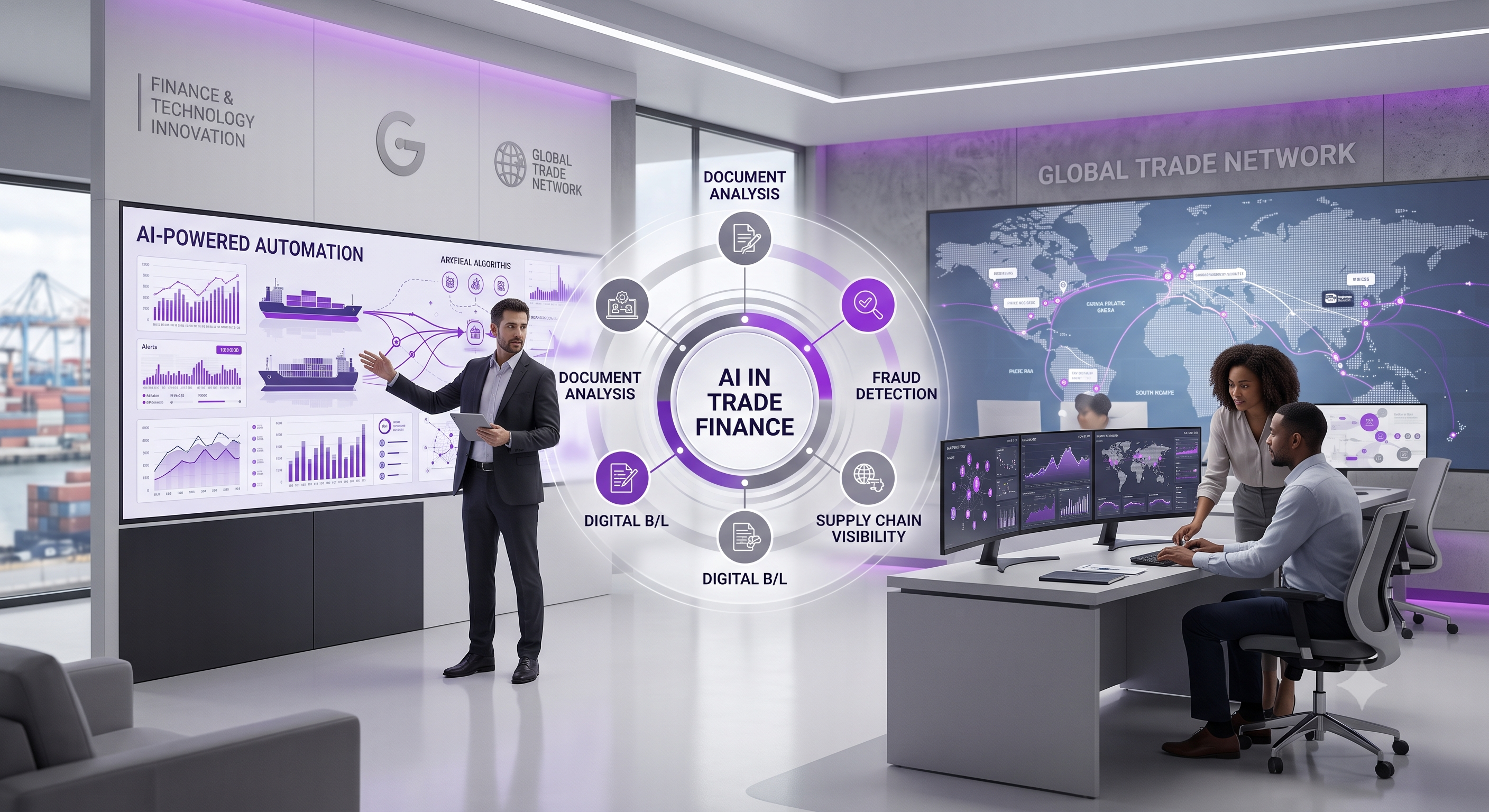


Banks have spent the last two years experimenting with AI to solve one of trade finance's oldest problems: too much paper, too many manual checks, and not enough time to process it all. The early approach was straightforward. Feed a large language model a trade packet, whether it's a letter of credit, a bill of lading, or a customs manifest, and let it handle extraction, compliance checks, and risk scoring in one pass. It sounded efficient. In practice, it created new risks that banks cannot afford to carry.
A typical trade packet can run over 100 pages, mixing letters of credit, invoices, and multi-country customs documentation. Asking one model to extract data, cross-reference shipping details, and screen for anti-money laundering risk all at once puts a lot of pressure on a single system.
Two failure patterns show up consistently.
The first is context loss. As documents pile up in a single session, models lose track of details from earlier pages. Research on standard AI memory windows shows that basic systems start losing accuracy after multiple steps. By the time the model reaches page 80 of a shipping manifest, it may have already lost the compliance clause stated on page 2.
The second is inconsistency in judgment. When a single model is asked to reason across too many types of tasks at once, its outputs become less reliable. Financial AI benchmarks that test performance across dozens of complex reasoning tasks show single models struggling with advanced financial logic. In practice, this shows up in two ways: the model clears a transaction it should have flagged, or it flags a transaction that was perfectly safe. Both outcomes have a cost. One exposes the bank to regulatory risk. The other clogs up the human review queue with unnecessary work.
For a Tier-1 bank processing thousands of transactions a day, either failure is expensive.
The alternative gaining traction across trade finance is a multi-agent architecture. Instead of one model trying to do everything, the work is split across specialized agents, each responsible for a specific part of the process. This mirrors how a trade finance department actually operates: one team handles document intake, another runs compliance checks, another maintains institutional knowledge about counterparties and trade routes, and a manager coordinates the findings before anything reaches a human reviewer.
This isn't a minor technical distinction. It changes what the system is good at. A document intake agent focused only on extraction and classification performs that task more reliably than a model trying to also reason about sanctions exposure at the same time. A compliance agent running hundreds of automated checks against regulatory frameworks catches more than a generalist model splitting its attention across ten different responsibilities.
Cutting down false alarms is useful. It reduces the backlog sitting in front of compliance teams and lets them focus on transactions that genuinely need scrutiny. But reducing false positives is not the priority that keeps risk committees up at night.
The real concern is false negatives: cases where an AI system stays silent on a risk it should have flagged. A reworded clause that quietly violates a maritime trade restriction. A transaction pattern that resembles money laundering but doesn't trigger an alert. When a system fails silently, the transaction moves forward without ever reaching human review. That is the scenario banks are actively building safeguards against.
This is why the design of these systems increasingly separates two layers: a reasoning layer, where AI agents analyze and debate findings, and an execution layer, where hard-coded rules make the final call. If the AI's output falls outside pre-set risk thresholds or fails to flag something it should have, the execution layer blocks it automatically. The AI stays flexible in how it reasons. The bank's policy enforcement does not bend.
There's also a commercial argument here. Multi-agent systems are more expensive to run than a single model call, largely because coordinating between agents requires more processing and adds a few seconds of latency per transaction. For a bank processing high volumes, running every task through the most powerful available model isn't sustainable.
The practical answer is a tiered approach: reserve the most capable models for genuinely complex reasoning, like resolving a legal contradiction between a letter of credit and a charter party agreement, and route routine, repetitive tasks like layout parsing or basic sanctions matching to smaller, cheaper models built for that specific job. Done well, this can cut computational costs significantly without giving up accuracy where it matters.
The result isn't just faster processing. It's a trade finance operation that can scale without scaling its risk exposure at the same rate, and one that gives compliance teams a clearer signal instead of more noise.
The shift from single-model AI to coordinated, multi-agent systems is still early, but the direction is clear. Banks that get this architecture right will process more transactions, catch more genuine risk, and free up their compliance teams to focus where it counts.
We go deeper into this shift, including the data behind current AI adoption in banking, the specific failure modes of monolithic AI systems, and the guardrails banks are putting in place, in our latest research report, Agentic AI Deployment in Trade Finance.
Download the full report here: [https://www.trademo.com/report/agentic-ai-deployment-in-trade-finance]