














HS Code Lookup for Chapter 02
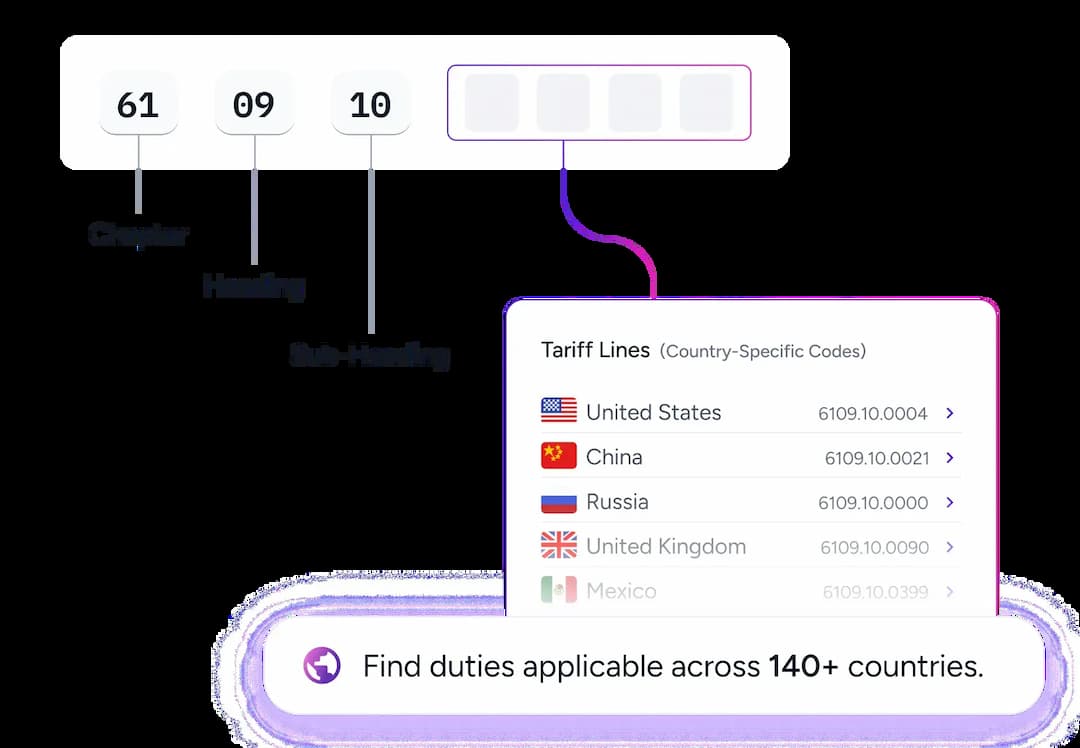
HS Code Lookup helps classify products under appropriate HS code and find duties applicable across 140+ countries. Find and discover HS classification, tariffs, taxes, controls, rulings, ECCNs, and default and preferential duties for HS code 02.

WCO Notes for Chapter 02
Chapter 2
Meat and edible meat offal
Note.
1.- This Chapter does not cover :
(a) Products of the kinds described in headings 02.01 to 02.08 or 02.10, unfit or unsuitable for human consumption;
(b) Edible, non-living insects (heading 04.10);
(c) Guts, bladders or stomachs of animals (heading 05.04) or animal blood (heading 05.11 or 30.02); or
(d) Animal fat, other than products of heading 02.09 (Chapter 15).
GENERAL
This Chapter applies to meat in carcasses (i.e., the body of an animal with or without the head), half‑carcasses (resulting from the lengthwise splitting of a carcass), quarters, pieces, etc., to meat offal, and to flours and meals of meat or meat offal, of all animals (except fish and crustaceans, molluscs and other aquatic invertebrates ‑ Chapter 3), suitable for human consumption.
Meat and meat offal unsuitable or unfit for human consumption are excluded (heading 05.11). Flours, meals and pellets unfit for human consumption, obtained from meat or meat offal, are also excluded (heading 23.01).
Offal generally can be grouped in four categories :
(1) That which is mainly used for human consumption (e.g., heads and cuts thereof (including ears), feet, tails, hearts, tongues, thick skirts, thin skirts, cauls, throats, thymus glands).
(2) That which is used solely in the preparation of pharmaceutical products (e.g., gall bags, adrenal glands, placenta).
(3) That which can be used for human consumption or for the preparation of pharmaceutical products (e.g., livers, kidneys, lungs, brains, pancreas, spleens, spinal cords, ovaries, uteri, testes, udders, thyroid glands, pituitary glands).
(4) That, such as skins, which can be used for human consumption or for other purposes (e.g., manufacture of leather).
The offal referred to in paragraph (1), fresh, chilled, frozen, salted, in brine, dried or smoked, remains classified in this Chapter unless it is unfit for human consumption, in which case it is to be classified in heading 05.11.
The offal referred to in paragraph (2) falls in heading 05.10 when fresh, chilled, frozen or otherwise provisionally preserved and in heading 30.01 when dried.
The offal referred to in paragraph (3) is classified as follows :
(a) In heading 05.10 when provisionally preserved for the preparation of pharmaceutical products (e.g., in glycerol, acetone, alcohol, formaldehyde, sodium borate).
(b) In heading 30.01 when dried.
(c) In Chapter 2 when suitable for human consumption, but in heading 05.11 if unfit for human consumption.
The offal referred to in paragraph (4) is classified in Chapter 2 when suitable for human consumption or generally in heading 05.11 or Chapter 41 if unfit for human consumption.
Guts, bladders and stomachs of animals (other than fish), whether or not edible, are classified in heading 05.04.
Animal fat presented separately is excluded (Chapter 15) (except in the case of pig fat, free of lean meat, and poultry fat, not rendered or otherwise extracted, which fall in heading 02.09 even if fit only for industrial use), but fat presented in the carcass or adhering to meat is treated as forming part of the meat.
Distinction between meat and meat offal of this Chapter and those of Chapter 16.
This Chapter covers meat and meat offal in the following states only, whether or not they have been previously scalded or similarly treated but not cooked :
(1) Fresh (including meat and meat offal, packed with salt as a temporary preservative during transport).
(2) Chilled, that is, reduced in temperature generally to around 0 °C, without being frozen.
(3) Frozen, that is, cooled to below the product’s freezing point until it is frozen throughout.
(4) Salted, in brine, dried or smoked.
Meat and meat offal, slightly sprinkled with sugar or with an aqueous solution of sugar are also classified in this Chapter.
Meat and meat offal in the states referred to in Items (1) to (4) above remain classified in this Chapter whether or not they have undergone tenderising treatment with proteolytic enzymes (e.g., papain) or have been cut, chopped or minced (ground). In addition, mixtures or combinations of products of different headings of the Chapter (e.g., poultry meat of heading 02.07 covered with pig fat of heading 02.09) remain classified in this Chapter.
Meat and meat offal not falling in any heading of this Chapter are classified in Chapter 16, e.g. :
(a) Sausages and similar products, whether or not cooked (heading 16.01).
(b) Meat and meat offal cooked in any way (boiled, steamed, grilled, fried or roasted), or otherwise prepared or preserved by any process not provided for in this Chapter, including those merely covered with batter or bread crumbs, truffled or seasoned (e.g., with pepper and salt), as well as liver pastes and patés (heading 16.02).
This Chapter also includes meat and meat offal suitable for human consumption, whether or not cooked, in the form of flour or meal.
It should be noted that meat and meat offal of this Chapter remain classified here even if put up in airtight packings (e.g., dried meat in cans). In most cases, however, products put up in these packings have been prepared or preserved otherwise than as provided for in the headings of this Chapter and, accordingly, are classified in Chapter 16.
Similarly, meat and meat offal of this Chapter remain classified here (e.g., fresh or chilled meat of bovine animals) when subjected to packaging by means of a Modified Atmospheric Packaging (MAP) process. In a MAP process the atmosphere surrounding the product is altered or controlled (e.g., by removing or reducing the oxygen content and replacing it with or increasing the nitrogen or carbon dioxide content).
°
° °
Subheading Explanatory Note.
With bone in
The expression “with bone in” means meat with all bones intact, as well as meat where some or part of the bones have been removed (e.g., shankless and semi-boneless hams). This expression does not cover products where the bones have been removed and thereafter reinserted so that they are no longer connected to the meat tissues.

What is HS code 02?

How many headings are there in HS code 02?
International Trade Compliance Simplified