














HS Code Lookup for Heading 0511
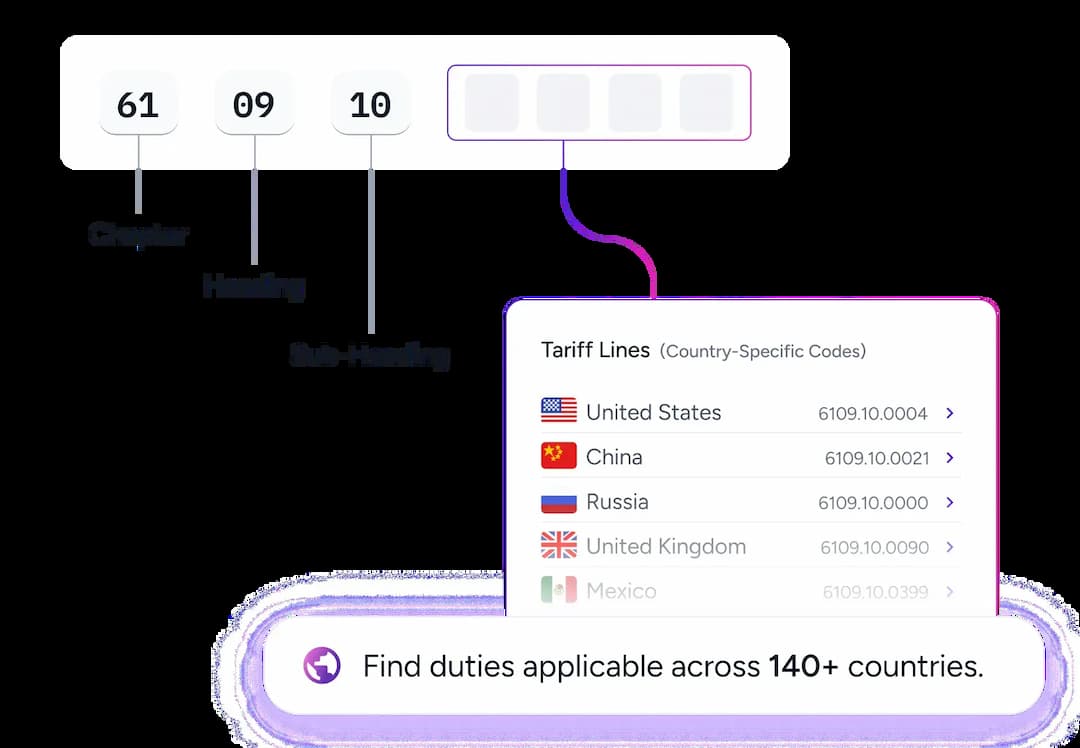
HS Code Lookup helps classify products under appropriate HS code and find duties applicable across 140+ countries. Find and discover HS classification, tariffs, taxes, controls, rulings, ECCNs, and default and preferential duties for HS code 0511.

WCO Notes for Heading 0511
05.11 ‑ Animal products not elsewhere specified or included; dead animals of Chapter 1 or 3, unfit for human consumption.
0511.10 - Bovine semen
- Other :
0511.91 - - Products of fish or crustaceans, molluscs or other aquatic invertebrates; dead animals of Chapter 3
0511.99 - - Other
This heading includes :
(1) Animal semen.
(2) Animal embryos, which are shipped frozen with the intended purpose of transplanting them into a recipient mother.
(3) Animal blood, liquid or dried, edible or not.
The heading excludes animal blood prepared for therapeutic, prophylactic or diagnostic uses (heading 30.02).
(4) Cochineal and similar insects, unfit for human consumption. The cochineal is an insect which lives on certain cactus plants. There are three kinds of cochineal on the market ‑ black, grey or silver, and reddish. The cochineal furnishes a red dye (cochineal extract) (heading 32.03) which is used in the preparation of carmine lake (heading 32.05).
Amongst the insects similar to the cochineal the most important is the animal kermes, which lives on a variety of dwarf oak tree. Kermes is used for the preparation of vivid and lasting red dyes which are classified in heading 32.03.
Animal kermes should not be confused with “kermes mineral” (heading 38.24).
Cochineal and kermes are presented dried and may be whole or powdered.
(5) Inedible fish eggs, roes and milt.
These comprise :
(i) Fertile eggs for hatching, recognisable by the presence of black spots which are the embryonic eyes.
(ii) Salted roes (e.g., of cod or mackerel) used as fishing bait. These can be distinguished from caviar substitutes (heading 16.04) by their strong disagreeable odour and because they are usually packed in bulk.
The heading excludes edible roes and milt (Chapter 3).
(6) Waste of fish or crustaceans, molluscs or other aquatic invertebrates.
This category covers, inter alia :
(i) Scales of whitebait or of similar fish, fresh or preserved (but not in solution); these are used for the preparation of pearl essence for the coating of imitation pearls.
(ii) Maws (swim bladders), raw, dried or salted, used in the manufacture of isinglass and fish glues.
(iii) Fish guts and waste of skins used for glue manufacture, etc.
(iv) Fish waste.
The heading also excludes :
(a) Edible fish livers, fish fins, heads, tails, maws (swim bladders) and other edible fish offal (Chapter 3).
(b) Shells of molluscs, crustaceans or echinoderms of heading 05.08.
(c) Inedible fish livers used in the preparation of pharmaceutical products (heading 05.10).
(7) Silkworm eggs. These have the appearance of small seeds, pale yellow turning gradually to ash grey or earthy yellow. They are usually presented in boxes (or cellular combs) or in cloth sachets.
(8) Ant eggs.
(9) Sinews and tendons used, like the waste cited in Items (10) and (11) below, mainly as raw materials for the manufacture of glue.
(10) Parings and similar waste, of raw hides or skins.
(11) Waste of raw furskins, clearly not capable of use by furriers.
(12) Dead animals of Chapter 1 or 3 and their meat or meat offals unfit for human consumption other than products of heading 02.09 or of one of the preceding headings of this Chapter.
(13) Horsehair and horsehair waste, whether or not put up as a layer with or without supporting material. This category covers hair of the manes or tails of equine or bovine animals. It includes not only unworked horsehair but also horsehair which has been washed, scoured, bleached, dyed, curled or otherwise prepared. The goods may be in bulk, in bunches or may be put up in skeins, etc.
This heading also covers a layer of horsehair on a support of textile fabric, paper, etc., or put up between sheets of textile fabric, paper, etc., by stapling or simple sewing.
The heading excludes horsehair which has undergone a spinning process and horsehair knotted end to end (Chapter 51).
(14) Natural sponges of animal origin. They comprise both raw sponges (including those merely washed) and sponges which have been prepared (e.g., by removal of calcareous matter or by bleaching). This category also covers waste sponge.
Loofah, also known as vegetable sponge, is classified in heading 14.04.
The heading further excludes :
(a) Shellac, seed lac, stick lac and other lacs (heading 13.01).
(b) Animal fats of Chapter 15.
(c) Collections and collectors’ pieces of zoological interest, consisting of stuffed or otherwise preserved animals, butterflies and other insects, eggs, etc. (heading 97.05).
______________________

What is HS code 0511?

How many sub-headings are there in HS code 0511?
International Trade Compliance Simplified