














HS Code Lookup for Heading 0805
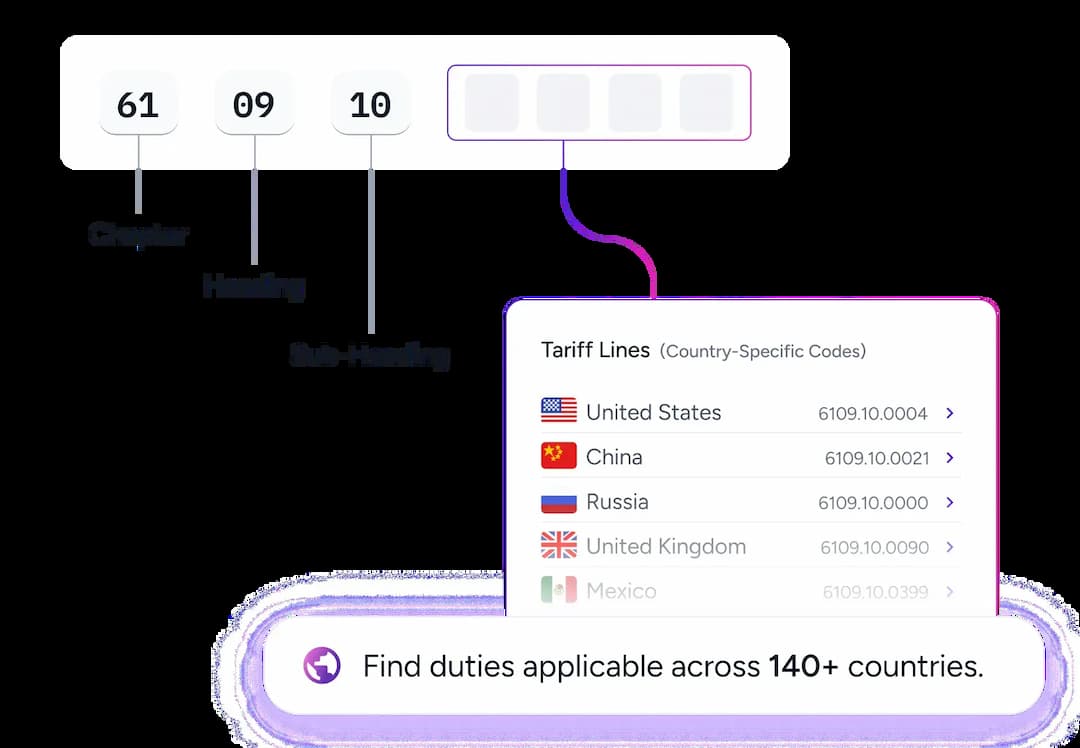
HS Code Lookup helps classify products under appropriate HS code and find duties applicable across 140+ countries. Find and discover HS classification, tariffs, taxes, controls, rulings, ECCNs, and default and preferential duties for HS code 0805.

WCO Notes for Heading 0805
08.05 - Citrus fruit, fresh or dried (+).
0805.10 ‑ Oranges
- Mandarins (including tangerines and satsumas); clementines, wilkings and similar citrus hybrids :
0805.21 ‑ - Mandarins (including tangerines and satsumas)
0805.22 ‑ - Clementines
0805.29 ‑ - Other
0805.40 ‑ Grapefruit and pomelos
0805.50 ‑ Lemons (Citrus limon, Citrus limonum) and limes (Citrus aurantifolia, Citrus latifolia)
0805.90 ‑ Other
The expression “citrus fruit” applies inter alia to :
(1) Oranges, sweet or bitter (Seville oranges).
(2) Mandarins (including tangerines and satsumas). Mandarins can be grouped in the following main classes or groups :
- Satsuma (Citrus unshiu Marcovitch), which consists of many varieties.
- King (Citrus nobilis Loureiro), which contains a few varieties.
- Mediterranean (Citrus deliciosa Tenore), also known as Willowleaf.
- Common (Citrus reticulata Blanco), which is represented by numerous varieties.
- Small-fruited mandarins, which consist of many species.
(3) Clementines, wilkings and similar citrus hybrids.
(4) Grapefruit and pomelos.
(5) Lemons (Citrus limon, Citrus limonum) and limes (Citrus aurantifolia, Citrus latifolia).
(6) Citrons, kumquats and bergamots, etc.
The heading also includes small green oranges and small green lemons of a kind used for preserving.
The heading excludes :
(a) Citrus fruit peel (heading 08.14).
(b) “Orange peas” or “orangettes” which are immature inedible oranges having fallen soon after the tree has blossomed, gathered dry with a view, in particular, to extraction of their essential oil (petit‑grain) (heading 12.11).
°
° °
Subheading Explanatory Notes.
Subheading 0805.21
This subheading covers mandarins (including tangerines and satsumas).
Mandarins (Citrus reticulata Blanco) under the “Common” group may be distinguished from ordinary oranges by their smaller, flattened shape, by easier peeling, by a more distinct division of their segments and by their sweeter and more perfumed taste. Mandarins have an open core (much more so than any of the oranges) and seeds with greenish cotyledons (minor exceptions).
Tangerines are round in shape and slightly smaller than an orange. Their peel is bright orange or red in colour. Tangerines peel easily, and their taste is less acid than that of other citrus fruit.
Satsumas (Citrus unshiu Marcovitch) are an early variety of mandarin. The fruit is large, yellow-orange in colour, juicy, non-acid and without pips.
Mandarin hybrids (including tangerine and satsuma hybrids) are classified in subheading 0805.29.
Subheading 0805.22
This subheading covers clementines.
Clementines (Citrus reticulate ‘Clementina’) may be distinguished from mandarins by the colour of their peel, which is orange to reddish-orange. The peel is smooth and glossy, but slightly pebbled. Furthermore, they are never flattened in shape as are mandarins, but are well rounded and smaller in size. Like mandarins, clementines can be peeled and divided into sections with ease. The taste is sweet, sub acid and aromatic, and is rather more orange-like.
Subheading 0805.29
This subheading covers Wilkings and similar citrus hybrids.
Wilkings are hybrids with parents belonging to two different mandarin groups (Willowleaf and King). They are small to medium-sized and slightly flattened in shape. Their peel is orange in colour at maturity, and is glossy and slightly pebbled. It is medium-thin, somewhat brittle, somewhat adherent but readily peelable. Their flesh is deep orange in colour, and they have more pips. Wilkings are very juicy and have a rich, aromatic and distinctive flavour.
The other main hybrids are tangelos (hybrid of the mandarin with the grapefruit or the pomelo), tangors (hybrid of the tangerine with the sweet orange), calamondins, lyos and rangpurs.

What is HS code 0805?

How many sub-headings are there in HS code 0805?
International Trade Compliance Simplified