














HS Code Lookup for Chapter 09
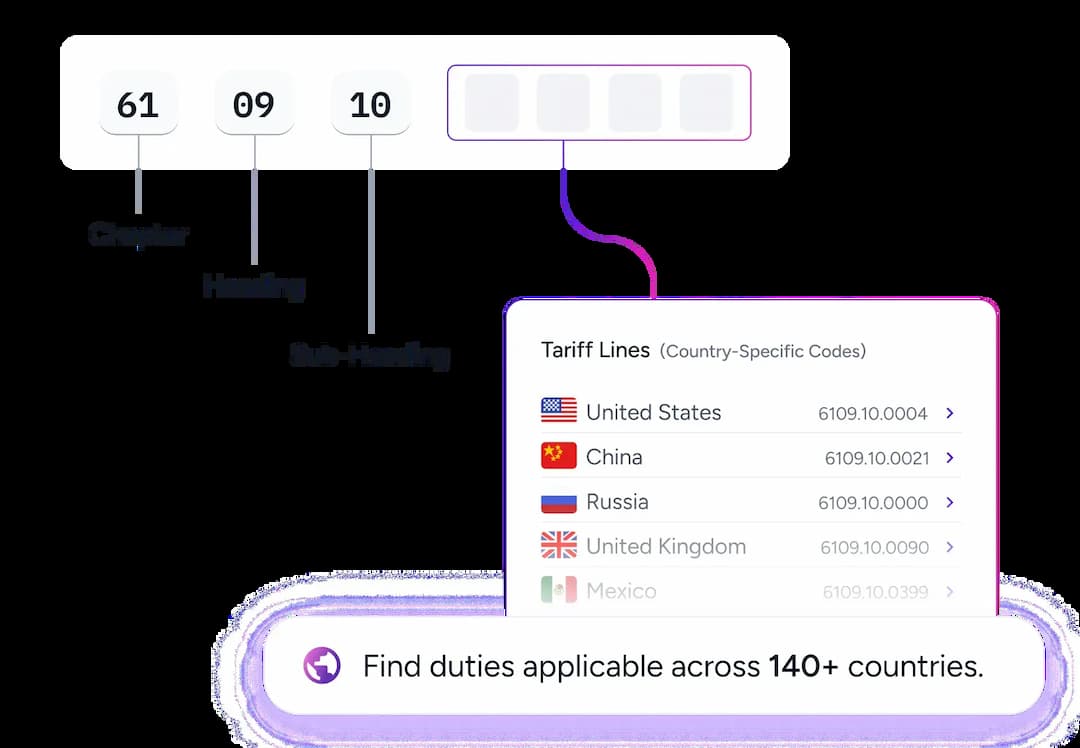
HS Code Lookup helps classify products under appropriate HS code and find duties applicable across 140+ countries. Find and discover HS classification, tariffs, taxes, controls, rulings, ECCNs, and default and preferential duties for HS code 09.

WCO Notes for Chapter 09
Chapter 9
Coffee, tea, maté and spices
Notes.
1.- Mixtures of the products of headings 09.04 to 09.10 are to be classified as follows :
(a) Mixtures of two or more of the products of the same heading are to be classified in that heading;
(b) Mixtures of two or more of the products of different headings are to be classified in heading 09.10.
The addition of other substances to the products of headings 09.04 to 09.10 (or to the mixtures referred to in paragraph (a) or (b) above) shall not affect their classification provided the resulting mixtures retain the essential character of the goods of those headings. Otherwise such mixtures are not classified in this Chapter; those constituting mixed condiments or mixed seasonings are classified in heading 21.03.
2.- This Chapter does not cover Cubeb pepper (Piper cubeba) or other products of heading 12.11.
GENERAL
This Chapter covers :
(1) Coffee, tea and maté.
(2) Spices, i.e., a group of vegetable products (including seeds, etc.), rich in essential oils and aromatic principles, and which, because of their characteristic taste, are mainly used as condiments.
These products may be whole or in crushed or powdered form.
As regards the classification of mixtures of products of headings 09.04 to 09.10, see Note 1 to this Chapter. Under the provisions of this Note, the addition of other substances to the products of headings 09.04 to 09.10 (or to the mixtures referred to in paragraph (a) or (b) of the Note) shall not affect their classification provided the resulting mixtures retain the essential character of the goods falling in those headings.
This applies, in particular, to spices and mixed spices containing added :
(a) Diluents (“spreader” bases) added to facilitate measuring out of the spices and their distribution in the food preparation (cereal flour, ground rusk, dextrose, etc.).
(b) Food colourings (e.g., xanthophyll).
(c) Products added to intensify or enhance the flavour of the spices (synergetics), such as sodium glutamate.
(d) Substances such as salt or chemical antioxidants added, usually in small quantity, to preserve the products and prolong their flavouring powers.
Spices (including mixed spices) containing added substances of other Chapters, but themselves having flavouring or seasoning properties, remain in this Chapter provided the added quantity does not affect the essential character of the mixture as a spice.
This Chapter also includes mixtures consisting of plants, parts of plants, seeds or fruit (whole, cut, crushed, ground or powdered) of species falling in different Chapters (e.g., Chapters 7, 9, 11, 12), of a kind used either directly for flavouring beverages or for preparing extracts for the manufacture of beverages,
(i) if the essential character is given by one or more species of any single one of the headings 09.04 to 09.10 (headings 09.04 to 09.10 as the case may be);
(ii) if the essential character is given by a mixture of species of two or more of the headings 09.04 to 09.10 (heading 09.10).
This Chapter however excludes such mixtures if the essential character is not given by the species mentioned in (i) or by the mixtures referred to in (ii) above (heading 21.06).
This Chapter further excludes :
(a) Vegetables (e.g., parsley, chervil, tarragon, cress, sweet marjoram, coriander and dill) of Chapter 7.
(b) Mustard seed (heading 12.07); mustard flour, whether unprepared or prepared (heading 21.03).
(c) Hop cones (heading 12.10).
(d) Certain fruits, seeds and parts of plants which, although they can be used as spices, are more often employed in perfumery or in medicine (heading 12.11) (e.g., cassia pods, rosemary, wild marjoram, basil, borage, hyssop, all species of mint, rue and sage).
(e) Mixed condiments and mixed seasonings (heading 21.03).

What is HS code 09?

How many headings are there in HS code 09?
International Trade Compliance Simplified