











Unlocking Cross-Border Growth: Modern Go-to-Market Strategies in Trade Finance
Register Now

HS Code Lookup for Heading 1103

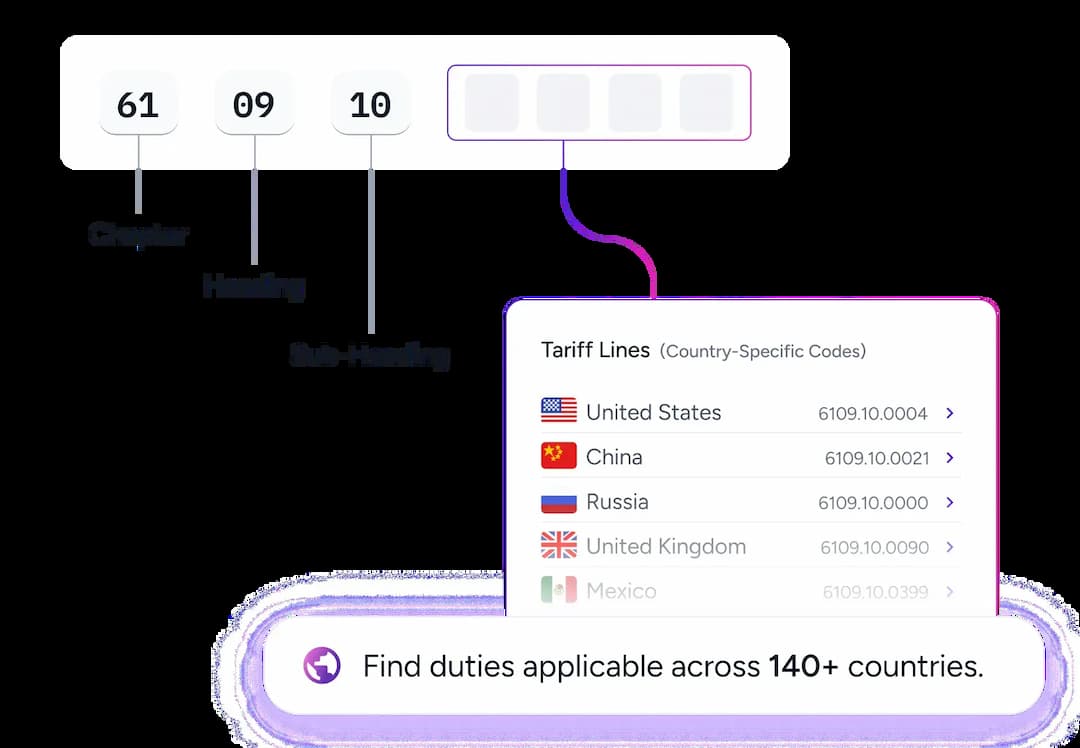
HS Code Lookup helps classify products under appropriate HS code and find duties applicable across 140+ countries. Find and discover HS classification, tariffs, taxes, controls, rulings, ECCNs, and default and preferential duties for HS code 1103.

search-icon
HS Code Image
Heading 1103
Products of the milling industry; malt; starches; inulin; wheat gluten - Cereal groats, meal and pellets.
List of Sub Headings & Description

WCO Notes for Heading 1103

11.03 ‑ Cereal groats, meal and pellets.

‑ Groats and meal :

1103.11 ‑ ‑ Of wheat

1103.13 ‑ ‑ Of maize (corn)

1103.19 ‑ ‑ Of other cereals

1103.20 ‑ Pellets

The cereal groats and meal of this heading are products, obtained by the fragmentation of cereal grains (including whole maize (corn) cobs ground with or without their husks), which, where appropriate, fulfil the requirements as to starch and ash content laid down in Chapter Note 2 (A) and which in all cases comply with the relevant criterion as to passage through a sieve laid down in Chapter Note 3.

As regards the distinction to be made between the flours of heading 11.01 or 11.02, the groats and meal of this heading and the products of heading 11.04, see the General Explanatory Note to the Chapter (Item (1), second paragraph).

Cereal groats are small fragments or floury kernels obtained by the rough grinding of grains.

Meal is a more granular product than flour and is obtained either from the first sifting after the initial milling operation, or by re‑grinding and re‑sifting the groats resulting from that initial milling.

Durum wheat meal, or semolina, is the principal raw material in the manufacture of macaroni, spaghetti or the like. Semolina is also used directly as a foodstuff (e.g., in making semolina puddings).

This heading also includes meal (e.g., of maize (corn)) pregelatinised by heat treatment, used, for instance, as an additive in brewing.

Pellets are products from the milling of cereals of this Chapter which have been agglomerated either directly by compression or by the addition of a binder in a proportion not exceeding 3 % by weight (see Note 1 to Section II). The heading does not cover pelletised residues derived from the milling of cereals (Chapter 23).

tips_icon
FAQs
What is HS code 1103?
Arrow button for expand and collapse
HS code 1103 includes Products of the milling industry; malt; starches; inulin; wheat gluten - Cereal groats, meal and pellets..
How many sub-headings are there in HS code 1103?
Arrow button for expand and collapse
There are 4 sub-heading(s) in HS code 1103.
What is an HS Code and Why Does it Hold For Cross-Border Trade?
HS code is a standardized six-digit numerical classification system developed by the World Customs Organization (WCO) and acts as a universal language for simplifying the process of identifying and classifying traded products. They ensure consistent customs clearance, enable accurate duty calculation, and help identify relevant trade regulations. This simplifies the process for businesses, saving time, reducing risk, and promoting informed decision-making.
What are Controls and Why should Businesses Focus on Them?
In global trade, controls refer to a set of regulations and policies implemented by governments to manage the import and export of goods and services. These controls can take various forms, including tariffs, quotas, embargoes, export controls, and licensing requirements. Companies should prioritize understanding and adhering to them for compliance, reduced risk of legal issues, mitigating reputational damage, staying competitive, and building trust with governments.
What are Tariffs in Global Trade and Why should Businesses Focus on Them?
In global trade, tariffs are a type of tax levied by a government on imported goods. They act as a financial barrier to entry, increasing the overall cost of the imported product for domestic consumers and businesses. By understanding how tariffs work and their potential impact, companies can make informed decisions about pricing, sourcing, and market expansion, ultimately ensuring their competitiveness in the global marketplace.
What are FTAs in Global Trade and Why should Businesses Focus on Them?
In global trade, Free Trade Agreements (FTAs) are legally binding agreements between two or more countries aimed at reducing or eliminating barriers to trade between them. By understanding the terms of relevant FTAs and strategically incorporating them into their business plans, companies can enjoy reduced costs, expanded market access, and a more competitive edge in international trade.

International Trade Compliance Simplified

140+
Countries Covered
440+
Government Authorities
300+
FTAs Monitored
500K+
Customs Rulings
880K+
Import & Export Compliance Data Entities
Location
United States
3000 El Camino Real, Building 4, Suite 200, Palo Alto, California 94306
India
2nd Floor, Plot No. 136, Sector 44, Gurugram, Haryana 122003