














HS Code Lookup for Heading 1701
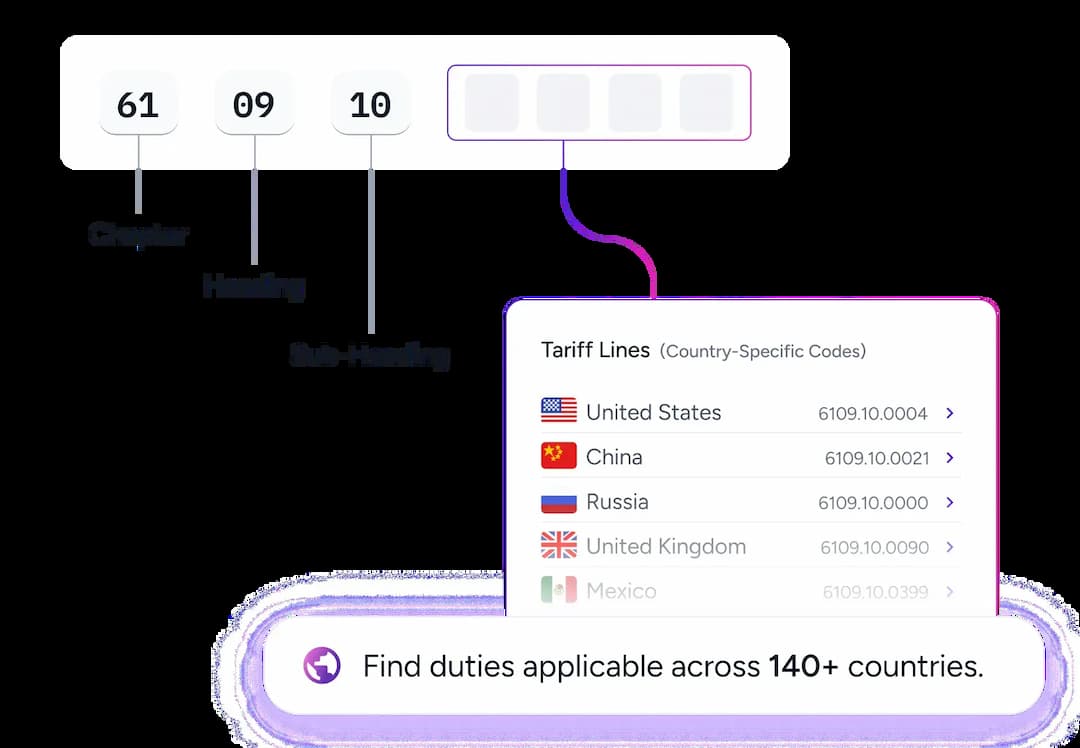
HS Code Lookup helps classify products under appropriate HS code and find duties applicable across 140+ countries. Find and discover HS classification, tariffs, taxes, controls, rulings, ECCNs, and default and preferential duties for HS code 1701.

WCO Notes for Heading 1701
17.01 ‑ Cane or beet sugar and chemically pure sucrose, in solid form (+).
‑ Raw sugar not containing added flavouring or colouring matter :
1701.12 ‑ ‑ Beet sugar
1701.13 ‑ ‑ Cane sugar specified in Subheading Note 2 to this Chapter
1701.14 ‑ ‑ Other cane sugar
‑ Other :
1701.91 ‑ ‑ Containing added flavouring or colouring matter
1701.99 ‑ ‑ Other
Cane sugaris derived from the juices of the sugar cane stalk. Beet sugar is derived from the juices obtained by extraction from the root of the sugar beet.
Raw or crude cane or beet sugars occur in the form of brown crystals or other solid forms, the colour being due to the presence of impurities. Their sucrose content by weight, in the dry state, corresponds to a polarimeter reading of less than 99.5° (see Subheading Note 1). They are generally destined for processing into refined sugar products. Raw sugar may, however, be of such a high degree of purity that it is suitable for human consumption without refining.
Refinedcane or beet sugars are produced by the further processing of raw sugar. They are generally produced as a white crystalline substance which is marketed in various degrees of fineness or in the form of small cubes, loaves, slabs, or sticks or regularly moulded, sawn or cut pieces.
In addition to the raw or refined sugars mentioned above, this heading covers brown sugar consisting of white sugar mixed with small quantities of, e.g., caramel or molasses, and sugar candy consisting of large crystals produced by slow crystallisation of concentrated solutions of sugar.
It should be noted that cane and beet sugar fall in this heading only when in the solid form (including powders); such sugar may contain added flavouring or colouring matter.
Sugar syrups of cane or beet sugar, consisting of aqueous solutions of sugars, are classified in heading 17.02 when not containing added flavouring or colouring matter and otherwise in heading 21.06.
The heading further excludes preparations in solid form (including granules or powders) which have lost the character of sugar, of a kind used for making beverages (heading 21.06).
The heading also includes chemically pure sucrose in solid form, whatever its origin. Sucrose (other than chemically pure sucrose) obtained from sources other than sugar cane or sugar beet is excluded (heading 17.02).
°
° °
Subheading Explanatory Note.
Subheadings 1701.12, 1701.13 and 1701.14
Raw cane sugar in trade always contains more than 0.1 % of invert sugar while the invert sugar content of raw beet sugar is normally less than 0.1 %. These two types of raw sugars may also be distinguished from each other by their difference in odour which develops on overnight storage in stoppered containers of samples in aqueous solution.

What is HS code 1701?

How many sub-headings are there in HS code 1701?
International Trade Compliance Simplified