















HS Code Lookup for Chapter 20
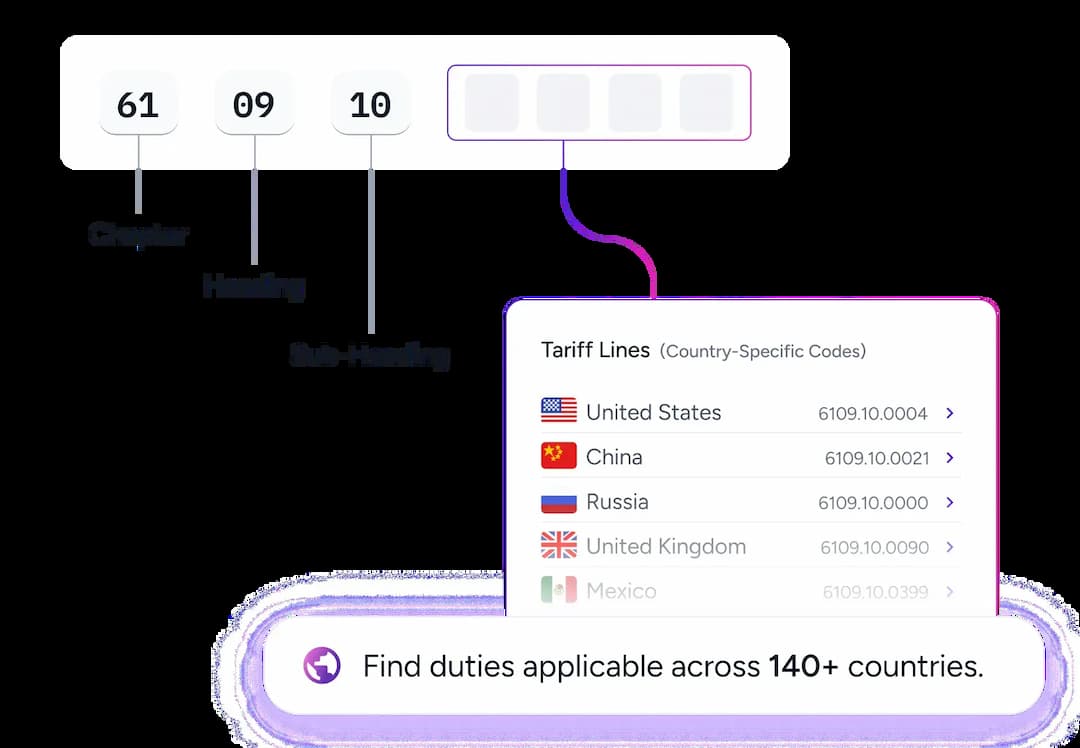
HS Code Lookup helps classify products under appropriate HS code and find duties applicable across 140+ countries. Find and discover HS classification, tariffs, taxes, controls, rulings, ECCNs, and default and preferential duties for HS code 20.

WCO Notes for Chapter 20
Chapter 20
Preparations of vegetables, fruit, nuts or other parts of plants
Notes.
1.- This Chapter does not cover :
(a) Vegetables, fruit or nuts, prepared or preserved by the processes specified in Chapter 7, 8 or 11;
(b) Vegetable fats and oils (Chapter 15);
(c) Food preparations containing more than 20 % by weight of sausage, meat, meat offal, blood, insects, fish or crustaceans, molluscs or other aquatic invertebrates, or any combination thereof (Chapter 16);
(d) Bakers’ wares and other products of heading 19.05; or
(e) Homogenised composite food preparations of heading 21.04.
2.- Headings 20.07 and 20.08 do not apply to fruit jellies, fruit pastes, sugar‑coated almonds or the like in the form of sugar confectionery (heading 17.04) or chocolate confectionery (heading 18.06).
3.- Headings 20.01, 20.04 and 20.05 cover, as the case may be, only those products of Chapter 7 or of heading 11.05 or 11.06 (other than flour, meal and powder of the products of Chapter 8) which have been prepared or preserved by processes other than those referred to in Note 1 (a).
4.- Tomato juice the dry weight content of which is 7 % or more is to be classified in heading 20.02.
5.- For the purposes of heading 20.07, the expression “obtained by cooking” means obtained by heat treatment at atmospheric pressure or under reduced pressure to increase the viscosity of a product through reduction of water content or other means.
6.- For the purposes of heading 20.09, the expression “juices, unfermented and not containing added spirit” means juices of an alcoholic strength by volume (see Note 2 to Chapter 22) not exceeding 0.5 % vol.
Subheading Notes.
1.- For the purposes of subheading 2005.10, the expression “homogenised vegetables” means preparations of vegetables, finely homogenised, put up for retail sale as food suitable for infants or young children or for dietetic purposes, in containers of a net weight content not exceeding 250 g. For the application of this definition no account is to be taken of small quantities of any ingredients which may have been added to the preparation for seasoning, preservation or other purposes. These preparations may contain a small quantity of visible pieces of vegetables. Subheading 2005.10 takes precedence over all other subheadings of heading 20.05.
2.- For the purposes of subheading 2007.10, the expression “homogenised preparations” means preparations of fruit, finely homogenised, put up for retail sale as food suitable for infants or young children or for dietetic purposes, in containers of a net weight content not exceeding 250 g. For the application of this definition no account is to be taken of small quantities of any ingredients which may have been added to the preparation for seasoning, preservation or other purposes. These preparations may contain a small quantity of visible pieces of fruit. Subheading 2007.10 takes precedence over all other subheadings of heading 20.07.
3.- For the purposes of subheadings 2009.12, 2009.21, 2009.31, 2009.41, 2009.61 and 2009.71, the expression “Brix value” means the direct reading of degrees Brix obtained from a Brix hydrometer or of refractive index expressed in terms of percentage sucrose content obtained from a refractometer, at a temperature of 20 °C or corrected for 20 °C if the reading is made at a different temperature.
GENERAL
This Chapter includes :
(1) Vegetables, fruit, nuts and other edible parts of plants prepared or preserved by vinegar or acetic acid.
(2) Vegetables, fruit, nuts, fruit‑peel and other parts of plants preserved by sugar.
(3) Jams, fruit jellies, marmalades, fruit or nut purées, fruit or nut pastes, obtained by cooking.
(4) Homogenised prepared or preserved vegetables and fruit.
(5) Fruit or vegetable juices, neither fermented nor containing added alcohol, or of an alcoholic strength by volume not exceeding 0.5 % vol.
(6) Vegetables, fruit, nuts and other edible parts of plants prepared or preserved by other processes not provided for in Chapter 7, 8 or 11 or elsewhere in the Nomenclature.
(7) Products of heading 07.14, 11.05 or 11.06 (other than flour, meal and powder of the products of Chapter 8), which have been prepared or preserved by processes other than those specified in Chapter 7 or 11.
(8) Fruit preserved by osmotic dehydration.
These products may be whole, in pieces or crushed.
The Chapter does not cover :
(a) Food preparations containing more than 20 % by weight of sausage, meat, meat offal, blood, insects, fish or crustaceans, molluscs or other aquatic invertebrates, or any combination thereof (Chapter 16).
(b) Products such as fruit tarts, prepared with pastry (heading 19.05).
(c) Soups and broths and preparations therefor and homogenised composite food preparations of heading 21.04.
(d) Fruit or vegetable juices of an alcoholic strength by volume exceeding 0.5 % vol (Chapter 22).

What is HS code 20?

How many headings are there in HS code 20?
International Trade Compliance Simplified