















HS Code Lookup for Heading 2814
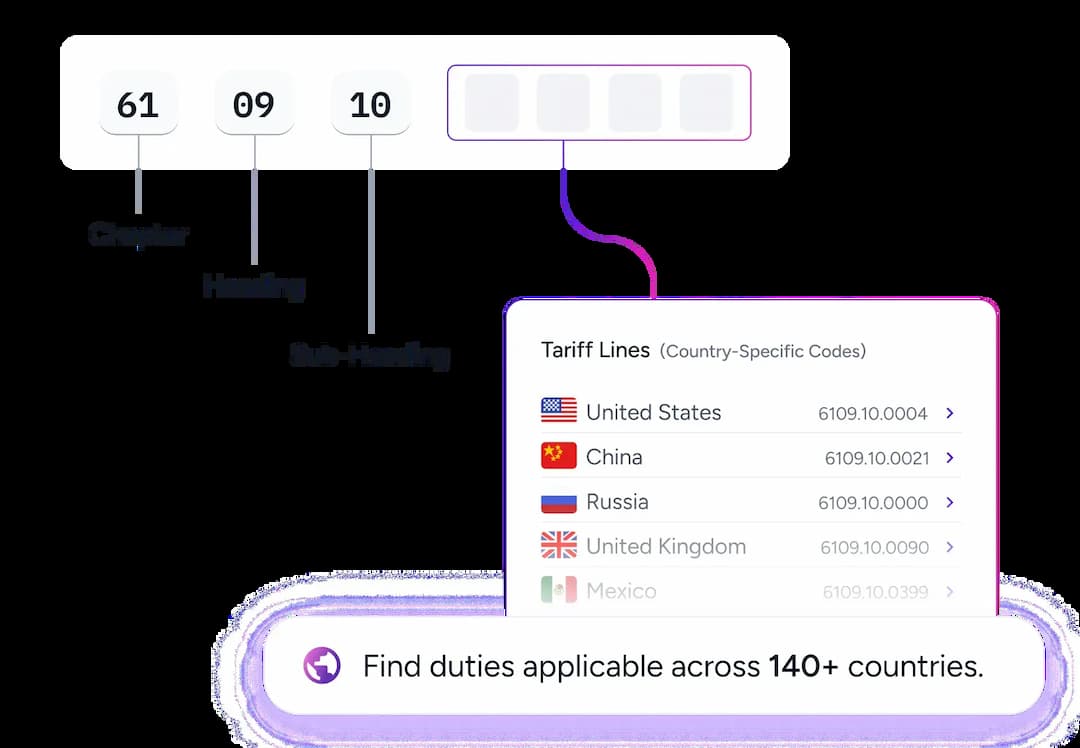
HS Code Lookup helps classify products under appropriate HS code and find duties applicable across 140+ countries. Find and discover HS classification, tariffs, taxes, controls, rulings, ECCNs, and default and preferential duties for HS code 2814.

WCO Notes for Heading 2814
Sub-Chapter IV
INORGANIC BASES AND OXIDES, HYDROXIDES AND PEROXIDES OF METAL
GENERAL
Bases are compounds characterised by a hydroxyl radical (OH) and which react with acids to form salts. In the liquid state or in solution, they are electrolytes giving a metal or an analogous ion (ammonium (NH4+)) at the cathode.
Metal oxides are compounds of a metal with oxygen. Many can combine with one or more molecules of water to form hydroxides.
Most oxides are basic since their hydroxides act as bases. Certain oxides (anhydride oxides), however, react only with alkaline or other bases to form salts, while another more common class (amphoteric oxides) can behave both as anhydride oxides or as bases. These classes of oxides must be regarded as anhydrides of acids, real or hypothetical, corresponding to their hydroxides.
Certain oxides (saline oxides) may be regarded as resulting from the combination of a basic oxide with an anhydride oxide.
This sub‑Chapter covers :
(1) Oxides, hydroxides and peroxides of metal, whether basic, acidic, amphoteric or saline.
(2) Other inorganic bases containing no oxygen, such as ammonia (heading 28.14), or hydrazine (heading 28.25), and those containing no metal, such as hydroxylamine (heading 28.25).
The sub‑Chapter excludes :
(a) The oxides and hydroxides of Chapter 25, particularly magnesia (magnesium oxide), whether or not pure, and quicklime and slaked lime (crude calcium oxide and hydroxide).
(b) Oxides and hydroxides constituting ores (headings 26.01 to 26.17), scalings, ash, slag, dross, scum or other metalliferous residues (headings 26.18 to 26.20).
(c) Oxides, peroxides and hydroxides of precious metals (heading 28.43), of radioactive elements (heading 28.44), of rare-earth metals, of yttrium or of scandium or of mixtures of these metals (heading 28.46), or of mercury (heading 28.52).
(d) Oxygen compounds of hydrogen of heading 22.01 (water), heading 28.45 (heavy water), heading 28.47 (hydrogen peroxide), or heading 28.53 (distilled and conductivity water and water of similar purity, including water treated with ion‑exchange media).
(e) Colouring matter with a basis of metal oxides (heading 32.06), prepared pigments, prepared opacifiers and prepared colours, vitrifiable enamels and glazes and similar products of the kind used in the ceramic, enamelling or glass industries (heading 32.07), and other preparations of Chapter 32, constituted by oxides, hydroxides or bases mixed with other products.
(f) Opacifying preparations for de‑lustring man‑made fibres (heading 38.09) and pickling preparations for metal surfaces (heading 38.10).
(g) Natural or synthetic precious or semi‑precious stones (headings 71.02 to 71.05).
28.14 ‑ Ammonia, anhydrous or in aqueous solution.
2814.10 ‑ Anhydrous ammonia
2814.20 ‑ Ammonia in aqueous solution
Ammonia is obtained either from impure ammoniacal gas liquors produced in coal gas purification or coke works (see Explanatory Note to heading 38.25, Item (A) (3)), or by synthesis from hydrogen and nitrogen.
This heading includes :
(1) Anhydrous ammonia (NH3), a colourless gas. It is less dense than air and easily liquefied by pressure. Presented in metal cylinders.
(2) Ammonia in aqueous solution (NH4OH), hydroxide of a hypothetical “element” ammonium (NH4). These solutions (generally containing 20, 27 or 34 % of NH3) are colourless or yellowish liquids presented in tightly‑stoppered containers. Alcoholic solutions of ammonia are excluded (heading 38.24).
Ammonia has many uses, for example, in the manufacture of nitric acid and nitrates, ammonium sulphate, other ammonium salts and nitrogenous fertilisers, sodium carbonate, cyanides, amines (e.g., naphthylamine). It emulsifies fatty matter and resins, and it acts as a detergent for removing stains, preparing polishing compounds, treating latex, removing varnish, etc. Liquefied ammonia is used in refrigerating plant.

What is HS code 2814?

How many sub-headings are there in HS code 2814?
International Trade Compliance Simplified