















HS Code Lookup for Heading 2826
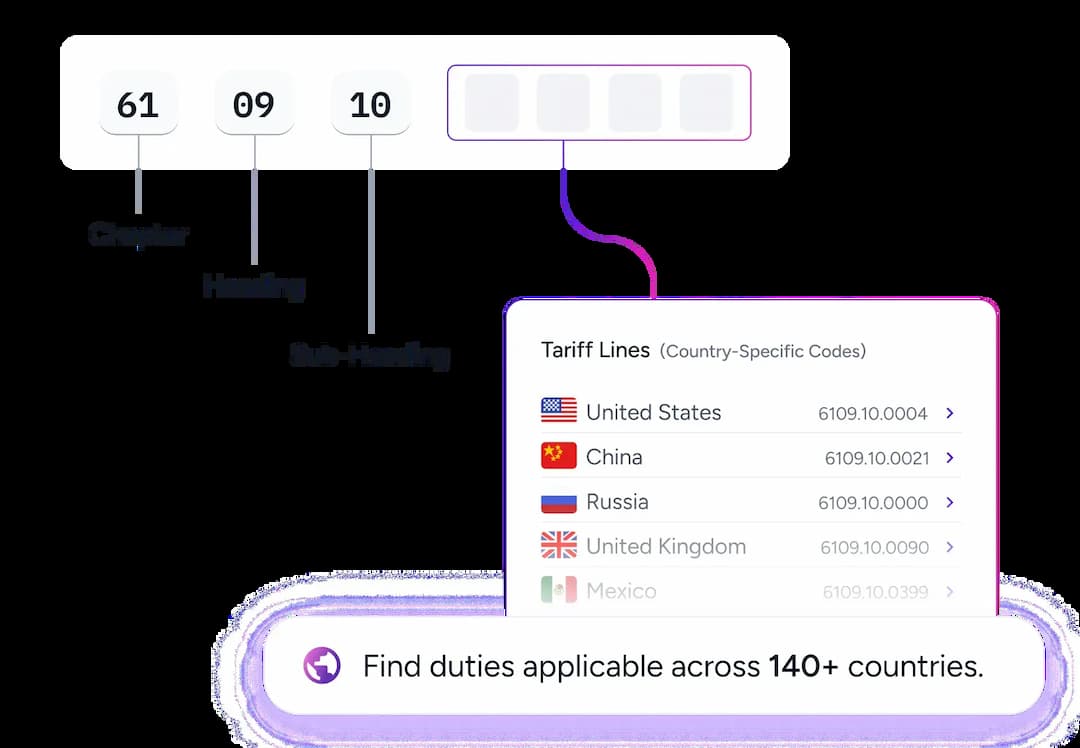
HS Code Lookup helps classify products under appropriate HS code and find duties applicable across 140+ countries. Find and discover HS classification, tariffs, taxes, controls, rulings, ECCNs, and default and preferential duties for HS code 2826.

WCO Notes for Heading 2826
Sub-Chapter V
SALTS AND PEROXYSALTS, OF INORGANIC ACIDS AND METALS
GENERAL
Metal salts are obtained by replacing the hydrogen element in an acid by a metal or by the ammonium ion (NH4+). In the liquid state or in solution, they are electrolytes giving a metal (or a metal ion) at the cathode.
In neutral salts all the hydrogen atoms are replaced by the metal, but acid salts still contain part of the hydrogen replaceable by metal; basic salts contain a greater quantity of basic oxide than is necessary to neutralise the acid (e.g., basic sulphate of cadmium (CdSO4.CdO)).
Sub‑Chapter V covers metal salts of the acids classified in sub‑Chapter II (acids derived from non‑metals) or in sub‑Chapter IV (acid‑function metal hydroxides).
Double or complex salts.
Certain double or complex salts are specifically referred to in headings 28.26 to 28.41; for example, fluorosilicates, fluoroborates and other complex fluorine salts (heading 28.26), alums (heading 28.33), complex cyanides (heading 28.37). As regards double or complex salts not so specified, see the Explanatory Note to heading 28.42.
This sub‑Chapter excludes, inter alia :
(a) Salts of Chapter 25 (e.g., sodium chloride).
(b) Salts constituting ores or other products of Chapter 26.
(c) Compounds of precious metals (heading 28.43), of radioactive elements (heading 28.44), of rare-earth metals, of yttrium or of scandium or of mixtures of these metals (heading 28.46), or of mercury (heading 28.52).
(d) Phosphides, carbides, hydrides, nitrides, azides, silicides and borides (headings 28.49, 28.50 and 28.53) and ferrophosphorus (Section XV).
(e) Salts of Chapter 31.
(f) Pigments, colours, opacifiers, enamels and other preparations included in Chapter 32. This sub‑Chapter covers unmixed metal salts (except luminophores), suitable for direct use as pigments; when mixed either together or with other products to form pigments, such salts fall in Chapter 32. Luminophores, mixed or not, fall in heading 32.06.
(g) Disinfectants, insecticides, fungicides, weed killers, etc., of heading 38.08.
(h) Fluxes and other auxiliary preparations for soldering, etc. (heading 38.10).
(ij) Cultured crystals (other than optical elements) weighing not less than 2.5 g each, of the halides of the alkali or alkaline‑earth metals (heading 38.24); when they are in the form of optical elements they are classified in heading 90.01.
(k) Precious or semi‑precious stones, natural or synthetic (headings 71.02 to 71.05).
28.26 ‑ Fluorides; fluorosilicates, fluoroaluminates and other complex fluorine salts.
‑ Fluorides :
2826.12 ‑ ‑ Of aluminium
2826.19 ‑ ‑ Other
2826.30 ‑ Sodium hexafluoroaluminate (synthetic cryolite)
2826.90 ‑ Other
(A) FLUORIDES
Subject to the exclusions specified in the introduction to this Sub-Chapter, this heading covers the fluorides (i.e., the metal salts of hydrofluoric acid of heading 28.11).
The most important fluorides are :
(1) Ammonium fluorides : the neutral fluoride (NH4F) and the acid fluoride (NH4F.HF). These occur in deliquescent, colourless, toxic crystals, soluble in water. Uses include : as antiseptics (for preserving hides or wood); to control fermentations, (in lieu of hydrofluoric acid); in dyeing (mordants); for etching glass (mainly acid fluoride); for scouring copper; in metallurgy (to disintegrate ores, to prepare platinum), etc.
(2) Sodium fluorides : the neutral fluoride(NaF) and the acid fluoride (NaF.HF). Obtained by calcining natural calcium fluoride of heading 25.29 (fluorspar or fluorite) with a sodium salt. Colourless crystals, not very soluble in water, toxic. Like ammonium fluorides, they are used as antiseptics (for preserving hides, wood, eggs), to control fermentations, and for etching or frosting glass. They are also used in the manufacture of vitrifiable enamels or of parasiticides.
(3) Aluminium fluoride (AlF3). Prepared from bauxite and hydrofluoric acid. Colourless crystals, insoluble in water. It is used as a flux in the enamel or ceramic industries and for purifying hydrogen peroxide.
(4) Potassium fluorides. Neutral potassium fluoride (KF.2H2O) occurs in colourless, deliquescent, toxic crystals, very soluble in water. Also an acid fluoride (KF.HF). Same uses as sodium fluorides. In addition, the acid fluoride is used in the metallurgy of zirconium or of tantalum.
(5) Calcium fluoride (CaF2). Prepared from the natural calcium fluoride (fluorite, fluorspar) of heading 25.29. Colourless crystals, insoluble in water; or may be in the gelatinous state. Used as a flux in metallurgy (particularly in the electrolytic preparation of magnesium from carnallite), and in the manufacture of glass or of ceramics.
(6) Chromium trifluoride (CrF3.4H2O). Dark green powder, soluble in water. In aqueous solution it attacks glass. Used as a mordant in dyeing.
(7) Zinc fluoride (ZnF2). White powder, insoluble in water. Used for impregnating wood, in the preparation of enamels and in galvanising.
(8) Antimony fluorides. The action of hydrofluoric acid on antimony oxides gives antimony trifluoride (SbF3), crystallising in deliquescent white needles, soluble in water, and antimony pentafluoride (SbF5), a viscous liquid which dissolves in water with a hissing sound to form a hydrate (with 2 H2O). These salts are used in ceramics, as mordants in dyeing or textile printing.
(9) Barium fluoride (BaF2). Prepared from hydrofluoric acid and barium oxide, sulphide or carbonate. A white powder, sparingly soluble in water; toxic. Used as a pigment in ceramics or enamels, as an antiseptic in embalming, as an insecticide, etc.
This heading excludes non‑metal fluorides (heading 28.12).
(B) FLUOROSILICATES
Fluorosilicates are the salts of the hexafluorosilicic acid (H2SiF6) of heading 28.11.
(1) Disodium hexafluorosilicate (sodium fluorosilicate) (Na2SiF6). Prepared from silicon fluoride, a by‑product of the manufacture of superphosphates. White powder, only sparingly soluble in cold water. Uses include the manufacture of opaque glass and enamels, synthetic stones, anti‑acid cements, rat poisons, insecticides; the extraction of beryllium metal (electrolytic); the refining of tin by electrolysis; coagulating latex; as an antiseptic.
(2) Dipotassium hexafluorosilicate (potassium fluorosilicate) (K2SiF6). White, odourless, crystalline powder, slightly soluble in water, soluble in hydrochloric acid. Uses include the manufacture of vitreous enamel frits, ceramics, insecticides, synthetic mica; in metallurgy of aluminium and magnesium.
(3) Calcium hexafluorosilicate (calcium fluorosilicate) (CaSiF6). White, crystalline powder; very slightly soluble in water; used as white pigment in ceramics.
(4) Copper hexafluorosilicate (copper fluorosilicate) (CuSiF6.6H2O). Blue, crystalline powder, soluble in water and toxic. Used for the production of mottled effects or as a fungicide.
(5) Zinc hexafluorosilicate (zinc fluorosilicate) (ZnSiF6.6H2O). Crystalline powder, soluble in water; reacts with calcium compounds to give a coating of calcium fluorides. Used for hardening concrete, for zinc electroplating, as an antiseptic or fungicide (wood infections).
(6) Barium hexafluorosilicate (barium fluorosilicate) (BaSiF6). White powder used against the Colorado beetle and other insects, and to exterminate noxious animals.
(7) Other fluorosilicates. Magnesium fluorosilicate and aluminium fluorosilicate; like zinc fluorosilicate, these are used for hardening concrete. Chromium fluorosilicate and iron fluorosilicate are used in the dyestuff industry.
The heading does not include topaz, a natural aluminium fluorosilicate (Chapter 71).
(C) FLUOROALUMINATES AND OTHER COMPLEX FLUORINE SALTS
(1) Trisodium hexafluoroaluminate (sodium hexafluoroaluminate) (Na3AlF6), synthetic cryolite, obtained as a precipitate on mixing aluminium oxide dissolved in hydrofluoric acid with sodium chloride, or by fusion of aluminium sulphate together with sodium fluoride. Occurs in whitish crystalline masses. It is used as a substitute for natural cryolite (heading 25.30) in the metallurgy of aluminium, in pyrotechnics, in enamels, in glass‑making or as an insecticide.
(2) Fluoroborates. Sodium fluoroborate (disinfectant), potassium fluoroborate (used in enamels), chromium fluoroborate and nickel fluoroborate (used in electro‑plating), etc.
(3) Fluorosulphates. In particular ammonium antimony fluorosulphate ((NH4)2SO4SbF3) or “Haen salt”; soluble crystals which corrode glass and metal. Used as a mordant in dyeing.
(4) Fluorophosphates, for example, those obtained from natural magnesium fluorophosphate (wagnerite) (heading 25.30) or aluminium lithium fluorophosphate (amblygonite) (heading 25.30).
(5) Fluorotantalates (obtained in the metallurgy of tantalum); fluorotitanates, fluorogermanates, fluoroniobates, fluorozirconates (obtained in the metallurgy of zirconium), fluorostannates, etc.
This heading includes metal fluoride oxides (of beryllium, etc.) and complex fluoride oxide salts but it excludes fluoride oxides of non‑metals (heading 28.12).
Fluoroformates, fluoroacetates or other organic complex fluorine salts are excluded (Chapter 29).

What is HS code 2826?

How many sub-headings are there in HS code 2826?
International Trade Compliance Simplified