















HS Code Lookup for Heading 2837
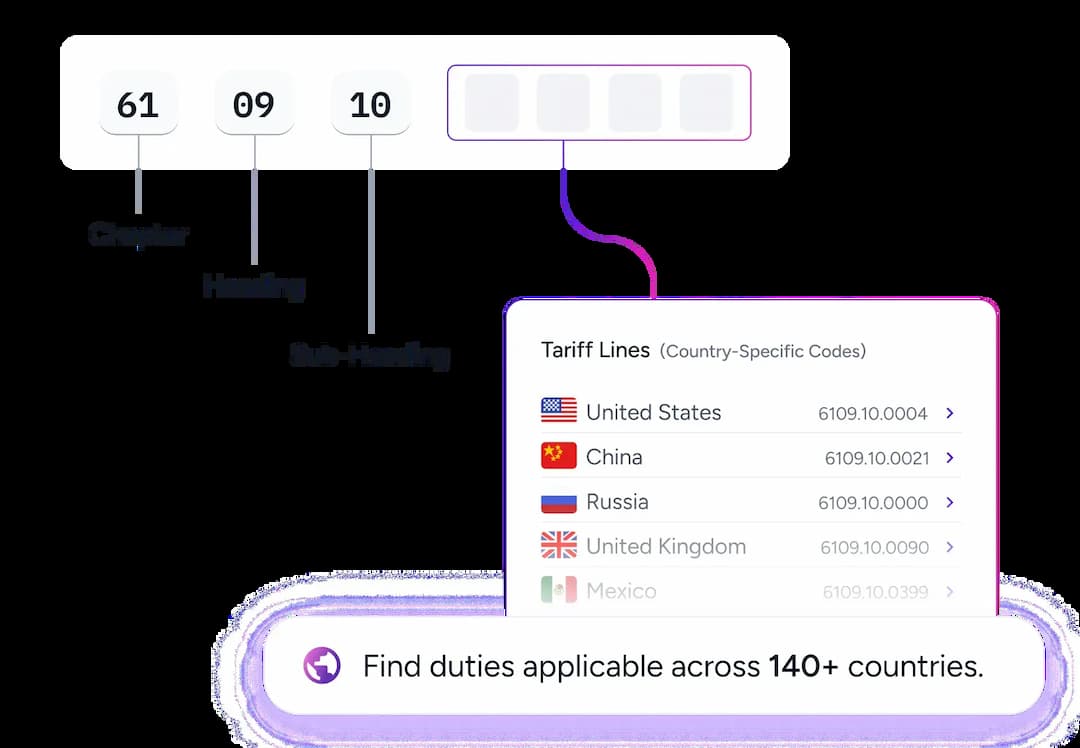
HS Code Lookup helps classify products under appropriate HS code and find duties applicable across 140+ countries. Find and discover HS classification, tariffs, taxes, controls, rulings, ECCNs, and default and preferential duties for HS code 2837.

WCO Notes for Heading 2837
28.37 ‑ Cyanides, cyanide oxides and complex cyanides.
‑ Cyanides and cyanide oxides :
2837.11 ‑ ‑ Of sodium
2837.19 ‑ ‑ Other
2837.20 ‑ Complex cyanides
Subject to the exclusions mentioned in the introduction to this sub‑Chapter, this heading covers cyanides, cyanide oxides (oxycyanides) and complex cyanides.
(A) CYANIDES
Cyanides are the metal salts of hydrogen cyanide (hydrocyanic acid) (HCN) (heading 28.11). These salts are very poisonous.
(1) Sodium cyanide (NaCN). Obtained by the action of coke or hydrocarbon gases and atmospheric nitrogen on sodium carbonate, by treating calcium cyanamide (see heading 31.02) with charcoal or by the interaction of pulverised coal, sodium and gaseous ammonia. White powder, plates or paste, crystalline, hygroscopic, very soluble in water and with an odour of bitter almonds. When brought to the melting‑point it absorbs oxygen; may also give hydrates. Is presented in sealed vessels. Used in the metallurgy of gold or silver, in gold‑ or silver‑plating, in photography, in lithography, as a parasiticide or insecticide, etc. Also used in the preparation of hydrogen cyanide, other cyanides and indigo; in flotation processes (in particular for separating galena from blende and pyrites from chalcopyrite).
(2) Potassium cyanide (KCN). Obtained by similar methods, has similar characteristics and uses to sodium cyanide.
(3) Calcium cyanide (Ca(CN)2). White or greyish powder according to its degree of purity, soluble in water. Used for destroying insects, fungus and noxious animals.
(4) Nickel cyanide (Ni(CN)2). Hydrated, greenish plates or powder; amorphous, a yellow powder. Used in metallurgy and in electroplating.
(5) Copper cyanides.
(a) Cuprous cyanide (CuCN). White or greyish powder, insoluble in water. Used for the same purposes as cupric cyanide and in medicine.
(b) Cupric cyanide (Cu(CN)2). Amorphous powder, insoluble in water, easily decomposed. Used for plating iron with copper and in organic synthesis.
(6) Zinc cyanide (Zn(CN)2). White powder, insoluble in water, used in electroplating.
The heading excludes cyanides of mercury (heading 28.52) and cyanides of non-metals, such as bromine cyanide (heading 28.53).
(B) HEXACYANOFERRATES (II) (FERROCYANIDES)
Hexacyanoferrates (II) (ferrocyanides) are the metal salts of hydrogen hexacyanoferrate (II) (H4Fe(CN)6) (heading 28.11). Obtained from spent oxide treated with calcium hydroxide or from the action of ferrous hydroxide on cyanides. Decomposed by heat.
The most important are :
(1) Tetrammonium hexacyanoferrate ((NH4)4Fe(CN)6). Crystals soluble in water. Used for “black nickel‑plating” and as a catalyst in the synthesis of ammonia.
(2) Tetrasodium hexacyanoferrate(Na4Fe(CN)6.10H2O). Yellow crystals, unaffected by air, soluble in water, especially when hot. Used for preparing hydrogen cyanide and Prussian blue, thio‑indigo, etc.; to case‑harden steel; in photography; in dyeing (as a mordant or as a blue tint); in printing (as an oxidising agent in aniline black printing) and as a fungicide.
(3) Tetrapotassium hexacyanoferrate (K4Fe(CN)6.3H2O). Yellow crystals, efflorescent, soluble in water, especially when hot. Same uses as tetrasodium hexacyanoferrate.
(4) Dicopper hexacyanoferrate (Cu2Fe(CN)6.xH2O). Purplis brown powder, insoluble in water. Used for preparing Florentine or Van Dyck brown for artists’ paints.
(5) Double hexacyanoferrates (e.g., dilithium dipotassium hexacyanoferrate Li2K2(Fe(CN)6).3H2O).
The heading excludes Prussian blue (Berlin blue) and other pigments based on hexacyanoferrates (heading 32.06).
(C) HEXACYANOFERRATES (III) (FERRICYANIDES)
Hexacyanoferrates (III) (ferricyanides) are the salts of hydrogen hexacyanoferrate (III) (H3Fe(CN)6) (heading 28.11).
The most important are :
(1) Trisodium hexacyanoferrate (Na3Fe(CN)6.H2O). Obtained by the action of chlorine on hexacyanoferrates (II); garnet‑coloured crystals, deliquescent, soluble in water and toxic; in aqueous solution it is greenish and decomposed by light. Used in dyeing and printing; in photography; for case‑hardening; in electroplating; and as an oxidising agent in organic synthesis.
(2) Tripotassium hexacyanoferrate (K3Fe(CN)6). Similar appearance to trisodium hexacyano- ferrates but less deliquescent. Same uses.
(D) OTHER COMPOUNDS
These include pentacyanonitrosylferrates (II), pentacyanonitrosylferrates (III), cyanocadmates, cyanochromates, cyanomanganates, cyanocobaltates, cyanoniccolates, cyanocuprates, etc., of inorganic bases.
This group includes, for example, sodium pentacyanonitrosylferrate (III) (sodium nitroprusside or sodium nitroferricyanide) (Na2Fe(CN)5NO.2H2O), used in chemical analysis.
Cyanomercurates are, however, excluded (heading 28.52).

What is HS code 2837?

How many sub-headings are there in HS code 2837?
International Trade Compliance Simplified