














HS Code Lookup for Heading 2840
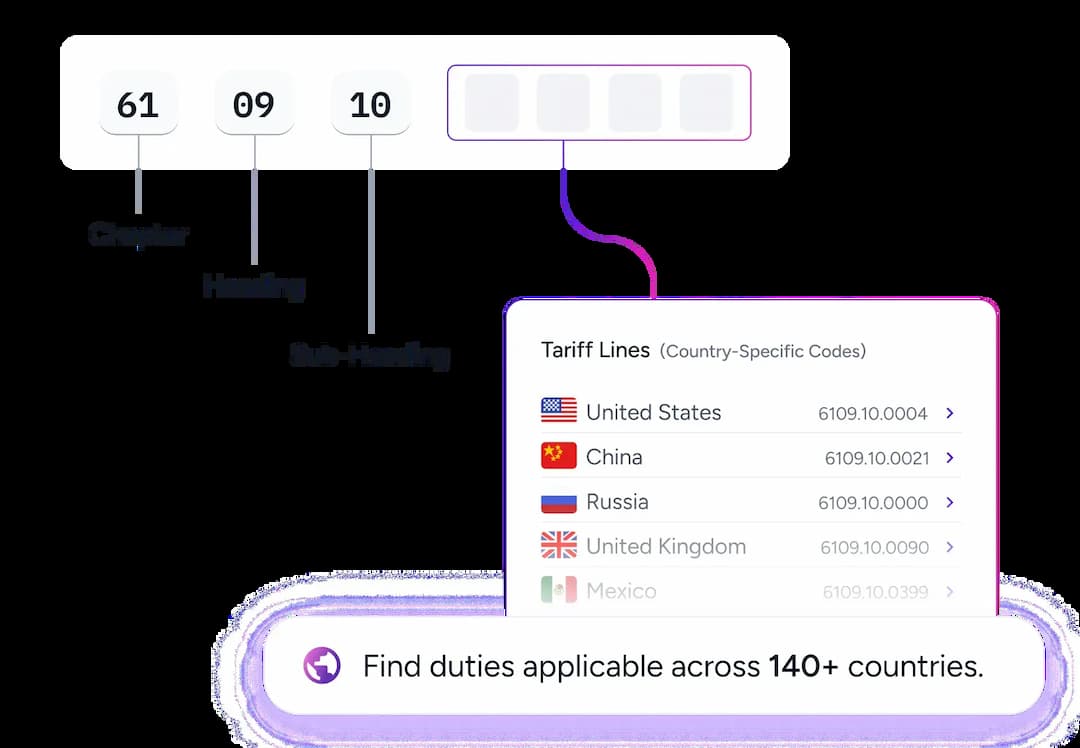
HS Code Lookup helps classify products under appropriate HS code and find duties applicable across 140+ countries. Find and discover HS classification, tariffs, taxes, controls, rulings, ECCNs, and default and preferential duties for HS code 2840.

WCO Notes for Heading 2840
28.40 ‑ Borates; peroxoborates (perborates).
‑ Disodium tetraborate (refined borax) :
2840.11 ‑ ‑ Anhydrous
2840.19 ‑ ‑ Other
2840.20 ‑ Other borates
2840.30 ‑ Peroxoborates (perborates)
(A) BORATES
Subject to the exclusions mentioned in the introduction to this sub‑Chapter, this heading covers borates, metal salts of the various boric acids, principally normal or orthoboric acid (H3BO3) (heading 28.10).
Borates obtained by crystallisation or by a chemical process are covered by this heading, as are also natural borates obtained by evaporating complex brines from certain salt lakes.
(1) Sodium borates. The most important is the tetraborate (disodium tetraborate, refined borax) (Na2B4O7). Obtained by crystallisation of solutions of natural borates, or by treating natural calcium borates or boric acid with sodium carbonate. Anhydrous or hydrated with 5 H2O or 10 H2O. Heated and then cooled down, it gives a vitreous mass (melted borax, borax glass, borax bead). Used for stiffening linen or paper; in soldering metals (flux for hard solder); as a flux for enamels; in the manufacture of vitrifiable colours, special glass (optical glass, glass for electric bulbs), glue or polish; for refining gold; and for preparing borates and anthraquinone dyes.
There are other sodium borates (metaborates, hydrogen diborate) for laboratory uses.
(2) Ammonium borates. The most important of these is metaborate (NH4BO2.2H2O). Colourless crystals, very soluble in water, efflorescent. Decomposed by heat to give a fusible varnish of boric anhydride; hence its use as a fire‑proofing material. Also used as a fixative in hair‑lotions; as a component of electrolytes for electrolytic capacitors and in the coating of paper.
(3) Precipitated calcium borates. Obtained by treating natural borates with calcium chloride; white powder used in fire retardant compositions, in anti‑freezing preparations and in ceramic insulators. It can also be used as an antiseptic.
(4) Manganese borates. Mainly tetraborate (MnB4O7), pinkish powder, sparingly soluble. Used as a drier in paints or varnishes.
(5) Nickel borate. Pale green crystals, used as a catalyst.
(6) Copper borate. Blue crystals, very hard, insoluble in water. Used as a pigment (ceramic colours) and as an antiseptic and insecticide.
(7) Lead borate. Greyish powder, insoluble in water. It is used to prepare driers, in glass‑making, as a pigment for porcelain and in electroplating.
(8) Other borates. Cadmium borate is used as a coating for fluorescent tubes. Cobalt borate is used as a drier; zinc borate as an antiseptic, in fire-proofing textiles or as a flux in ceramics, zirconium borate as an opacifier.
Natural sodium borates (kernite, tincal), used to prepare the borates of this heading, and natural calcium borates, (pandermite, priceite), used in the manufacture of boric acid, are excluded (heading 25.28).
(B) PEROXOBORATES (PERBORATES)
Subject to the exclusions mentioned in the introduction to this sub‑Chapter, this heading covers metal peroxoborates, which are more oxygenated than borates and readily release their oxygen.
They are generally complex products the formula of which corresponds to several acids such as HBO3 or HBO4.
The main peroxoborates are :
(1) Sodium peroxoborate (perborax). Obtained by the action of sodium peroxide on an aqueous solution of boric acid, or by treating an aqueous solution of sodium borate with hydrogen peroxide. White amorphous powder or crystals (with 1 or 4 H2O). Used for bleaching linen, textiles and straw; for preserving hides; in the manufacture of household washing preparations, detergents and antiseptics.
(2) Magnesium peroxoborate. White powder, insoluble in water, used in medicine or in the manufacture of toothpastes.
(3) Potassium peroxoborate. Similar characteristics and uses to sodium peroxoborate.
(4) Other peroxoborates. Ammonium, aluminium, calcium or zinc peroxoborates, which occur as white powders, are used in medicine and in the manufacture of tooth‑pastes.

What is HS code 2840?

How many sub-headings are there in HS code 2840?
International Trade Compliance Simplified