














HS Code Lookup for Heading 2901
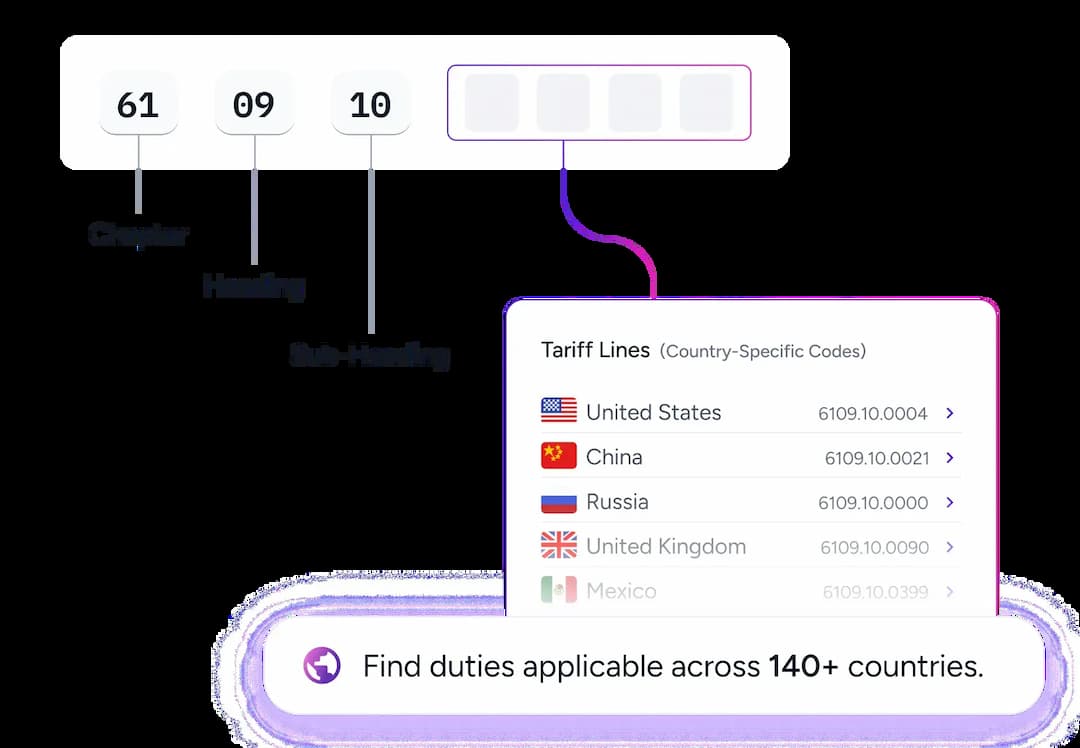
HS Code Lookup helps classify products under appropriate HS code and find duties applicable across 140+ countries. Find and discover HS classification, tariffs, taxes, controls, rulings, ECCNs, and default and preferential duties for HS code 2901.

WCO Notes for Heading 2901
Sub-Chapter I
HYDROCARBONS AND THEIR HALOGENATED, SULPHONATED, NITRATED OR NITROSATED DERIVATIVES
29.01 - Acyclic hydrocarbons.
2901.10 - Saturated
- Unsaturated :
2901.21 - - Ethylene
2901.22 - - Propene (propylene)
2901.23 - - Butene (butylene) and isomers thereof
2901.24 - - Buta-1,3-diene and isoprene
2901.29 - - Other
Acyclic hydrocarbons are compounds containing only carbon and hydrogen which have no rings in their structure. They can be classified in two categories :
(A) Saturated acyclic hydrocarbons.
(B) Unsaturated acyclic hydrocarbons.
(A) SATURATED ACYCLIC HYDROCARBONS
These form a homologous series which may be represented by the general formula (CnH2n+2). They occur abundantly in nature and are the main components of petroleum oils.
The basic hydrocarbon is methane (CH4) with one atom of carbon. Methane and also propane (C3H8) with three atoms of carbon are, however, classified in heading 27.11 even if they are pure.
The saturated acyclic hydrocarbons of this heading include :
(1) Ethane (C2H6) with two atoms of carbon.
To be classified in this heading, ethane must have a purity of 95 % or more by volume. Ethane of lower purity is excluded (heading 27.11).
(2) Butanes (C4H10) with four atoms of carbon.
(3) Pentanes, with five atoms of carbon.
(4) Hexanes, with six atoms of carbon.
(5) Heptanes, with seven atoms of carbon.
(6) Octanes, with eight atoms of carbon.
(7) Nonanes, with nine atoms of carbon.
(8) Decanes, with ten atoms of carbon.
(9) Pentadecanes, with fifteen atoms of carbon.
(10) Triacontanes, with thirty atoms of carbon.
(11) Hexacontanes, with sixty atoms of carbon.
These saturated hydrocarbons are all insoluble in water. At normal temperature and pressure, such hydrocarbons containing up to four atoms of carbon are gaseous; those containing five to fifteen atoms of carbon are liquid; hydrocarbons with a greater number of carbon atoms are generally solid.
One or more of the hydrogen atoms in these hydrocarbon molecules may be replaced by alkyl radicals (e.g., methyl, ethyl, propyl); thus isobutane (2-methylpropane, trimethylmethane) has the same molecular formula as the normal butane.
In industry and commerce, the most important hydrocarbons of this heading are ethane and butane gases which are derived from petroleum oil and natural gas.
To fall in this heading, these saturated acyclic hydrocarbons must be in the form of separate chemically defined compounds, whether obtained by refining petroleum oils and natural gas or by synthesis (as regards the purity criterion for ethane, see Item (1) above). But the heading excludes crude butane, crude petroleum gases and similar crude gaseous hydrocarbons of heading 27.11.
(B) UNSATURATED ACYCLIC HYDROCARBONS
These unsaturated hydrocarbons contain two, four, six, etc., less atoms of hydrogen than saturated acyclic hydrocarbons having the same number of atoms of carbon. This involves the presence of double or triple bonds.
(1) Monoethylenic hydrocarbons.
These constitute a homologous series represented by the general formula (CnH2n). They are found in the products obtained by thermal decomposition of numerous organic substances (coal gas, products of the cracking of petroleum oils, etc.); they may also be produced by synthesis.
(a) The first members of the series are gaseous, these are :
(i) Ethylene (ethene) (C2H4). Colourless gas with a faint odour of ether and strong anaesthetic properties. Used in the preparation of a wide range of organic compounds (e.g., ethylene oxide, ethylbenzene, synthetic ethanol, polyethylene).
To fall in this heading, ethylene must have a purity of 95 % or more by volume. Ethylene of lower purity is excluded (heading 27.11).
(ii) Propene (propylene) (C3H6). Colourless, highly inflammable gas which is an asphyxiant.
To fall in this heading, propene (propylene) must have a purity of 90 % or more by volume. Propylene of lower purity is excluded (heading 27.11).
(iii) Butenes (butylenes) (C4H8).
To fall in this heading, these unsaturated acyclic hydrocarbons must be in the form of separate chemically defined compounds. But the heading excludes crude gaseous hydrocarbons of heading 27.11.
In normal trade, all these products are in liquid form, under pressure.
(b) Monoethylenic hydrocarbons containing five to fifteen atoms of carbon are liquid. The most important include :
(i) Pentenes (amylenes).
(ii) Hexenes.
(iii) Heptenes.
(iv) Octenes.
(c) Those containing more than fifteen atoms of carbon are solids.
(2) Polyethylenic hydrocarbons.
These constitute a series with two or more double bonds.
They include :
(a) Propadiene (allene) (C3H4)
(b) Buta-1,2-diene (1,2-butadiene, methylallene) (C4H6)
(c) Buta-1,3-diene (1,3-butadiene) (C4H6) a colourless, highly inflammable gas and
(d) 2-Methylbuta-1,3-diene (isoprene) (C5H8), a colourless, highly inflammable liquid.
(3) Acetylene series.
Acetylenic hydrocarbons contain either one triple bond (mono-acetylenes, general (CnH2n-2) or more than one triple bond (polyacetylenes).
The most important product is acetylene (C2H2), a colourless gas with a characteristic odour. From acetylene a wide range of products can be synthesised (e.g., acetic acid, acetone, isoprene, chloroacetic acid, ethanol).
It is presented dissolved in acetone under pressure in special steel cylinders packed with diatomite, and remains classified under the heading (see Chapter Note 1 (e)).
Other members of the series are :
(a) Propyne (allylene, methylacetylene).
(b) Butyne (ethylacetylene).
(4) Ethylene-acetylene hydrocarbons.
These contain both ethylenic and acetylenic bonds in their molecules. The most important of these are vinylacetylene (acetylene in which one hydrogen atom has been replaced by a vinyl group), and methylvinylacetylene, (in which both hydrogen atoms have been replaced - one by a vinyl group and the other by a methyl group).

What is HS code 2901?

How many sub-headings are there in HS code 2901?
International Trade Compliance Simplified