















HS Code Lookup for Heading 2902
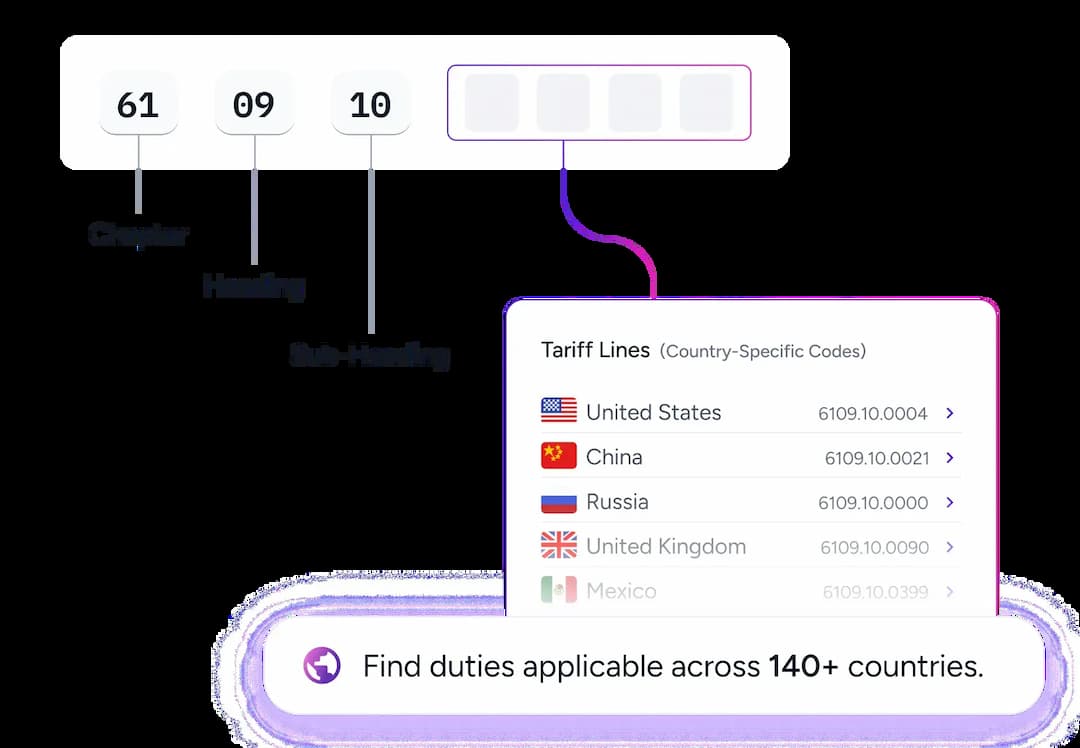
HS Code Lookup helps classify products under appropriate HS code and find duties applicable across 140+ countries. Find and discover HS classification, tariffs, taxes, controls, rulings, ECCNs, and default and preferential duties for HS code 2902.

WCO Notes for Heading 2902
29.02 - Cyclic hydrocarbons.
- Cyclanes, cyclenes and cycloterpenes :
2902.11 - - Cyclohexane
2902.19 - - Other
2902.20 - Benzene
2902.30 - Toluene
- Xylenes :
2902.41 - - o-Xylene
2902.42 - - m-Xylene
2902.43 - - p-Xylene
2902.44 - - Mixed xylene isomers
2902.50 - Styrene
2902.60 - Ethylbenzene
2902.70 - Cumene
2902.90 - Other
Cyclic hydrocarbons are compounds containing only carbon and hydrogen which have at least one ring in their structure. They can be classified in three categories :
(A) Cyclanes and cyclenes.
(B) Cycloterpenes.
(C) Aromatic hydrocarbons.
(A) CYCLANES AND CYCLENES
These are cyclic hydrocarbons which correspond to the general formula CnH2n when they are saturated monocyclic cyclanes and to the general formula CnH2n-x (in which x may be 2, 4, 6, etc.) when they are polycyclic cyclanes or when they are unsaturated (cyclenes).
(1) The monocyclic cyclanes include the polymethylene and naphthene hydrocarbons found in certain petroleum oils; examples are :
(a) Cyclopropane (C3H6) (gas).
(b) Cyclobutane (C4H8) (gas).
(c) Cyclopentane (C5H10) (liquid).
(d) Cyclohexane (C6H12) (liquid).
(2) The polycyclic cyclanes include :
(a) Decahydronaphthalene (C10H18), a colourless liquid used as a solvent for paints and lacquers, for polishes, etc.
(b) Bridge-linked compounds such as 1,4,4a,5,6,7,8,8a-octahydro-exo-1,4-endo-5,8-dimethanonaphthalene (C12H16) from which the pesticide HEOD is derived.
(c) Compounds with a “cage” structure such as pentacyclo [5.2.1.02,6.03,9.05,8] decane (C10H12) from which the formula of dodecachloropentacyclo [5.2.1.02,6.03,9.05,8] decane is derived.
(3) The cyclenes include :
(a) Cyclobutene (C4H6) gas.
(b) Cyclopentene (C5H8), liquid.
(c) Cyclohexene (C6H10), liquid.
(d) Cyclo-octatetraene (C8H8), liquid.
(e) Azulene (C10H8), solid.
This heading does not, however, include synthetic carotenes which fall in heading 32.04.
(B) CYCLOTERPENES
These hydrocarbons do not differ in general chemical structure from the cyclene group and have the general formula (C5H8)n where n may be 2 or more. They occur naturally in the vegetable kingdom as odoriferous, volatile liquids, for example :
(1) Pinene, a constituent of spirits of turpentine, pinewood oil, cinnamon oil, etc.; it is a colourless liquid.
(2) Camphene, contained in nutmeg oil, petitgrain oil, etc.
(3) Limonene*, found in citrus fruit oils; dipentene, being the mixed optical isomers of limonene. Crude dipentene is excluded (heading 38.05).
This heading excludes essential oils (heading 33.01), and gum, wood or sulphate turpentine and other terpenic oils produced by the distillation or other treatment of coniferous woods (heading 38.05).
(C) AROMATIC HYDROCARBONS
These compounds contain one or more fused or unfused benzene rings, benzene being a hydrocarbon composed of 6 atoms of carbon and 6 atoms of hydrogen, arranged in 6 groups of (CH) to form a hexagonal ring.
(I) Hydrocarbons with only one benzene ring. These include benzene and its homologues.
(a) Benzene (C6H6). Occurs in coal gas, in some petroleum oils, and in the liquid products of the dry distillation of numerous organic compounds rich in carbon (coal, lignite, etc.); also obtained synthetically. In the pure state, it is a colourless, mobile, refractive liquid, volatile and inflammable, with an aromatic odour. It readily dissolves resins, fats, essential oils, rubber, etc. Numerous products can be obtained from benzene synthesis.
To fall in this heading, benzene must have a purity of 95 % or more by weight. Benzene of lower purity is excluded (heading 27.07).
(b) Toluene (methylbenzene) (C6H5CH3). A benzene derivative in which one atom of hydrogen has been replaced by a methyl group. Obtained by distilling light coal tar oil, or by cyclisation of acyclic hydrocarbons. Colourless, mobile, refractive, inflammable liquid, with an aromatic odour similar to that of benzene.
To fall in this heading, toluene must have a purity of 95 % or more by weight. Toluene of lower purity is excluded (heading 27.07).
(c) Xylene (dimethylbenzene) (C6H4(CH3)2)*. A benzene derivative in which two atoms of hydrogen have been replaced by two methyl groups. There are three isomers : o-xylene, m-xylene and p-xylene. Xylene is a clear, inflammable liquid found in light coal tar oil.
To fall in this heading, xylene must contain 95 % or more by weight of xylene isomers, all isomers being taken together. Xylene of lower purity is excluded (heading 27.07).
(d) Other aromatic hydrocarbons of this group are formed by a benzene ring and one or more side chains, open or closed; these include :
(1) Styrene (C6H5CH=CH2)*. A colourless, oily liquid used mainly in the preparation of plastics (polystyrene) and of synthetic rubber.
(2) Ethylbenzene (C6H5C2H5). A colourless inflammable, mobile liquid, contained in coal tar, normally manufactured from benzene and ethylene.
(3) Cumene (C6H5CH(CH3)2). A colourless liquid found in certain petroleum oils. Used mainly in the production of phenol, acetone a- methylstyrene or as a solvent.
(4) p-Cymene (CH3C6H4CH(CH3)2)*. Found abundantly in several essential oils. Colourless liquid with an agreeable odour.
Crude p-cymene is excluded (heading 38.05).
(5) Tetrahydronaphthalene (tetralin) (C10H12). Obtained by the catalytic hydrogenation of naphthalene. Colourless liquid, with a terpene-like odour, used as a solvent, etc.
(II) Hydrocarbons with two or more unfused benzene rings; these include :
(a) Biphenyl (C6H5C6H5). Sparkling white crystals with an agreeable odour; used in particular for the preparation of the chlorinated derivatives (plasticisers), as a coolant (alone or mixed with biphenyl ether), and as a moderator in nuclear reactors.
(b) Diphenylmethane (C6H5CH2C6H5). A hydrocarbon with two benzene rings linked by a methylene group (CH2). Crystallises in colourless needles with a strong odour reminiscent of geraniums; used in organic synthesis.
(c) Triphenylmethane (CH(C6H5)3). A methane with three atoms of hydrogen replaced by three benzene rings.
(d) Terphenyls. The mixed terphenyl isomers are used as coolants and as moderators in nuclear reactors.
(III) Hydrocarbons with two or more benzene rings fused.
(a) Naphthalene (C10H8). Results from the fusion of two benzene rings. It occurs in coal tar, in petroleum oils, in coal gas, in lignite tar, etc. It crystallises in fine white flakes, with a characteristic odour.
To fall in this heading, naphthalene must have a crystallising point of 79.4 °C or more. Naphthalene of lower purity is excluded (heading 27.07).
(b) Phenanthrene (C14H10). Results from the fusion of three benzene rings. One of the products of the distillation of coal tar; fine, colourless, fluorescent crystals.
Phenanthrene falls here only when it is a separate chemically defined compound in the pure or commercially pure state. When crude, it is excluded (heading 27.07).
(c) Anthracene (C14H10). Also results from the fusion of three benzene rings, and is found in coal tar. Colourless crystals or yellowish powder, and is purple-blue fluorescent.
To fall in this heading, anthracene must have a purity of 90 % or more by weight. Anthracene of lower purity is excluded (heading 27.07).
This group also includes the following hydrocarbons :
(1) Acenaphthene.
(2) Methylanthracenes.
(3) Fluorene.
(4) Fluoranthene.
(5) Pyrene.
This heading excludes those dodecylbenzenes and those nonylnaphthalenes which are mixed alkylarenes (heading 38.17).

What is HS code 2902?

How many sub-headings are there in HS code 2902?
International Trade Compliance Simplified