














HS Code Lookup for Heading 2906
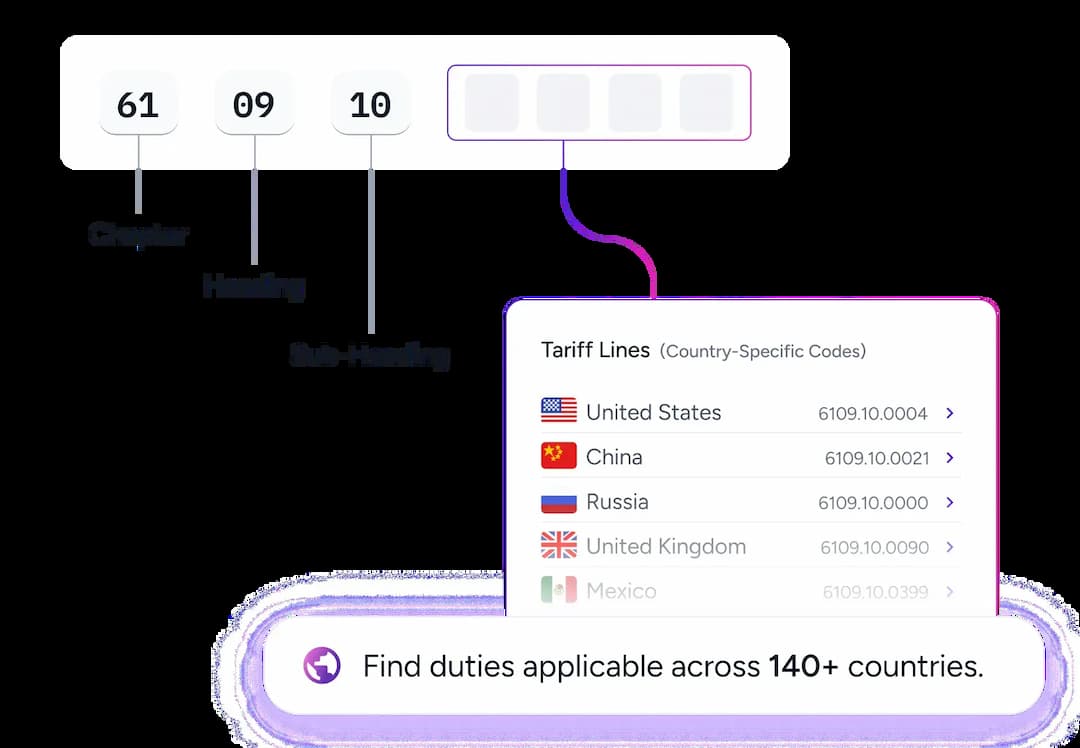
HS Code Lookup helps classify products under appropriate HS code and find duties applicable across 140+ countries. Find and discover HS classification, tariffs, taxes, controls, rulings, ECCNs, and default and preferential duties for HS code 2906.

WCO Notes for Heading 2906
29.06 - Cyclic alcohols and their halogenated, sulphonated, nitrated or nitrosated derivatives.
- Cyclanic, cyclenic or cycloterpenic :
2906.11 - - Menthol
2906.12 - - Cyclohexanol, methylcyclohexanols and dimethylcyclohexanols
2906.13 - - Sterols and inositols
2906.19 - - Other
- Aromatic :
2906.21 - - Benzyl alcohol
2906.29 - - Other
(A) CYCLANIC, CYCLENIC OR CYCLOTERPENIC ALCOHOLS AND THEIR HALOGENATED, SULPHONATED, NITRATED OR NITROSATED DERIVATIVES
(1) Menthol*, a secondary alcohol which is the main constituent of peppermint oil. Crystals; used as an antiseptic, as a local anaesthetic and also to relieve nasal congestion.
(2) Cyclohexanol, methyl- and dimethylcyclohexanols are compounds with a characteristic odour like camphor. They are used as solvents for varnishes. Dimethylcyclohexanol is used in soap-making.
(3) Sterols are alicyclic alcohols, saturated or unsaturated, the structure of which is derived from the hydrocarbon perhydro-1,2-cyclopentanophenanthrene, the hydroxyl group being linked to the 3-carbon, with a methyl group on the 10- and 13-carbons and a side chain of 8 to 10 carbon atoms linked to the 17-carbon. They exist abundantly both in the animal (zoosterols) and vegetable (phytosterols) kingdoms. The most important is cholesterol obtained mainly from the spinal cords of cattle and from wool grease; it is also obtained from bile, and as a by-product during the extraction of lecithin from egg-yolks. It is in the form of shiny, colourless tablets, insoluble in water.
This heading excludes ergosterol, found in fungi (mushrooms) and in spurred rye, a provitamin from which vitamin D2 is obtained by ultra-violet irradiation. Both ergosterol and vitamin D2 fall in heading 29.36.
(4) Inositols, constituents of body tissue. There are nine isomeric forms of inositol. White crystals. Widely distributed in plants and animals.
(5) Terpineols, very important alcohols used as a basis for perfumes such as lilac, etc. Found in nature either in the free state or esterified in many essential oils (e.g., of cardamoms, sweet orange, orange-flower, petit-grain, sweet marjoram, nutmeg, turpentine, cherry-laurel, camphor).
Commercial terpineol is usually a mixture of isomers but it remains in this heading (see Note 1 (b) to Chapter 29). It is a colourless, oily liquid, and is sometimes used as a bactericide. A solid isomer is used in medicine and may also be used as a bactericide.
(6) Terpin, obtainedsynthetically. White crystals. Terpin hydrate is obtained from turpentine; colourless crystals, aromatic. Used in medicine, and also for the preparation of terpineol.
(7) Borneol (Borneo camphor), the alcohol corresponding to the ketone camphor. Appearance and odour like natural camphor; crystalline white or sometimes brownish mass; volatile at room temperature.
(8) Isoborneol, lamellar crystals; an intermediate stage in the conversion of alphapinene to camphor.
(9) Santalol, main constituent of sandalwood oil.
(B) AROMATIC ALCOHOLS AND THEIR HALOGENATED, SULPHONATED, NITRATED OR NITROSATED DERIVATIVES
Aromatic alcohols contain the hydroxyl group (-OH) linked not to the aromatic rings but to the side chains.
(1) Benzyl alcohol (phenylmethanol, phenylcarbinol). Found in the free state or esterified in oils of jasmine and tuberose, and esterified in storax and balsam of Tolu. Colourless liquid with a pleasant aromatic odour; used in organic synthesis and in the preparation of varnishes, dyestuffs, artificial perfumes, etc.
(2) 2-Phenylethanol (phenylethyl alcohol). A liquid forming the main constituent in attar of roses.
(3) 3-Phenylpropanol (phenylpropyl alcohol). Found in storax, in Sumatra gum benzoin, in cassia oil and in Chinese cinnamon oil; it is a dense, colourless liquid with a faint odour of hyacinths.
(4) Cinnamyl alcohol. Found in liquid storax and in balsam of Peru. Crystallises in needles with an odour of hyacinths.
(5) Diphenylmethanol (diphenylcarbinol, benzhydrol). Crystallises in needles.
(6) Triphenylmethanol (triphenylcarbinol). Crystals. This alcohol is the parent substance of an important group of dyes which includes aurine, rosaniline, etc.
*
* *
For the purposes of this heading, aldehyde-bisulphite compounds and ketone-bisulphite compounds are classified as sulphonated derivatives of alcohols. This heading also covers metal alcoholates of cyclic alcohols.
______________________

What is HS code 2906?

How many sub-headings are there in HS code 2906?
International Trade Compliance Simplified