















HS Code Lookup for Heading 2914
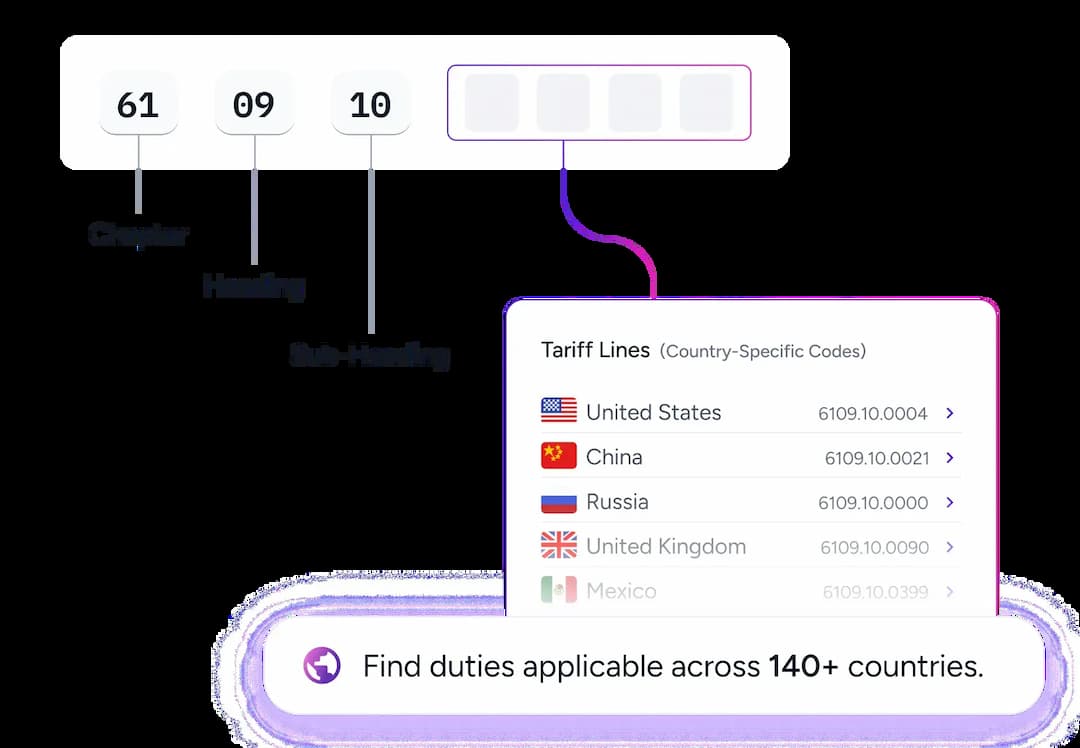
HS Code Lookup helps classify products under appropriate HS code and find duties applicable across 140+ countries. Find and discover HS classification, tariffs, taxes, controls, rulings, ECCNs, and default and preferential duties for HS code 2914.

WCO Notes for Heading 2914
Sub-Chapter VI
KETONE‑FUNCTION COMPOUNDS AND QUINONE‑FUNCTION COMPOUNDS
29.14 ‑ Ketones and quinones, whether or not with other oxygen function, and their halogenated, sulphonated, nitrated or nitrosated derivatives.
‑ Acyclic ketones without other oxygen function :
2914.11 ‑ ‑ Acetone
2914.12 ‑ ‑ Butanone (methyl ethyl ketone)
2914.13 ‑ ‑ 4‑Methylpentan‑2‑one (methyl isobutyl ketone)
2914.19 ‑ ‑ Other
‑ Cyclanic, cyclenic or cycloterpenic ketones without other oxygen function :
2914.22 ‑ ‑ Cyclohexanone and methylcyclohexanones
2914.23 ‑ ‑ Ionones and methylionones
2914.29 ‑ ‑ Other
- Aromatic ketones without other oxygen function :
2914.31 ‑ ‑ Phenylacetone (phenylpropan-2-one)
2914.39 ‑ ‑ Other
2914.40 ‑ Ketone-alcohols and ketone-aldehydes
2914.50 ‑ Ketone‑phenols and ketones with other oxygen function
‑ Quinones :
2914.61 ‑ ‑ Anthraquinone
2914.62 ‑ ‑ Coenzyme Q10 (ubidecarenone (INN))
2914.69 ‑ ‑ Other
‑ Halogenated, sulphonated, nitrated or nitrosated derivatives :
2914.71 ‑ ‑ Chlordecone (ISO)
2914.79 ‑ ‑ Other
The term “ketones and quinones with other oxygen function” means ketones and quinones which contain also one or more of the oxygen functions referred to in previous sub‑Chapters (alcohol, ether, phenol, aldehyde, etc., functions).
(A) KETONES*
These are compounds containing the group (>C=O), so‑called “carbonyl” group, and can be represented by the general formula (R-CO-R1), in which R and R1stand for alkyl or aryl radicals (methyl, ethyl, propyl, phenyl, etc.).
Ketones may have two tautomeric forms, the true ketonic form (-CO-) and the enolic form (=C(OH)-), both of which fall in this heading.
(I) Acyclic ketones.
(1) Acetone (propanone) (CH3COCH3). Found in the products of the dry distillation of wood (methyl alcohol and crude pyroligneous acid), but is mainly obtained by synthesis. Colourless liquid with an agreeable ether‑like odour. Used in numerous organic syntheses, for the manufacture of plastics, as a solvent for acetylene, acetylcellulose and resins, etc.
(2) Butanone (methyl ethyl ketone) (CH3COC2H5). Colourless liquid found in the by‑products of the distillation of alcohol from beet molasses. Also obtained by the oxidation of secondary butyl alcohol.
(3) 4‑Methylpentan‑2‑one (methyl isobutyl ketone) ((CH3)2CHCH2COCH3). Liquid with an agreeable odour; used as a solvent for cellulose nitrate, gums and resins.
(4) Mesityl oxide. Colourless liquid formed by the condensation of two acetone molecules.
(5) Phorones. Compounds formed by the condensation of three acetone molecules.
(6) Pseudoionones. Complex ketones, liquid, yellowish in colour, smelling of violets; used for the preparation of ionone (artificial violet oil).
(7) Pseudomethylionones. Liquids with the same properties as pseudoionones, with a violet‑like odour. Used in perfumery.
(8) Diacetyl (CH3COCOCH3)*. Greenish‑yellow liquid, with a penetrating quinone‑like odour. Used for flavouring butter and margarine.
(9) Acetylacetone (CH3COCH2COCH3)*. Colourless liquid, with an agreeable odour; used in organic synthesis.
(10) Acetonylacetone (CH3COCH2CH2COCH3)*. Colourless liquid with an agreeable odour; used in organic synthesis.
(II) Cyclanic, cyclenic or cycloterpenic ketones.
(1) Camphor (C10H16O)*. The heading covers both natural and synthetic camphor. The former is obtained from the Laurus camphora tree, indigenous to China and Japan. Synthetic camphor is derived from pinene (obtained from spirits of turpentine). Both are colourless crystalline masses, translucent, soft to the touch, and with a characteristic odour. Natural and synthetic camphor are used in medicine as an antiseptic, for the manufacture of celluloid and in moth balls.
So‑called “Borneo camphor” or “borneol” is not a ketone but an alcohol, and is formed by reducing camphor; it is excluded (heading 29.06).
(2) Cyclohexanone (C6H10O). Obtained by synthesis; a liquid with an odour similar to that of acetone. Strong solvent for acetylcellulose and natural or artificial resins.
(3) Methylcyclohexanones. Liquids insoluble in water.
(4) Ionones (C13H20O), formed by the condensation of citral with acetone. They include :
(a) α‑Ionone. Colourless liquid with a strong violet‑like odour.
(b) β‑Ionone. Colourless liquid with a violet‑like odour less delicate than that of α‑ionone.
Both are used in perfumery.
(5) Methylionones. Colourless to amber‑yellow liquids.
(6) Fenchone (C10H16O). Occurs in fennel and thuja oils. A clear, colourless liquid, with a camphor‑like odour; used as a camphor substitute.
(7) Irone. Occurs in the essential oil obtained from the roots of some varieties of iris. An oily liquid, colourless, with an iris‑like odour; strongly diluted, it has a delicate, violet‑like odour. Used in perfumery.
(8) Jasmone (C11H16O). Derived from jasmine‑blossom. A light yellow oil with a strong jasmine odour, used in perfumery.
(9) Carvone (C10H14O). Occurs in caraway, aniseed and mint oils. A colourless liquid, with a strong aromatic odour.
(10) Cyclopentanone (adipoketone) (C4H8CO). Occurs in the distillation products of wood. A liquid with a mint‑like odour.
(11) Menthone (C10H18O). Found in peppermint and other essential oils. Obtained synthetically by oxidation of menthol. An unstable, colourless, refractive liquid, with an odour of mint.
(III) Aromatic ketones.
(1) Methyl naphthyl ketone.
(2) Benzylideneacetone (C6H5CH=CHCOCH3). Colourless crystals, smelling of sweet peas.
(3) Acetophenone (CH3COC6H5). Oily, colourless or yellow liquid, with an agreeable aromatic odour; used in perfumery and for organic synthesis.
(4) Propiophenone.
(5) Methylacetophenone (CH3C6H4COCH3). Colourless or yellowish liquid, with an agreeable odour.
(6) Butyldimethylacetophenone.
(7) Benzophenone (C6H5COC6H5). Colourless or slightly yellow crystals with an agreeable ether‑like odour. Used in the manufacture of synthetic perfumes and for organic synthesis.
(8) Benzanthrone. Yellowish needles.
(9) Phenylacetone (phenylpropan-2-one). Colourless to light yellow liquid. Used principally in organic synthesis and as a precursor in the production of amphetamines (see the list of precursors at the end of Chapter 29).
(B) KETONE‑ALCOHOLS
Compounds whose molecules contain both the alcohol and ketone functions.
(1) 4‑Hydroxy‑4‑methylpentan‑2‑one (diacetone alcohol). Colourless liquid.
(2) Acetol (acetylcarbinol) (CH3COCH2OH). Colourless liquid with a penetrating odour; used as a solvent for cellulose varnishes and resins.
(C) KETONE‑ALDEHYDES
Compounds whose molecules contain both the ketone and aldehyde functions.
(D) KETONE‑PHENOLS
Compounds whose molecules contain both the ketone and phenol functions.
(E) QUINONES
These are diketones derived from aromatic compounds by conversion of two  CH groups into >C=O groups with any necessary rearrangement of double bonds.
(1) Anthraquinone(C6H4(CO)2C6H4)*. Yellow needles which, when ground, give a white powder. Used in the manufacture of dyes.
(2) p‑Benzoquinone (quinone) (C6H4O2). Yellow crystals with a penetrating odour.
(3) 1,4‑Naphthoquinone (C10H6O2). Yellow needles.
(4) 2‑Methylanthraquinone. White needles.
(5) Acenaphthenequinone. Yellow needles.
(6) Phenanthraquinone. Yellow needles.
(F) QUINONE‑ALCOHOLS, QUINONE‑PHENOLS, QUINONE‑ALDEHYDES AND OTHER OXYGEN FUNCTION QUINONES
Quinone‑alcohols, quinone‑phenols and quinone‑aldehydes are compounds which, independently of their quinone function, also contain, in their molecules, alcohol, phenol and aldehyde functions, respectively.
(1) α‑Hydroxyanthraquinone.
(2) Quinizarin.
(3) Chrysazin.
(4) Coenzyme Q10* (ubidecarenone (INN)).
(G) HALOGENATED, SULPHONATED, NITRATED OR NITROSATED DERIVATIVES OF KETONES, QUINONES, KETONE‑ALCOHOLS, ETC., QUINONE‑ALCOHOLS, ETC.
(1) Bromocamphor (C10H15OBr). Needles with a strong camphor‑like odour. Used as a sedative.
(2) 4’‑Tert‑butyl‑2’,6’-dimethyl‑3’,5’‑dinitroacetophenone (ketone musk).
(3) Camphorsulphonic acid.
(4) Chlordecone (ISO).
*
* *
This heading also covers combinations of halogenated, sulphonated, nitrated or nitrosated derivatives (e.g., sulphohalogenated, nitrohalogenated, nitrosulphonated and nitrosulpho- halogenated derivatives).
Organic colouring matter is excluded from this heading (Chapter 32). The heading also excludes ketone‑bisulphite compounds which are classified as sulphonated derivatives of alcohols (headings 29.05 to 29.11).
______________________

What is HS code 2914?

How many sub-headings are there in HS code 2914?
International Trade Compliance Simplified