














HS Code Lookup for Heading 2915
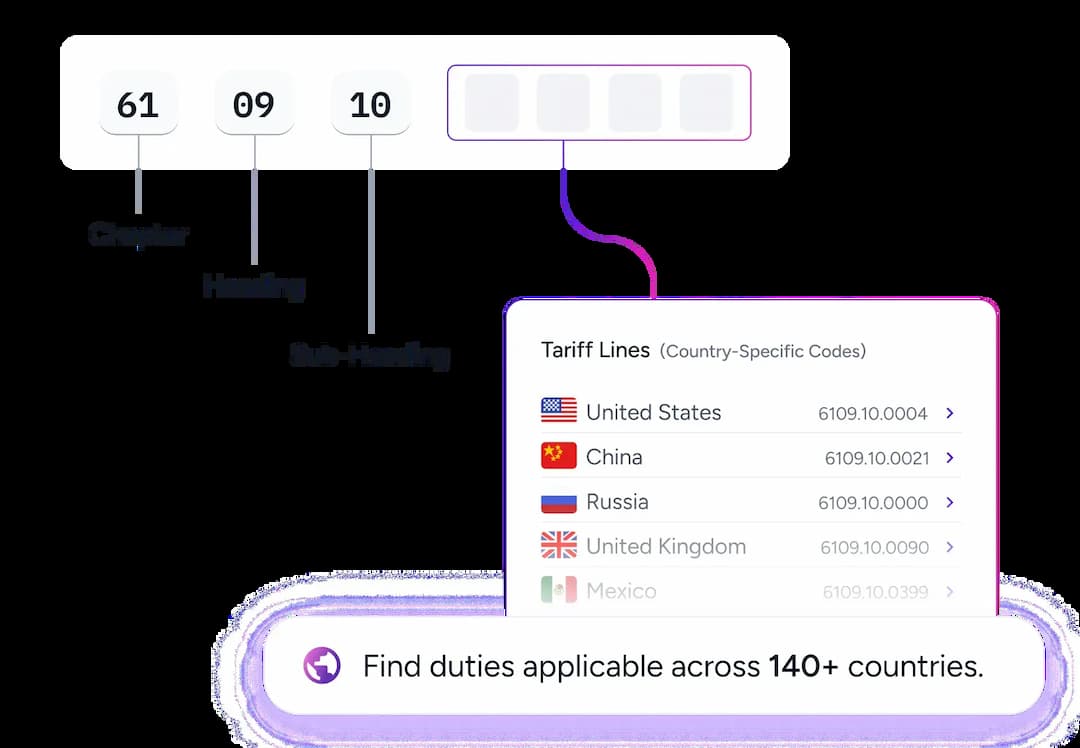
HS Code Lookup helps classify products under appropriate HS code and find duties applicable across 140+ countries. Find and discover HS classification, tariffs, taxes, controls, rulings, ECCNs, and default and preferential duties for HS code 2915.

WCO Notes for Heading 2915
Sub-Chapter VII
CARBOXYLIC ACIDS AND THEIR ANHYDRIDES, HALIDES, PEROXIDES AND PEROXYACIDS AND THEIR HALOGENATED, SULPHONATED, NITRATED OR NITROSATED DERIVATIVES
GENERAL
This sub-Chapter covers the carboxylic acids which contain the characteristic function (–COOH), called the carboxyl group. In theory, the heading also covers the ortho-acids (RC(OH)3) since these may be regarded as hydrated carboxylic acids(RCOOH + H2O = RC(OH)3). In practice, however, these do not exist in the free state, but they do give rise to stable esters (ortho-esters, to be regarded as esters of hydrated carboxylic acids).
Carboxylic acids may contain one or more carboxyl groups (–COOH) (monocarboxylic acids or polycarboxylic acids, respectively).
If the hydroxyl group (–OH) is removed, the residue is an acyl radical which can be representedby the formula (RCO–) where R is an alkyl or aryl radical (methyl, ethyl, phenyl, etc.). Acyl radicals enter into the formulae of anhydrides, halides, peroxides, peroxyacids, esters and salts.
Sulphonic acids, which contain the group (–SO3H) are quite different from carboxylic acids; they are classified as sulphonated derivatives in various sub-Chapters. This sub-Chapter includes only those which are sulphonated derivatives of the chemicals of this sub-Chapter.
(A) ACID ANHYDRIDES
Acid anhydrides result from the elimination of a molecule of water, either from two molecules of a monobasic acid, or from one molecule of dibasic acid. They are characterised by the group (–C(O)OC(O)–).
(B) ACID HALIDES
The halides (e.g., chlorides and bromides) of acids have the general formula (RCOX, where X is a halogen), i.e., they are represented by acyl radicals combined with chlorine, bromine or other halogens.
(C) ACID PEROXIDES
Acid peroxides, also known as diacyl peroxides, are compounds in which two acyl radicals are linked by two oxygen atoms; their general formula is RC(O)OOC(O)R1*, in which R and R1 may be the same or different.
(D) PEROXYACIDS
Peroxyacids have the general formula (RC(O)OOH).
(E) ESTERS OF ACIDS
Esters of carboxylic acids are obtained by replacing the hydrogen atom of the carboxyl group (–COOH) by an alkyl or aryl radical. They may be represented by the general formula (RC(O)OR1) in which R and R1are alkyl or aryl radicals (methyl, ethyl, phenyl, etc.).
(F) PEROXYESTERS
The general formula of peroxyesters is RC(O)OOR1, in which R and R1 are organic radicals that may be the same or different.
(G) SALTS OF ACIDS
Salts of carboxylic acids are obtained by replacing the hydrogen atom of the carboxyl group (–COOH) by an inorganic cation, for example, sodium, potassium, ammonium. They may be represented by the formula (RC(O)OM) in which R is an alkyl, aryl or alkaryl radical and M is a metallic or other inorganic cation.
(H) HALOGENATED, SULPHONATED, NITRATED OR NITROSATED DERIVATIVES OF ACIDS
In the halogenated, sulphonated, nitrated or nitrosated derivatives of the compounds described in Parts (A) to (F) above, the oxygen-containing functional groups remain intact, but one or more hydrogens in the radicals R or R1have been replaced, respectively, by halogens, sulpho (–SO3H), nitro (–NO2) or nitroso (–NO) groups or by any combination thereof.
29.15 - Saturated acyclic monocarboxylic acids and their anhydrides, halides, peroxides and peroxyacids; their halogenated, sulphonated, nitrated or nitrosated derivatives.
- Formic acid, its salts and esters :
2915.11 - - Formic acid
2915.12 - - Salts of formic acid
2915.13 - - Esters of formic acid
- Acetic acid and its salts; acetic anhydride :
2915.21 - - Acetic acid
2915.24 - - Acetic anhydride
2915.29 - - Other
- Esters of acetic acid :
2915.31 - - Ethyl acetate
2915.32 - - Vinyl acetate
2915.33 - - n-Butyl acetate
2915.36 - - Dinoseb (ISO) acetate
2915.39 - - Other
2915.40 - Mono-, di- or trichloroacetic acids, their salts and esters
2915.50 - Propionic acid, its salts and esters
2915.60 - Butanoic acids, pentanoic acids, their salts and esters
2915.70 - Palmitic acid, stearic acid, their salts and esters
2915.90 - Other
This heading covers saturated acyclic monocarboxylic acids and their anhydrides, halides, peroxides and peroxyacids, esters and salts, as well as the halogenated, sulphonated, nitrated or nitrosated derivatives (including compound derivatives) of any of these products.
(I) Formic acid (HCOOH) and its salts and esters.
(a) Formic acid is found in nature and obtained synthetically. A mobile, colourless liquid, giving off slight fumes when exposed to air; has an irritating odour and is caustic. Used in dyeing, in tanning, in the coagulation of latex, in medicine as an antiseptic, or in organic synthesis.
(b) The main salts of formic acid are :
(1) Sodium formate (HCOONa). Deliquescent crystalline white powder; used in medicine, in tanning and in organic synthesis.
(2) Calcium formate ((HCOO)2Ca). Crystals.
(3) Aluminium formate ((HCOO)3Al). White powder used in the textile industry as a mordant and for waterproofing. There is also a basic formate usually put up in aqueous solution.
(4) Nickel formate ((HCOO)2Ni). Used as a catalyst for the hydrogenation of oil.
(c) The main esters of formic acid are :
(1) Methyl formate (HCOOCH3). A colourless liquid with an agreeable odour.
(2) Ethyl formate (HCOOC2H5). A colourless, mobile, volatile and inflammable liquid with an odour of rum.
(3) Benzyl, bornyl, citronellyl, geranyl, isobornyl, linalyl, menthyl, phenylethyl, rhodinyl and terpenyl formates. Mainly used in perfumery.
(II) Acetic acid (CH3COOH) and its salts and esters.
(a) Acetic acid is obtained by the dry distillation of wood, or synthetically. A very acid liquid with a characteristic and penetrating odour of vinegar caustic. When cold it solidifies into colourless crystals (glacial acetic acid). A solvent for phosphorus and sulphur and for many organic substances.
Commercial acetic acid is slightly yellowish in colour, and has very often a slight empyreumatic odour. Used in the textile industry, in tanning, as a coagulant for latex, or for the manufacture of acetates, synthetic plasticisers, pharmaceutical products, etc.
(b) The main salts of acetic acid are :
(1) Sodium acetate (CH3COONa). Colourless and odourless crystals, or anhydrous white or faintly yellow powder. Used as a mordant and for many chemical preparations.
(2) Cobalt acetate ((CH3COO)2Co). Deliquescent violet-red crystals with an odour of acetic acid.
(3) Calcium acetate ((CH3COO)2Ca). Colourless crystals when pure.
(4) Basic copper acetate (CH3COOCuOH). Needles or small crystalline flakes, blue in colour; disintegrates on contact with air and turns greenish.
(5) Neutral copper acetate ((CH3COO)2Cu). Greenish-blue powder or small crystals; disintegrates on contact with air and turns to a whitish powder
(6) Lead acetate, neutral ((CH3COO)2Pb), or basic (e.g., Pb(CH3COO)2. 3PbO.H2O). The neutral acetate occurs as colourless or faintly yellow or blue, toxic crystals. The basic acetate is a dense, white powder, used in medicine and as a reagent for chemical analyses.
(7) Lithium and potassium acetates, used in medicine; chromium, aluminium and iron acetates, used as mordants.
(c) The main esters of acetic acid are :
(1) Methyl acetate (CH3COOCH3). Found amongst the products of the dry distillation of wood. A liquid with a fruity odour; used for preparing artificial fruit essences, and as a solvent for fats, resins and cellulose nitrate, etc.
(2) Ethyl acetate (CH3COOC2H5). Colourless, very mobile, highly inflammable liquid with a fruity odour; it may contain ethanol as an impurity. Used as a solvent for cellulose nitrate, varnishes, etc.; also in medicine as an antispasmodic and analgesic.
(3) Vinyl acetate (CH3COOCH=CH2). Colourless liquid with a characteristic odour; a monomer used for preparing poly(vinyl acetate) (polymers of heading 39.05).
(4) n-Propyl and isopropyl acetates. Used for making artificial fruit essences.
(5) n-Butyl acetate. Colourless liquid; used for making artificial fruit essences and as a solvent.
(6) Isobutyl acetate. Colourless liquid; used for making artificial fruit essences and as a solvent.
(7) n-Pentyl acetate (n-amyl acetate) and 3-methylbutyl acetate (iso-amyl acetate). Used for making artificial fruit essences.
(8) 2-Ethoxyethyl acetate.
(9) Benzyl, terpenyl, linalyl, geranyl, citronellyl, anisyl, paratolyl, cinnamyl, phenylethyl, bornyl and isobornyl acetates. All used in perfumery.
(10) Glycerol acetates (mono-, di-, triacetin).
Theheading also includes acetic anhydride ((CH3CO)2O). Colourless liquid with a strong, irritating odour; caustic; used for chemical syntheses.
(III) Mono-, di- and trichloroacetic acids and their salts and esters.
(a) Monochloroacetic acid (ClCH2COOH). Colourless crystals.
(b) Dichloroacetic acid (Cl2CHCOOH). Colourless liquid.
(c) Trichloroacetic acid (Cl3CCOOH). Colourless crystals with penetrating odour; used in organic synthesis and in medicine.
(IV) Propionic acid (CH3CH2COOH) and its salts and esters. Propionic acid is a liquid with an odour similar to acetic acid.
(V) Butanoic acids and their salts and esters.
(a) Butyric acid (butanoic acid)* is a dense, oily liquid with a disagreeable rancid odour; colourless. Used for deliming hides.
(b) Isobutyric acid (2-methylpropanoic acid).
(VI) Pentanoic acids and their salts and esters.
(a) Valeric acid (pentanoic acid) is a colourless, transparent oily liquid with a disagreeable rancid odour.
(b) Isovaleric acid (3-methylbutanoic acid).
(c) Pivalic acid (2,2-dimethylpropanoic acid).
(d) 2-Methylbutanoic acid.
(VII) Palmitic acid (CH3(CH2)14COOH) and its salts and esters.
(a) Palmitic acid is found in fats as a glyceride; it is a white powder, shiny crystals or colourless flakes.
(b) Its main salts are :
(1) Calcium palmitate, used in perfumery.
(2) Aluminium palmitate, used for water-proofing textiles and for thickening lubricating oils.
The water-soluble palmitic salts (e.g., sodium, potassium and ammonium palmitates) are soaps but they remain classified in this heading.
(VIII) Stearic acid (CH3(CH2)16COOH) and its salts and esters.
(a) Stearic acid is found in fats as a glyceride; white, amorphous, and similar to wax.
(b) Its main salts are :
(1) Calcium stearate, used in water-proofing textiles.
(2) Magnesium stearate, used in the manufacture of varnishes.
(3) Zinc stearate, used in medicine, in the rubber and plastics industries, and in the manufacture of oil-cloth.
(4) Aluminium stearate, used for the same purposes as aluminium palmitate.
(5) Copper stearate, used for bronzing plaster and as an antifouling agent.
(6) Lead stearate, used as a drier.
The water-soluble stearic salts (e.g., sodium, potassium and ammonium stearates) are soaps but they remain classified in this heading.
(c) The esters also include ethyl and butyl stearates (used as plasticisers), and glycol stearate (used as a substitute for natural wax).
(IX) Other products of this heading include :
(a) Ethyl chloroformate, sometimes called ethyl chlorocarbonate - a colourless, lachrymatory liquid with a suffocating odour; inflammable. Used in organic synthesis.
(b) Acetyl chloride (CH3COCl). Colourless liquid; when exposed to air gives off fumes irritating to the eyes; it has a strong odour.
(c) Acetyl bromide (CH3COBr). Same characteristics as the chloride; used in organic synthesis.
(d) Mono-, di- and tribromoacetic acids and their salts and esters.
(e) n-Hexoic (caproic) and 2-ethylbutyric acids and their salts and esters.
(f) n-Octoic (caprylic) and 2-ethylhexoic acids and their salts and esters.
*
* *
This heading excludes :
(a) Potable solutions of acetic acid in water containing 10 % or less by weight of acetic acid (heading 22.09).
(b) Salts and esters of crude stearic acid (generally heading 34.01, 34.04 or 38.24).
(c) Mixtures of glycerol mono-, di- and tristearates, fat emulsifiers (heading 34.04 when they have the character of artificial waxes or heading 38.24 in other cases).
(d) Fatty acids of a purity of less than 90 % (calculated on the weight of the dry product) (heading 38.23).

What is HS code 2915?

How many sub-headings are there in HS code 2915?
International Trade Compliance Simplified