














HS Code Lookup for Heading 2916
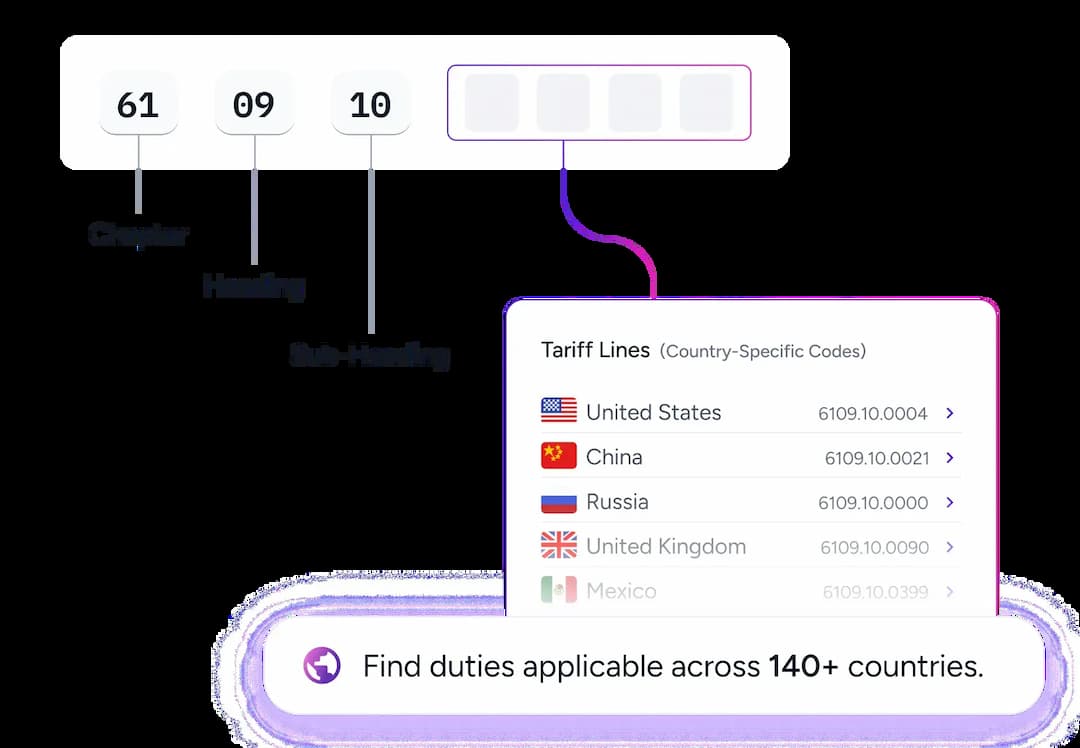
HS Code Lookup helps classify products under appropriate HS code and find duties applicable across 140+ countries. Find and discover HS classification, tariffs, taxes, controls, rulings, ECCNs, and default and preferential duties for HS code 2916.

WCO Notes for Heading 2916
29.16 - Unsaturated acyclic monocarboxylic acids, cyclic monocarboxylic acids, their anhydrides, halides, peroxides and peroxyacids; their halogenated, sulphonated, nitrated or nitrosated derivatives.
- Unsaturated acyclic monocarboxylic acids, their anhydrides, halides, peroxides, peroxyacids and their derivatives :
2916.11 - - Acrylic acid and its salts
2916.12 - - Esters of acrylic acid
2916.13 - - Methacrylic acid and its salts
2916.14 - - Esters of methacrylic acid
2916.15 - - Oleic, linoleic or linolenic acids, their salts and esters
2916.16 - - Binapacryl (ISO)
2916.19 - - Other
2916.20 - Cyclanic, cyclenic or cycloterpenic monocarboxylic acids, their anhydrides, halides, peroxides, peroxyacids and their derivatives
- Aromatic monocarboxylic acids, their anhydrides, halides, peroxides, peroxyacids and their derivatives :
2916.31 - - Benzoic acid, its salts and esters
2916.32 - - Benzoyl peroxide and benzoyl chloride
2916.34 - - Phenylacetic acid and its salts
2916.39 - - Other
This heading covers unsaturated acyclic monocarboxylic acids and cyclic monocarboxylic acids and their anhydrides, halides, peroxides, peroxyacids, esters and salts, as well as the halogenated, sulphonated, nitrated or nitrosated derivatives (including compound derivatives) of any of these products.
(A) UNSATURATED ACYCLIC MONOCARBOXYLIC ACIDS AND THEIR SALTS, ESTERS AND OTHER DERIVATIVES
(1) Acrylic acid (CH2=CHCOOH)*. Colourless liquid with acrid odour. Polymerises readily; monomer for polyacrylic acids and other acrylic polymers.
(2) Methacrylic acid. The polymers of esters of this acid constitute plastics (Chapter 39).
(3) Oleic acid (C18H34O2). Found in fats and oils as a glyceride. A colourless odourless liquid; crystallises in needles at a temperature of about 4 °C.
The water-soluble oleic salts (e.g., sodium, potassium, and ammonium oleates) are soaps but they remain classified in this heading.
(4) Linoleic acid (C18H32O2). Contained in linseed oil as a glyceride; a drying acid.
(5) Linolenic acid (C18H30O2).
(6) Heptynoic and octynoic acids.
(B) CYCLANIC, CYCLENIC OR CYCLOTERPENIC MONOCARBOXYLIC ACIDS AND THEIR SALTS, ESTERS AND OTHER DERIVATIVES
(1) Cyclohexanecarboxylic acid.
(2) Cyclopentenylacetic acid.
(C) AROMATIC SATURATED MONOCARBOXYLIC ACIDS AND THEIR SALTS, ESTERS AND OTHER DERIVATIVES
(1) Benzoic acid (C6H5COOH)*. Found in some resins and balsams. Prepared synthetically; crystallises in white needles or shiny white flakes, odourless if the acid is pure; an antiseptic and antiputrefaction agent.
Its main salts are ammonium, sodium, potassium and calcium benzoates.
Its main esters are benzyl, naphthyl, methyl, ethyl, geranyl, citronellyl, linalyl and rhodinyl benzoates.
The heading also includes, inter alia, the following derivatives of benzoic acid :
(a) Benzoyl peroxide*. White, granular, crystalline solid. Used in medicine, in the rubber and plastics industries, for bleaching oils, fats, flours, etc.
(b) Benzoyl chloride (C6H5COCl)*. White crystals. Colourless liquid with a characteristic odour, lachrymatory; gives off fumes when exposed to air.
(c) Nitrobenzoic acids (o-, m- and p-) (O2NC6H4COOH).
(d) Nitrobenzoyl chlorides (o-, m- and p-) (O2NC6H4COCl).
(e) Chlorobenzoic acids (ClC6H4COOH).
(f) Dichlorobenzoic acids (Cl2C6H3COOH).
(2) Phenylacetic acid (C6H5CH2COOH). Shiny, white crystal plates with a floral odour. Used in perfumes and flavourings, in the manufacture of penicillin G and fungicides, in organic synthesis and as a precursor in the production of amphetamines (see the list of precursors at the end of Chapter 29).
Its main esters are ethyl phenylacetate, methyl phenylacetate and o-methoxyphenyl phenylacetate (guaiacol phenylacetate).
(3) Phenylpropionic, naphthoic acids.
(D) AROMATIC UNSATURATED MONOCARBOXYLIC ACIDS AND THEIR SALTS, ESTERS AND OTHER DERIVATIVES
Cinnamic acid (C6H5CH=CHCOOH). Found in cinnamon oil and in balsams of Tolu and Peru. Colourless crystals.
Its main salts are sodium and potassium cinnamates.
Its main esters are methyl, ethyl, benzyl and propyl cinnamates, used in perfumery.
*
* *
This heading excludes oleic acid of a purity of less than 85 % (calculated on the weight of the dry product) and other fatty acids of a purity of less than 90 % (calculated on the weight of the dry product) (heading 38.23).

What is HS code 2916?

How many sub-headings are there in HS code 2916?
International Trade Compliance Simplified