














HS Code Lookup for Heading 2917
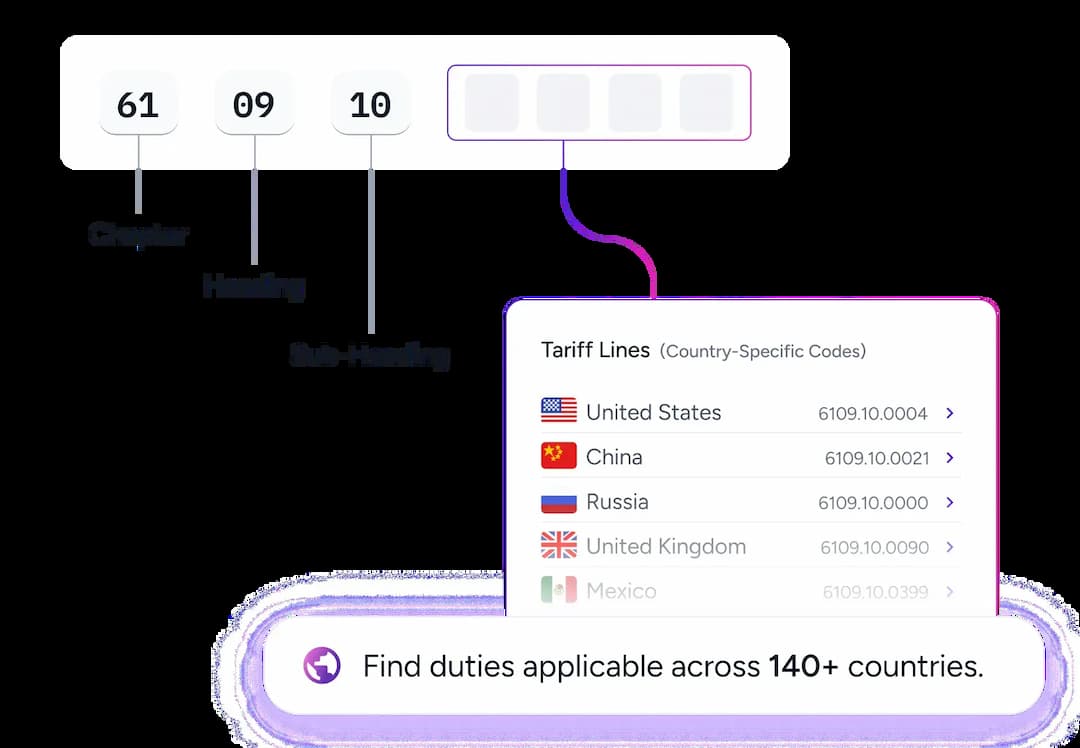
HS Code Lookup helps classify products under appropriate HS code and find duties applicable across 140+ countries. Find and discover HS classification, tariffs, taxes, controls, rulings, ECCNs, and default and preferential duties for HS code 2917.

WCO Notes for Heading 2917
29.17 - Polycarboxylic acids, their anhydrides, halides, peroxides and peroxyacids; their halogenated, sulphonated, nitrated or nitrosated derivatives.
- Acyclic polycarboxylic acids, their anhydrides, halides, peroxides, peroxyacids and their derivatives :
2917.11 - - Oxalic acid, its salts and esters
2917.12 - - Adipic acid, its salts and esters
2917.13 - - Azelaic acid, sebacic acid, their salts and esters
2917.14 - - Maleic anhydride
2917.19 - - Other
2917.20 - Cyclanic, cyclenic or cycloterpenic polycarboxylic acids, their anhydrides, halides, peroxides, peroxyacids and their derivatives
- Aromatic polycarboxylic acids, their anhydrides, halides, peroxides, peroxyacids and their derivatives :
2917.32 - - Dioctyl orthophthalates
2917.33 - - Dinonyl or didecyl orthophthalates
2917.34 - - Other esters of orthophthalic acid
2917.35 - - Phthalic anhydride
2917.36 - - Terephthalic acid and its salts
2917.37 - - Dimethyl terephthalate
2917.39 - - Other
This heading covers polycarboxylic acids and their anhydrides, halides, peroxides, peroxyacids, esters and salts, as well as the halogenated, sulphonated, nitrated or nitrosated derivatives (including compound derivatives) of any of these products.
(A) ACYCLIC POLYCARBOXYLIC ACIDS AND THEIR ESTERS, SALTS AND DERIVATIVES
(1) Oxalic acid (HOOCCOOH). Fine crystals, colourless, transparent and odourless; toxic. Used as a bleaching agent for textiles and for hides, as a mordant in the textile industry, and in organic synthesis.
Its main salts are ammonium, potassium, sodium, calcium, iron and ammonium-iron oxalates.
Its main esters are dimethyl and diethyl oxalates.
(2) Adipic acid (HOOC(CH2)4COOH). Crystallises in colourless needles; used, inter alia, for the manufacture of some plastics such as polyamides.
(3) Azelaic acid*. Yellowish to white crystalline powder; used, inter alia, for preparing plastics (alkyd resins, polyamides, polyurethanes) and in other organic syntheses.
(4) Sebacic acid. White leaflets; used, inter alia, as stabiliser in plastics (in alkyd resins, maleic and other polyesters, polyurethanes); in the manufacture of plastics.
(5) Maleic anhydride*. Colourless crystalline mass; used for preparing plastics (polyesters) and in other organic syntheses.
(6) Maleic acid (HOOCCH=CHCOOH). Large colourless crystals or in cast blocks; used, inter alia, for the preparation of certain plastics (e.g., polyesters).
(7) Malonic acid (HOOCCH2COOH). Crystallises in large colourless flakes.
The most important esters include diethyl malonate, which is used in organic syntheses (e.g., of medicaments such as the barbiturates).
(8) Succinic acid (HOOCC(CH2)2COOH). Colourless, odourless and transparent crystals. Used in organic synthesis.
(B) CYCLANIC, CYCLENIC OR CYCLOTERPENIC POLYCARBOXYLIC ACIDS AND THEIR ESTERS, SALTS AND OTHER DERIVATIVES
(C) AROMATIC POLYCARBOXYLIC ACIDS AND THEIR ESTERS, SALTS AND OTHER DERIVATIVES
(1) Phthalic anhydride (C6H4(CO)2O)*. Crystallises in translucent white needles, crystalline masses or white flakes; very light and voluminous, with a characteristic odour. Used in organic synthesis (of plastics (alkyd resins) and of plasticisers, etc.).
(2) Benzenedicarboxylic acids (o-, m-, p-) (C6H4(COOH)2). Ortho-benzenedicarboxylic acid is commonly called phthalic acid (ortho-phthalic acid). Meta-benzenedicarboxylic acid is commonly called isophthalic acid, and para-benzenedicarboxylic acid is commonly called terephthalic acid. Crystals. They are used for preparing synthetic colouring matter, plastics (alkyd resins) and plasticisers.
 The esters include dimethyl, diethyl, dibutyl (di-n-butyl, diisobutyl, etc.), dioctyl (di‑n‑octyl, diisooctyl, bis(2-ethylhexyl), etc.), dinonyl (di-n-nonyl, diisononyl, etc.), didecyl (di-n-decyl, etc.) or dicyclohexyl orthophthalates and other esters of orthophthalic acid, e.g., phthalates of ethylene glycol esters, as well as the dimethyl and other esters of terephthalic acid*.
(3) Dichlorophthalic and tetrachlorophthalic acids and their anhydrides.

What is HS code 2917?

How many sub-headings are there in HS code 2917?
International Trade Compliance Simplified