














HS Code Lookup for Heading 2918
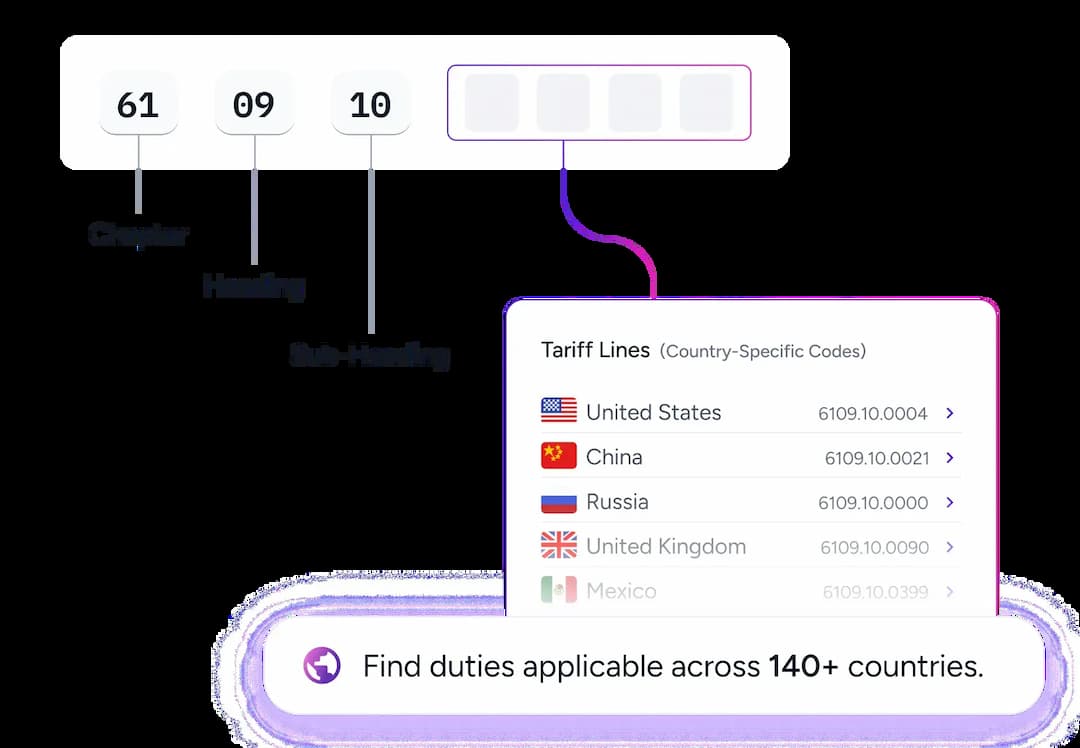
HS Code Lookup helps classify products under appropriate HS code and find duties applicable across 140+ countries. Find and discover HS classification, tariffs, taxes, controls, rulings, ECCNs, and default and preferential duties for HS code 2918.

WCO Notes for Heading 2918
29.18 - Carboxylic acids with additional oxygen function and their anhydrides, halides, peroxides and peroxyacids; their halogenated, sulphonated, nitrated or nitrosated derivatives.
- Carboxylic acids with alcohol function but without other oxygen function, their anhydrides, halides, peroxides, peroxyacids and their derivatives :
2918.11 - - Lactic acid, its salts and esters
2918.12 - - Tartaric acid
2918.13 - - Salts and esters of tartaric acid
2918.14 - - Citric acid
2918.15 - - Salts and esters of citric acid
2918.16 - - Gluconic acid, its salts and esters
2918.17 - - 2,2-Diphenyl-2-hydroxyacetic acid (benzilic acid)
2918.18 - - Chlorobenzilate (ISO)
2918.19 - - Other
- Carboxylic acids with phenol function but without other oxygen function, their anhydrides, halides, peroxides, peroxyacids and their derivatives :
2918.21 - - Salicylic acid and its salts
2918.22 - - O-Acetylsalicylic acid, its salts and esters
2918.23 - - Other esters of salicylic acid and their salts
2918.29 - - Other
2918.30 - Carboxylic acids with aldehyde or ketone function but without other oxygen function, their anhydrides, halides, peroxides, peroxyacids and their derivatives
- Other :
2918.91 - - 2,4,5-T (ISO) (2,4,5‑trichlorophenoxyacetic acid), its salts and esters
2918.99 - - Other
This heading covers carboxylic acids with additional oxygen function and their anhydrides, halides, peroxides, peroxyacids, esters and salts, as well as the halogenated, sulphonated, nitrated or nitrosated derivatives (including compound derivatives) of any of these products.
The term “additional oxygen function” means carboxylic acids which contain also one or more of the oxygen functions referred to in previous sub-Chapters (alcohol, ether, phenol, aldehyde, ketone, etc., functions).
(A) CARBOXYLIC ACIDS WITH ALCOHOL FUNCTION AND THEIR ESTERS, SALTS AND OTHER DERIVATIVES
These contain both the alcohol function (–CH2OH,  CHOH or
  COH) and the acid function (–COOH). These two functions may each react according to their own nature, hence as alcohols, these compounds may give ethers, esters and other derivatives, and as acids, they may form salts, esters, etc. The main alcohol acids include :
(1) Lactic acid (CH3CH(OH)COOH). Prepared by fermenting glucose or previously inverted cane-sugar with lactic ferment. Very hygroscopic crystalline masses, or a dense, syrupy liquid, colourless or faintly yellow. Used in medicine, for dyeing and for deliming hides. This heading includes lactic acid whether industrial, commercial or pharmaceutical. The industrial acid ranges from yellow to brown in colour and has a disagreeable, very acid odour. The commercial or pharmaceutical acids usually contain 75 % or more of lactic acid.
The main salts are calcium (used in medicine), strontium, magnesium, zinc, antimony, iron and bismuth lactates.
Its esters include ethyl and butyl lactates, used as solvents for varnishes.
Mercury lactate is excluded (heading 28.52).
(2) Tartaric acid (HOOCCH(OH)CH(OH)COOH). Transparent colourless crystals. Used in dyeing, photography, manufacture of baking powder, in oenology and medicine.
Its salts include :
(a) Sodium tartrate.
(b) Potassium tartrate.
(c) Refined potassium hydrogen tartrate (cream of tartar).
Crude tartar (Argol) is excluded (heading 23.07).
(d) Calcium tartrate, small crystals.
Crude calcium citrate is excluded (heading 38.24).
(e) Antimony potassium tartrate (emetic), sodium potassium tartrate (sel de Seignette) and iron potassium tartrate.
Its esters include :
(i) Ethyl tartrates.
(ii) Butyl tartrates.
(iii) Pentyl tartrates.
(3) Citric acid*. Found in the free state of citrus fruit juices; also obtained from the fermentation of glucose or sucrose by some citromyces. Crystallises in large, colourless, transparent prisms or in crystalline, white, odourless powder. Used for preparing beverages, in the textile industry, in oenology, in medicine, in making citrates, etc.
Its salts include :
(a) Lithium citrate.
(b) Calcium citrate.
Crude calcium citrate is excluded (heading 38.24).
(c) Aluminium citrate, used as a mordant in dyeing.
(d) Iron citrate, used in photography.
Its main esters are :
(i) Triethyl citrate.
(ii) Tributyl citrate.
(4) Gluconic acid and its salts. Gluconic acid is normally presented as an aqueous solution. Its calcium salt is used e.g., in medicine, for cleaning and as a concrete additive.
(5) Glucoheptonic acid and its salts, e.g., calcium glucoheptonate.
(6) Phenylglycolic acid (mandelic acid)*.
(7) Malic acid (HOOCCH(OH)CH2COOH). Deliquescent, colourless, crystalline masses; used in organic synthesis, in medicine, etc.
(8) 2,2-Diphenyl-2-hydroxyacetic acid (benzilic acid)*. White crystalline aromatic acid soluble in many primary alcohols; used in organic synthesis, in medicine and precursor in the production of chemical warfare agents.
(B) CARBOXYLIC ACIDS WITH PHENOL FUNCTION AND THEIR ESTERS, SALTS AND OTHER DERIVATIVES
Phenol-acids, cyclic (aromatic) acids which contain both the acid group (–COOH) and one or more groups (–OH) in the nucleus. The simplest phenol-acid has the formula (HOC6H4COOH).
(I) Salicylic acid (orthohydroxybenzoic acid) (HOC6H4COOH)*. Crystallises in white, voluminous flakes, or in white, light, odourless powder. Extensively used in medicine and also for preparing azo-dyes, etc.
Its most important salts are :
(a) Sodium salicylate. Crystalline powder or white, odourless flakes. Used in medicine.
(b) Bismuth salicylate, an odourless, white powder, used in medicine.
Its most important esters are :
(a) Methyl salicylate. Constituent of oil of wintergreen. An oily, colourless liquid with a strong persistent aromatic odour; used in medicine.
(b) Phenyl salicylate (salol). Crystallises as colourless flakes with a faint, agreeable, aromatic odour. Used in medicine and as an antiseptic.
(c) Ethyl, naphthyl, butyl, amyl, benzyl, bornyl, citronellyl, geranyl, menthyl, rhodinyl salicylates.
(II) o-Acetylsalicylic acid (CH3C(O)OC6H4COOH). Crystalline white powder; odourless; used in medicine.
(III) Sulphosalicylic acid (salicylsulphonic acid).
(IV) p-Hydroxybenzoic acid, crystalline.
Its main esters include :
(1) Methyl p-hydroxybenzoate.
(2) Ethyl p-hydroxybenzoate.
(3) Propyl p-hydroxybenzoate.
These esters are used as preservatives.
(V) Cresotic acids.
(VI) Acetyl-o-cresotic acids.
(VII) Gallic acid ((HO)3C6H2COOH). Obtained from gall nuts. Fine, silky, shining colourless or faintly yellow, odourless crystals. Used for the preparation of dyes and inks, in photography, in tanning as a mordant, etc.
Its main salts and esters include :
(1) Basic bismuth gallate. An amorphous powder, lemon-yellow, odourless, astringent and absorbent; used in medicine.
(2) Methyl gallate, crystals. Used as a disinfectant and astringent, and also in ophthalmology.
(3) Propyl gallate.
(VIII) Hydroxynaphthoic acids.
(IX) Hydroxyanthracenecarboxylic acids.
(C) CARBOXYLIC ACIDS WITH ALDEHYDE OR KETONE FUNCTION AND THEIR ESTERS, SALTS AND OTHER DERIVATIVES
(1) Aldehyde-acids contain both the aldehyde (–CHO) groupand the acid group (–COOH).
(2) Ketone-acids contain both the ketone group ( C=O) and the acid group (–COOH).
The most important ester of these acids is ethyl aceto-acetate and its sodium derivative.
(D) OTHER CARBOXYLIC ACIDS WITH ADDITIONAL OXYGEN FUNCTION AND THEIR ESTERS, SALTS AND OTHER DERIVATIVES
Anisic acid (CH3OC6H4COOH). Obtained by oxidation of anisaldehyde, of anethole and aniseed oil. Colourless crystals with a slight odour of anethole; used as an antiseptic, in medicine and in the manufacture of dyes.
______________________

What is HS code 2918?

How many sub-headings are there in HS code 2918?
International Trade Compliance Simplified