














HS Code Lookup for Heading 2930
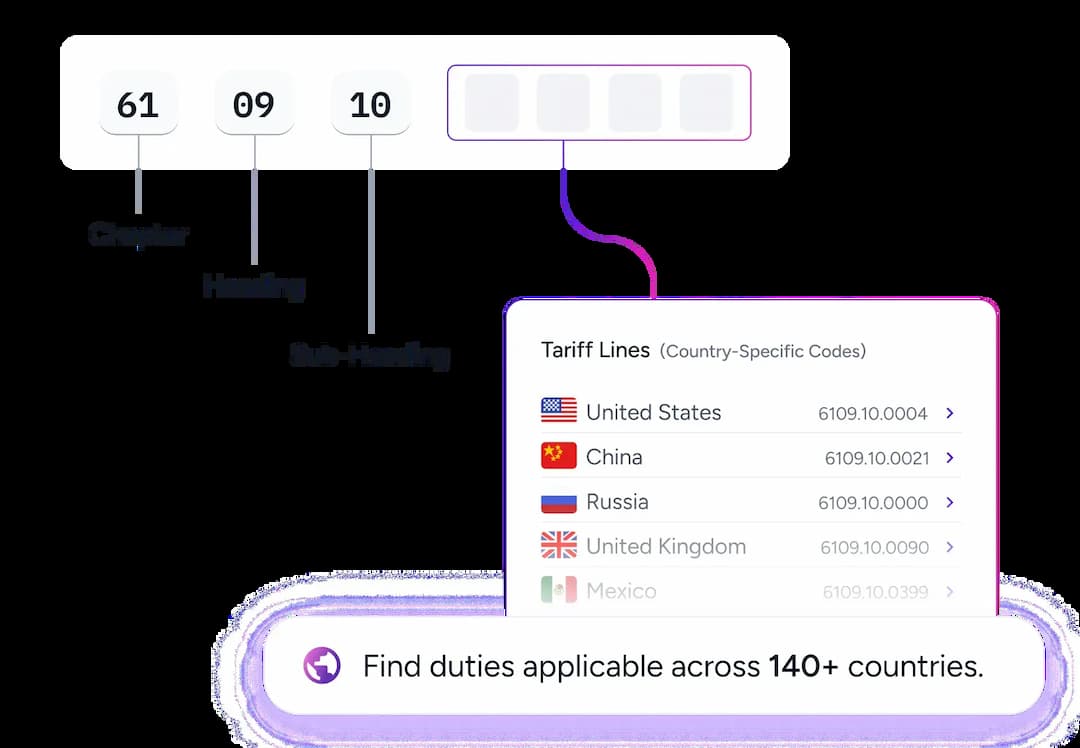
HS Code Lookup helps classify products under appropriate HS code and find duties applicable across 140+ countries. Find and discover HS classification, tariffs, taxes, controls, rulings, ECCNs, and default and preferential duties for HS code 2930.

WCO Notes for Heading 2930
Sub-Chapter X
ORGANO-INORGANIC COMPOUNDS, HETEROCYCLIC COMPOUNDS, NUCLEIC ACIDS AND THEIR SALTS, AND SULPHONAMIDES
GENERAL
The organo-inorganic compounds covered by headings 29.30 and 29.31 are organic compounds whose molecules contain, in addition to atoms of hydrogen, oxygen or nitrogen, those of metals or other non-metals (such as sulphur, arsenic, lead, iron, etc.) directly linked to carbon.
Heading 29.30 (organo-sulphur compounds) and heading 29.31 (other organo-inorganic compounds) do not include sulphonated or halogenated derivatives (including compound derivatives) which, apart from hydrogen, oxygen and nitrogen, only have directly linked to carbon the atoms of sulphur or of halogens which give them their nature of sulphonated or halogenated derivatives (or compound derivatives).
Headings 29.32 to 29.34 cover heterocyclic compounds.
The term "heterocyclic" refers to organic compounds composed of one or more rings, and which contain in the ring(s), in addition to the carbon atoms, atoms of other elements such as oxygen, nitrogen or sulphur. In this way, the following heterocyclic groups are derived :
(A) FIVE-MEMBERED RINGS
(1) Containing one hetero-atom :
(a) Of oxygen : Furan group (heading 29.32)*.
(b) Of sulphur : Thiophen group (heading 29.34)*.
(c) Of nitrogen : Pyrrole group (heading 29.33)*.
(2) Containing two hetero-atoms :
(a) One oxygen, one nitrogen : Oxazole and isoxazole groups (heading 29.34)*.
(b) One sulphur, one nitrogen : Thiazole group (heading 29.34)*.
(c) Two nitrogen : Imidazole and pyrazole groups (heading 29.33)*.
(3) Containing three or more hetero-atoms :
(a) One oxygen, two nitrogen : Furazan group (heading 29.34)*.
(b) Three nitrogen : Triazole group (heading 29.33)*.
(c) Four nitrogen : Tetrazole group (heading 29.33)*.
(B) SIX-MEMBERED RINGS
(1) Containing one hetero-atom :
(a) Of oxygen : Pyran group (heading 29.32)*.
(b) Of sulphur : Thiin (Thiapyran) group (heading 29.34)*.
(c) Of nitrogen : Pyridine group (heading 29.33)*.
(2) Containing two hetero-atoms :
(a) One oxygen, one nitrogen : Oxazine group (heading 29.34)*.
(b) One sulphur, one nitrogen : Thiazine group (heading 29.34)*.
(c) Two nitrogen : Pyridazine, pyrimidine, pyrazine and piperazine groups (heading 29.33)*.
(C) OTHER MORE COMPLEX HETEROCYCLIC COMPOUNDS
These result from the condensation of five- or six-membered heterocyclic compounds with other carbocyclic rings.
Examples include the following groups :
(a) Coumarone (heading 29.32)*.
(b) Benzopyran (heading 29.32)*.
(c) Xanthene (heading 29.32)*.
(d) Indole (heading 29.33)*.
(e) Quinoline and isoquinoline (heading 29.33)*.
(f) Acridine (heading 29.33)*.
(g) Benzothiophene (Thionaphthene) (heading 29.34)*.
(h) Indazole (heading 29.33)*.
(ij) Benzimidazole (heading 29.33)*.
(k) Phenazine (heading 29.33)*.
(l) Phenoxazine (heading 29.34)*.
(m) Benzoxazole (heading 29.34)*.
(n) Carbazole (heading 29.33)*.
(o) Quinazoline (heading 29.33)*.
(p) Benzothiazole (heading 29.34)*.
For the purposes of headings 29.32 to 29.34, with respect to compounds containing more than one heterocyclic ring, if only one of the heterocyclic rings is specifically named in a subheading within headings 29.32 to 29.34, the compound should be classified in that subheading. However, if two or more of the heterocyclic rings are specifically named at the subheading level, the compound should be classified in the specific subheading that occurs last in numerical order.
*
* *
29.30 - Organo-sulphur compounds.
2930.10 - 2-(N,N-Dimethylamino) ethanethiol
2930.20 - Thiocarbamates and dithiocarbamates
2930.30 - Thiuram mono-, di- or tetrasulphides
2930.40 - Methionine
2930.60 - 2-(N,N-Diethylamino)ethanethiol
2930.70 - Bis(2-hydroxyethyl)sulfide (thiodiglycol (INN))
2930.80 - Aldicarb (ISO), captafol (ISO) and methamidophos (ISO)
2930.90 - Other
This heading includes organo-sulphur compounds whose molecules have sulphur atom(s) directly linked to carbon atom(s) (see Note 6 to this Chapter). It includes compounds whose molecules contain, in addition to sulphur atom(s), other non-metal or metal atom(s) directly linked to carbon atom(s).
(A) DITHIOCARBONATES (XANTHATES)*
These are diesters or salts of monoesters of dithiocarbonic acid and correspond to the general formula (ROC(S)SR1) in which R is an organic radical and R1 is a metal (sodium, potassium, etc.) or an organic radical.
(1) Sodium ethyldithiocarbonate (ethylxanthate)*. Amorphous; used to prepare synthetic indigo, and in the flotation of ores.
(2) Potassium ethyldithiocarbonate (ethylxanthate). Oily, yellowish crystals; used as a flotation agent for lead and zinc ores, and as an antiparasitic and anticryptogamic agent.
(3) Methyl-, butyl-, pentyl- and benzyldithiocarbonates (xanthates).
(B) THIOCARBAMATES, DITHIOCARBAMATES AND THIURAM SULPHIDES
(1) Thiocarbamates include the salts and esters of thiocarbamic acid (H2NCOSH or H2NCSOH) (which does not exist in the free state), whether or not hydrogen atoms of the NH2 group are substituted with alkyl or aryl groups.
(2) Dithiocarbamates* include the salts and esters of dithiocarbamic acid, whether or not hydrogen atoms of the NH2 group are substituted with alkyl or aryl groups. The metal salts of substituted dithiocarbamic acids (e.g., zinc dibutyldithiocarbamate) are used as vulcanisation accelerators in the rubber industry.
(3) Thiuram mono-, di- or tetrasulphides. The alkyl substituted derivatives (e.g., tetraethylthiuram disulphide) are used as vulcanisation accelerators.
(C) SULPHIDES (OR THIOETHERS)*
These may be regarded as ethers in which the oxygen atom is replaced by one of sulphur
(ROR1) ....................................................................................... (RSR1)
ether sulphide
(1) Methionine*. White platelets or powder. An amino acid. Essential component in human nutrition, not synthesised by the body.
(2) Dimethyl sulphide, diphenyl sulphide. Colourless liquids with a very disagreeable odour.
(3) Bis(2-hydroxyethyl)sulfide or thiodiglycol (INN); a liquid used as a solvent for dyes in textile printing.
(4) Thioaniline or 4,4’-diaminodiphenyl sulphide.
(D) THIOAMIDES*
(1) Thiourea (H2NCSNH2) is the diamide of thiocarbonic acid and is thus the sulphur analogue of urea. Lustrous, white crystals. Used in photography, as an auxiliary in dyeing, and for preparing intermediate compounds in the dyestuff and pharmaceutical industries.
(2) Thiocarbanilide (diphenylthiourea)*. Colourless, crystalline tablets or amorphous white powder. Used for preparing intermediate compounds in the dyestuffs industry (sulphur dyes, indigo) and synthetic pharmaceutical products; also as an accelerator in the vulcanisation of rubber, and for the flotation of ores.
(3) Di-o-tolylthiourea. White powder, insoluble in water; used as an accelerator in the vulcanisation of rubber.
(E) THIOLS (MERCAPTANS)
These sulphur compounds correspond to alcohols or phenols in which the oxygen atoms have been replaced by sulphur atoms.
(ROH) ........................................................................................ (RSH)
alcohol or phenol mercaptan
(1) Thioalcohols, like alcohols, may be primary, secondary or tertiary, containing the groups (–CH2SH), ( CHSH) or (
 CSH), respectively.
They are generally colourless or yellowish liquids with a disagreeable odour.
(a) Methanethiol (methyl mercaptan).
(b) Ethanethiol (ethyl mercaptan).
(c) Butanethiol (butyl mercaptan).
(d) Pentanethiol (pentyl mercaptan).
(2) Thiophenols.
(a) Thiophenol (C6H5SH)
(b) o-Mercaptobenzoic acid, sometimes described as thiosalicylic acid.
(F) THIOALDEHYDES
General formula (RCSH).
(G) THIOKETONES
General formula (RCSR1).
(H) THIOACIDS
General formula (RCOSH or RCSOH and also RCSSH).
An example is dithiosalicylic acid (HOC6H4CSSH), but this name is often applied to the compound di(o-carboxyphenyl) disulphide.
(IJ) SULPHINIC ACIDS, SULPHOXIDES AND SULPHONES
These have the general formulae (RSO2H), (RSOR1) and (RSO2R1), respectively.
An example is sulphonal, colourless crystals, used in medicine.
(K) ISOTHIOCYANATES
General formula (RN=CS).
They may be regarded as the “esters” of isothiocyanic acid. They include ethyl isothiocyanate; phenyl isothiocyanate; allyl isothiocyanate (or artificial mustard oil).

What is HS code 2930?

How many sub-headings are there in HS code 2930?
International Trade Compliance Simplified