














HS Code Lookup for Heading 2931
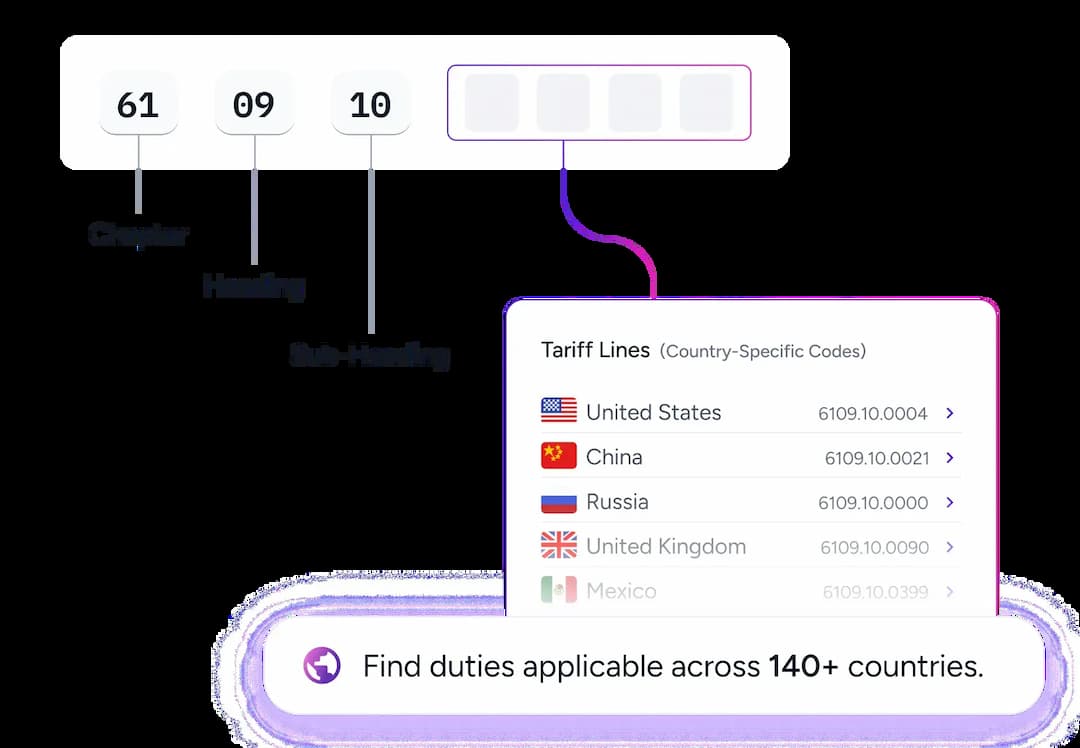
HS Code Lookup helps classify products under appropriate HS code and find duties applicable across 140+ countries. Find and discover HS classification, tariffs, taxes, controls, rulings, ECCNs, and default and preferential duties for HS code 2931.

WCO Notes for Heading 2931
29.31 - Other organo-inorganic compounds.
2931.10 - Tetramethyl lead and tetraethyl lead
2931.20 - Tributyltin compounds
- Non-halogenated organo-phosphorous derivatives :
2931.41 ‑ ‑ Dimethyl methylphosphonate
2931.42 ‑ ‑ Dimethyl propylphosphonate
2931.43 ‑ ‑ Diethyl ethylphosphonate
2931.44 ‑ ‑ Methylphosphonic acid
2931.45 ‑ ‑ Salt of methylphosphonic acid and (aminoiminomethyl)urea (1 : 1)
2931.46 ‑ ‑ 2,4,6-Tripropyl-1,3,5,2,4,6-trioxatriphosphinane 2,4,6-trioxide
2931.47 ‑ ‑ (5-Ethyl-2-methyl-2-oxido-1,3,2-dioxaphosphinan-5-yl) methyl methyl methylphosphonate
2931.48 ‑ ‑ 3,9-Dimethyl-2,4,8,10-tetraoxa-3,9-diphosphaspiro[5.5] undecane 3,9-dioxide
2931.49 ‑ ‑ Other
- Halogenated organo-phosphorous derivatives :
2931.51 ‑ ‑ Methylphosphonic dichloride
2931.52 ‑ ‑ Propylphosphonic dichloride
2931.53 ‑ ‑ O-(3-chloropropyl) O-[4-nitro-3-(trifluoromethyl)phenyl] methylphosphonothionate
2931.54 ‑ ‑ Trichlorfon (ISO)
2931.59 ‑ ‑ Other
2931.90 - Other
This heading includes :
(1) Tetramethyl lead (Pb(CH3)4)and tetraethyl lead (Pb(C2H5)4). Volatile liquids, colourless in the pure state, whereas the technical products are yellow; toxic; very efficient anti-knock agents.
(2) Tributyltin compounds.
(3) Organo-phosphorous compounds.
These are organic compounds containing at least one phosphorous atom directly linked to a carbon atom.
This group includes :
(I) Non-halogenated organo-phosphorous derivatives such as :
(a) Dimethyl methylphosphonate*, dimethyl propylphosphonate, diethyl ethylphosphonate and methylphosphonic acid.
(b) Salt of methylphosphonic acid and (aminoiminomethyl)urea (1 : 1).
(c) 2,4,6-Tripropyl-1,3,5,2,4,6-trioxatriphosphinane 2,4,6-trioxide.
(d) (5-Ethyl-2-methyl-2-oxido-1,3,2-dioxaphosphinan-5-yl) methyl methyl methylphosphonate.
(e) 3,9-Dimethyl-2,4,8,10-tetraoxa-3,9-diphosphaspiro[5.5] undecane 3,9-dioxide.
(f) Sodium 3-(trihydroxysilyl) propyl methylphosphonate.
(II) Halogenated organo-phosphorous derivatives such as :
(a) Methylphosphonic dichloride.
(b) Propylphosphonic dichloride.
(c) O-(3-chloropropyl) O-[4-nitro-3-(trifluoromethyl)phenyl] methylphosphonothionate.
(d) Trichlorfon (ISO).
(e) O-Isopropyl methylphosphonofluoridate (sarin).
(f) O-Pinacolyl methylphosphonofluoridate (soman).
Trade in chemicals mentioned as examples in (I) and (II) is controlled by the Convention on the Prohibition of the Development, Production, Stockpiling and Use of Chemical Weapons and on their Destruction (Chemical Weapons Convention), except trichlorfon (ISO), which is controlled under the Rotterdam Convention.
(4) Organo-silicon compounds. These are separate chemically defined compounds in which the silicon atom is directly linked to at least one carbon atom of an organic radical. These compounds include organic silanes and siloxanes; in some cases these products are polymerized to make silicones. Silanes include chlorosilanes (e.g., dimethyldichlorosilane), alkoxysilanes (e.g., methyltrimethoxysilane), alkyl or aryl silanes (e.g., diphenylsilanediol, tetramethylsilane) and other multifunctional (amino, nitrile, oxiranyl, oximo, acetoxy, etc.) silanes. Siloxanes include hexamethyldisiloxane*, octamethyltrisiloxane, octamethylcyclotetrasiloxane, decamethylcyclopentasiloxane and dodecamethylcyclohexasiloxane. The heading also includes hexamethyldisilazane and organo-disilanes.
This heading does not include inorganic silicon compounds, which are generally classifiable in Chapter 28 (e.g., silicon tetrachloride (SiCl4) in heading 28.12 or trichlorosilane (SiHCl3) in heading 28.53). Silicic acid esters and their salts are classified in heading 29.20. Deliberate mixtures of separate chemically defined organo-silicon compounds are classified elsewhere in the Nomenclature, generally in heading 38.24. This heading further excludes non-chemically defined products containing in the molecule more than one silicon-oxygen-silicon linkage, and containing organic groups connected to the silicon atoms by direct silicon-carbon bonds. These are silicones of heading 39.10.
(5) Iron carbonyl, nickel carbonyl, etc.
(6) Organo-arsenic compounds.
(a) Methylarsonic acid (CH3AsO(OH)2) and its salts. Crystallises in flakes, and forms crystalline salts such as sodium methylarsonate (colourless, used in medicine).
(b) Cacodylic acid and its salts. These contain the radical (–As(CH3)2) known as cacodyl. Used in medicine.
Cacodylic acid occurs as odourless, colourless crystals. Its main salt is sodium cacodylate, a crystalline white powder.
(c) p-Aminophenylarsonic acid (H2NC6H4AsO(OH)2) and its salts. Crystallises in shiny white needles. Its main salt is sodium p-aminophenylarsonate, an odourless, white, crystalline powder; used in medicine, particularly against sleeping-sickness.
(d) Amino-hydroxyphenylarsonic acids, their formyl and acetyl derivatives and their salts.
(e) Arsenobenzene (C6H5As=AsC6H5) and its derivatives, compounds analogous to azo compounds but containing the arseno group (–As=As–) instead of the azo group (–N=N–).
(7) o-Iodosobenzoic acid.
(8) Metal alkyls, metal fullerenes and metallocenes.
This heading excludes organo-sulphur compounds whose molecules have sulphur atom(s) directly linked to carbon atom(s) (see Note 6 to this Chapter). It excludes compounds whose molecules contain, in addition to sulphur atom(s) directly linked to carbon atom(s), other non-metal or metal atom(s) directly linked to carbon atom(s) (e.g., fonofos (ISO)) (heading 29.30).
This heading also excludes organo-mercury compounds which may contain one or more mercury atoms, in particular the (–HgX) group in which X is an inorganic or organic acid residue (heading 28.52).

What is HS code 2931?

How many sub-headings are there in HS code 2931?
International Trade Compliance Simplified