














HS Code Lookup for Heading 2932
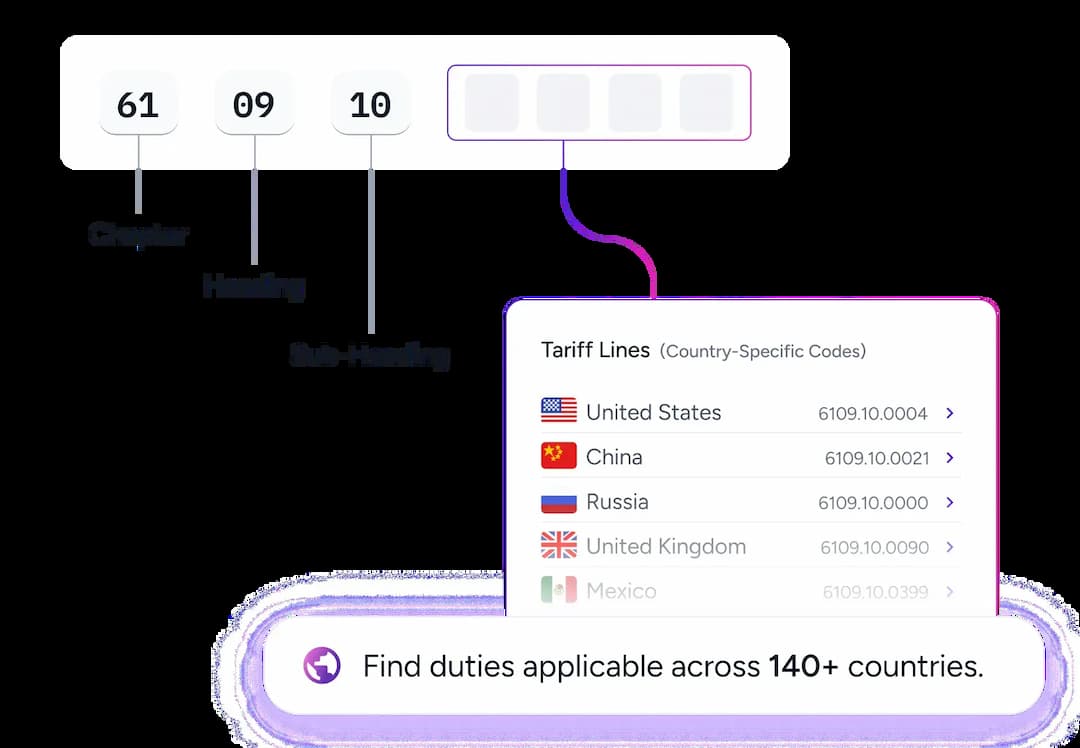
HS Code Lookup helps classify products under appropriate HS code and find duties applicable across 140+ countries. Find and discover HS classification, tariffs, taxes, controls, rulings, ECCNs, and default and preferential duties for HS code 2932.

WCO Notes for Heading 2932
29.32 - Heterocyclic compounds with oxygen hetero-atom(s) only (+).
- Compounds containing an unfused furan ring (whether or not hydrogenated) in the structure :
2932.11 - - Tetrahydrofuran
2932.12 - - 2-Furaldehyde (furfuraldehyde)
2932.13 - - Furfuryl alcohol and tetrahydrofurfuryl alcohol
2932.14 - - Sucralose
2932.19 - - Other
2932.20 - Lactones
- Other :
2932.91 - - Isosafrole
2932.92 - - 1-(1,3-Benzodioxol-5-yl)propan-2-one
2932.93 - - Piperonal
2932.94 - - Safrole
2932.95 - - Tetrahydrocannabinols (all isomers)
2932.96 - - Carbofuran (ISO)
2932.99 - - Other
The heterocyclic compounds covered by this heading are :
(A) Compounds containing an unfused furan ring (whether or not hydrogenated) in the structure.
This part includes, inter alia :
(1) Tetrahydrofuran. Colourless liquid.
(2) 2-Furaldehyde(furfural)*. Prepared by distilling cereal bran with sulphuric acid. Colourless liquid with a characteristic aromatic odour; it turns yellow and then brown when exposed to air. Used in the purification of mineral oils, for the preparation of synthetic resins, as a solvent for cellulose nitrate and varnishes, as an insecticide, etc.
(3) Furfuryl alcohol*. Colourless liquid which darkens when exposed to air. Reacts vigorously with concentrated mineral acids. Used as a solvent for cellulose nitrate, and for the preparation of varnishes and protective waterproof coatings.
(4) Tetrahydrofurfuryl alcohol. Colourless liquid.
(5) Sucralose* (1,6-Dichloro-1,6-dideoxy-β-D-fructofuranosyl-4-chloro-4-deoxy-α-D- galactopyranoside). Odorless, white to almost white crystalline powder. Artificial sweetener mainly used for medicine and food, especially for the treatment and diet of diabetic patients.
(6) Furan.
(B) Lactones*.
These compounds may be considered as internal esters of carboxylic acids with alcohol or phenol function, formed by elimination of water. The molecules may contain one or more ester functions in a ring. They are known as mono-, di-, trilactones, etc., according to the number of ester functions present. However, cyclic esters of polyhydric alcohols with polybasic acids are excluded (see Note 7 to this Chapter).
Lactones are fairly stable compounds, but are characterized by the ease with which the lactone ring can be opened using an alkali.
This part includes, inter alia :
(a) Coumarin (1,2-benzopyrone)*. This is the lactone of orthocoumaric acid. It crystallises in white flakes. It is used in perfumery, in medicine and for flavouring butter, castor oil, medicaments, etc. It also inhibits plant germination.
(b) Methylcoumarins. Same appearance as coumarin and also used in perfumery.
(c) Ethylcoumarins.
(d) Dicoumarol (dicoumarin). Crystals. Used in surgery as an anti-coagulant.
(e) 7-Hydroxycoumarin (umbelliferone). White crystals. Absorbs ultra-violet rays, hence its use in suntan lotions and creams.
(f) Dihydroxycoumarins (aesculetin and daphnetin). Crystals soluble in hot water.
Glucosides of dihydroxycoumarins (aesculin and daphnin) fall in heading 29.38.
(g) Nonalactone. Colourless or yellowish liquid; used in perfumery.
(h) Undecalactone. Similar appearance and same uses as nonalactone.
(ij) Butyrolactone (hydroxybutyric acid lactone). Colourless liquid with a pleasant odour; miscible with water. An intermediate product and solvent for synthetic resins. Used in preparations for removing paint stains, and in the petroleum industries.
(k) Propionolactone. Liquid, soluble in water. A disinfectant, sterilising agent and germicide.
(l) Glucuronolactone (glucuronic acid lactone). White powder, very soluble in water. Used in medicine and as a growth factor.
(m) D-Gluconolactone (gluconic acid d-lactone). Soluble crystals. Used in foodstuffs as an acidulant.
(n) Pantolactone. Soluble crystals. Used to rectify pantothenic acid.
(o) Santonin. This is the internal ester of santonic acid extracted from santonica, the dried unexpanded flower heads of Artemisia cina. Odourless, colourless crystals; a fairly energetic vermifuge (anthelmintic).
(p) Phenolphthalein*. Obtained by the condensation of phthalic anhydride with phenol. A white or yellowish-white, odourless crystalline powder, soluble in ethanol. Reacts with alkalis to give a cherry-red colour which disappears when the solution is acidified. Used as a chemical reagent and as a laxative.
This group includes iodophenolphthalein, a yellow powder, also used as a laxative.
This heading, however, excludes :
(i) Sodium derivatives of phthalein tetrahalides (heading 29.18).
(ii) Fluorescein (resorcinol-phthalein) (heading 32.04).
(q) Thymolphthalein. White crystals, used also as a reagent in analyses and in medicine.
(r) Isoascorbic acid. Granular crystals.
It should, however, be noted that this heading excludes ascorbic acid (heading 29.36).
(s) Dehydracetic acid. Colourless crystals, insoluble in water.
(t) Ambrettolide. Colourless liquid, musk-scented, used in perfumery.
(u) Diketene. Colourless, non-hygroscopic liquid.
(v) 3,6-Dimethyl-1,4-dioxane-2,5-dione.
(C) Other heterocyclic compounds with oxygen hetero-atom(s) only.
This part includes, inter alia :
(1) Benzofuran (coumarone). Found in light oils of the distillation of coal tar. A colourless liquid, used for the manufacture of artificial plastic materials (coumarone resins), etc.
(2) 1,3-Dioxolan.
(3) 1,4-Dioxan (diethylene dioxide), used as a solvent.
(4) 1,3-Dioxan.
(5) Safrole*. Obtained from sassafras oil. A colourless liquid which turns yellowish; used in perfumery and as a precursor for methylenedioxyamphetamine and methylenedioxymethamphetamine (see the list of precursors at the end of Chapter 29).
(6) Isosafrole. Obtained from safrole; used in perfumery and as a precursor for methylenedioxyamphetamine and methylenedioxymethamphetamine (see the list of precursors at the end of Chapter 29).
(7) Tetrahydrocannabinols.
(8) Piperonal (piperonylaldehyde or heliotropin) (CH2O2C6H3CHO)*. White crystals or flakes with an odour of heliotrope; used in perfumery and to flavour liqueurs and as a precursor for methylenedioxyamphetamine and methylenedioxymethamphetamine (see the list of precursors at the end of Chapter 29).
(9) Piperonylic acid.
(10) 1-(1,3-Benzodioxol-5-yl)propan-2-one (3,4-methylenedioxyphenylacetone)*. White to yellowish crystals. Used as a precursor in the production of methylenedioxyamphetamine and methylenedioxymethamphetamine (see the list of precursors at the end of Chapter 29).
(11) Carbofuran (ISO). It is one of the most toxic carbamate pesticides. Trade is controlled under the Rotterdam Convention.
Hydromercuridibromofluorescein is to be classified in heading 28.52.
*
* *
Certain substances of this heading, which are regarded as narcotic drugs or as psychotropic substances under international instruments, are indicated in the list appearing at the end of Chapter 29.
This heading excludes :
(a) Ketone peroxides (heading 29.09)*.
(b) Epoxides with a three-membered ring (heading 29.10).
(c) Cyclic polymers of aldehydes (heading 29.12) or of thioaldehydes (heading 29.30).
(d) Anhydrides of polybasic carboxylic acids and cyclic esters of polyhydric alcohols or phenols with polybasic acids (heading 29.17).
°
° °
Subheading Explanatory Note.
Subheading 2932.20
Lactones containing an additional hetero-atom, other than the oxygen atom of a lactone group (e.g., dilactone), in the same ring should not be classified in the subheadings for lactones. In such cases, the additional hetero-atom should be taken into account in determining the classification. Thus, for example, anhydromethylenecitric acid should be classified in subheading 2932.99 and not in subheading 2932.20.
If the ester function forms part of two or more rings and if one of these rings does not contain an additional hetero-atom (other than the oxygen atom of a lactone group), then the molecule should be considered as a lactone.
To be classified in subheading 2932.20, lactones must have the different lactone groups separated by at least one carbon atom at each end. However, this subheading does not include those products in which the carbon atoms separating and adjacent to the lactone groups form an oxo group (>C=O), an imino group (>C=NH) or a thioxo group (>C=S)*.

What is HS code 2932?

How many sub-headings are there in HS code 2932?
International Trade Compliance Simplified