














HS Code Lookup for Chapter 32
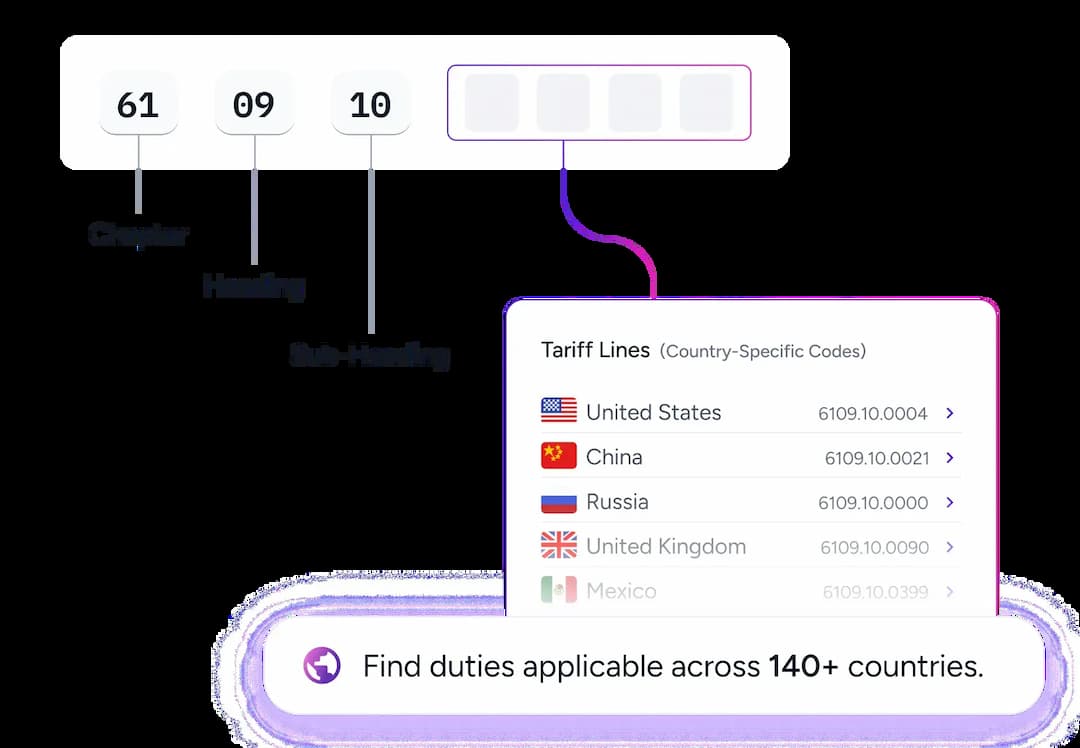
HS Code Lookup helps classify products under appropriate HS code and find duties applicable across 140+ countries. Find and discover HS classification, tariffs, taxes, controls, rulings, ECCNs, and default and preferential duties for HS code 32.

WCO Notes for Chapter 32
Chapter 32
Tanning or dyeing extracts; tannins and their derivatives;
dyes, pigments and other colouring matter;
paints and varnishes; putty and other mastics; inks
Notes.
1.- This Chapter does not cover :
(a) Separate chemically defined elements or compounds (except those of heading 32.03 or 32.04, inorganic products of a kind used as luminophores (heading 32.06), glass obtained from fused quartz or other fused silica in the forms provided for in heading 32.07, and also dyes and other colouring matter put up in forms or packings for retail sale, of heading 32.12);
(b) Tannates or other tannin derivatives of products of headings 29.36 to 29.39, 29.41 or 35.01 to 35.04; or
(c) Mastics of asphalt or other bituminous mastics (heading 27.15).
2.- Heading 32.04 includes mixtures of stabilised diazonium salts and couplers for the production of azo dyes.
3.- Headings 32.03, 32.04, 32.05 and 32.06 apply also to preparations based on colouring matter (including, in the case of heading 32.06, colouring pigments of heading 25.30 or Chapter 28, metal flakes and metal powders), of a kind used for colouring any material or used as ingredients in the manufacture of colouring preparations. The headings do not apply, however, to pigments dispersed in non-aqueous media, in liquid or paste form, of a kind used in the manufacture of paints, including enamels (heading 32.12), or to other preparations of heading 32.07, 32.08, 32.09, 32.10, 32.12, 32.13 or 32.15.
4.- Heading 32.08 includes solutions (other than collodions) consisting of any of the products specified in headings 39.01 to 39.13 in volatile organic solvents when the weight of the solvent exceeds 50 % of the weight of the solution.
5.- The expression “colouring matter” in this Chapter does not include products of a kind used as extenders in oil paints, whether or not they are also suitable for colouring distempers.
6.- The expression “stamping foils” in heading 32.12 applies only to thin sheets of a kind used for printing, for example, book covers or hat bands, and consisting of :
(a) Metallic powder (including powder of precious metal) or pigment, agglomerated with glue, gelatin or other binder; or
(b) Metal (including precious metal) or pigment, deposited on a supporting sheet of any material.
GENERAL
This Chapter covers preparations used in the tanning and bating of hides and skins (tanning extracts of vegetable origin, synthetic tanning substances, whether or not mixed with natural tanning materials, and artificial bates).
It also includes colouring matter of vegetable, animal or mineral origin and synthetic organic colouring matter and most of the preparations obtained from these colouring matters (paints, ceramic colours, inks, etc.). Various other preparations such as varnishes, driers and putty are also included.
Except as regards the goods covered by headings 32.03 or 32.04, inorganic products of a kind used as luminophores (heading 32.06), glass obtained from fused quartz or other fused silica in the forms provided for in heading 32.07 and also the dyes or other colouring matter put up in forms or packings for retail sale (heading 32.12), products consisting of chemically defined elements or compounds are excluded from this Chapter, and in general fall in Chapter 28 or 29.
In the case of certain paints and varnishes of headings 32.08 to 32.10 or mastics of heading 32.14, the intermixture of the various constituents, or the addition of certain constituents (e.g., hardeners) must be carried out at the time of use. Such products remain classified in these headings provided the constituents are :
(i) having regard to the method in which they are put up, clearly identifiable as being intended to be used together without first being repacked;
(ii) presented together; and
(iii) identifiable, whether by their nature or by the relative proportions in which they are present, as being complementary one to another.
However, in the case of products to which a hardener has to be added at the time of use, the absence of the hardener does not exclude these products from these headings, provided they are, by their composition or packing, clearly identifiable as intended to be used in the preparation of paints, varnishes or mastics.

What is HS code 32?

How many headings are there in HS code 32?
International Trade Compliance Simplified