














HS Code Lookup for Heading 3402
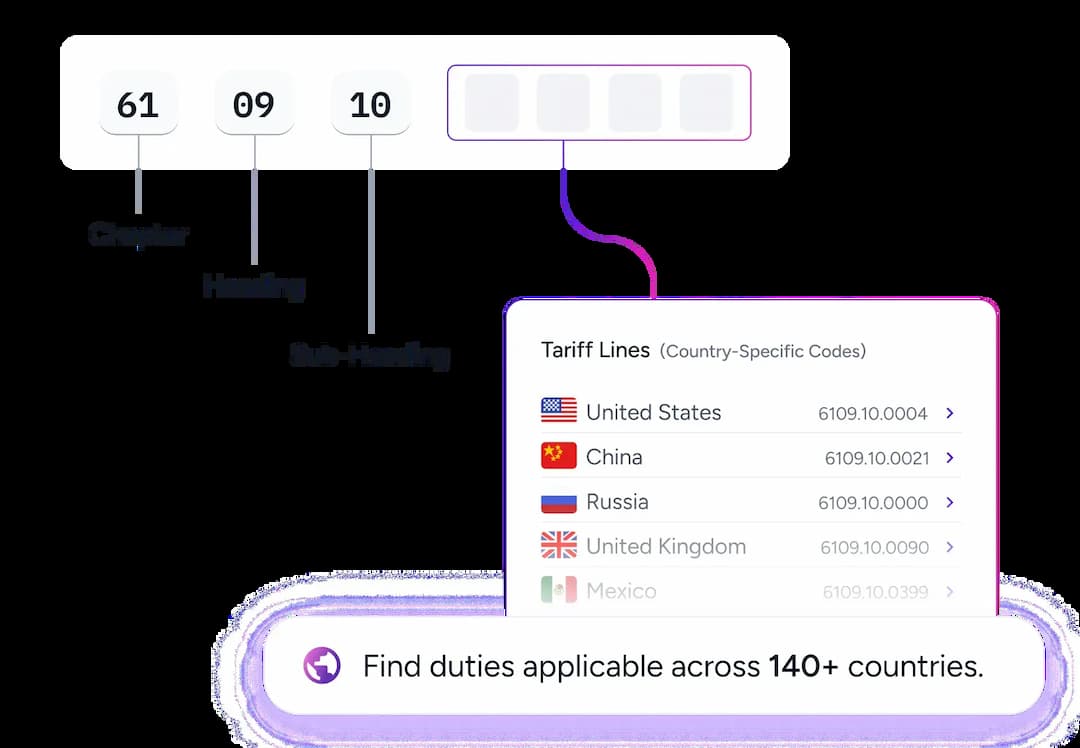
HS Code Lookup helps classify products under appropriate HS code and find duties applicable across 140+ countries. Find and discover HS classification, tariffs, taxes, controls, rulings, ECCNs, and default and preferential duties for HS code 3402.

WCO Notes for Heading 3402
34.02 - Organic surface-active agents (other than soap); surface-active preparations, washing preparations (including auxiliary washing preparations) and cleaning preparations, whether or not containing soap, other than those of heading 34.01.
- Anionic organic surface-active agents, whether or not put up for retail sale :
3402.31 - - Linear alkylbenzene sulphonic acids and their salts
3402.39 - - Other
- Other organic surface-active agents, whether or not put up for retail sale :
3402.41 - - Cationic
3402.42 - - Non-ionic
3402.49 - - Other
3402.50 - Preparations put up for retail sale
3402.90 - Other
(I) ORGANIC SURFACE-ACTIVE AGENTS (OTHER THAN SOAP)
The organic surface-active agents of this heading are chemical compounds, not chemically defined, which contain one or more hydrophilic or hydrophobic functional groups in such a proportion that, when mixed with water at a concentration of 0.5 % at 20 °C and left to stand for one hour at the same temperature, they give a transparent or translucent liquid or stable emulsion without separation of insoluble matter (see Note 3 (a) to this Chapter). For the purposes of this heading, an emulsion should not be considered as having a stable character if, after being left to stand for one hour at 20 °C, (1) solid particles are visible to the naked eye, (2) it has separated into visually distinguishable phases or (3) it has separated into a transparent part and a translucent part, visible to the naked eye.
Organic surface-active agents are capable of adsorption at an interface; in this state they display a number of physico-chemical properties, particularly surface activity (e.g., reduction of surface tension, foaming, emulsifying, wetting), which is why they are usually known as “surfactants”.
However, products which are not capable of reducing the surface tension of distilled water to 4.5 x 10⁻² N/m (45 dyne/cm) or less at a concentration of 0.5 % at 20 °C are not regarded as surface-active agents and are therefore excluded from this heading.
Organic surface-active agents may be :
(1) Anionic, in which case they ionise in aqueous solution to produce negatively charged organic ions responsible for the surface activity. Examples are : sulphates and sulphonates of fats, vegetable oils (triglycerides) or resin acids; sulphates and sulphonates derived from fatty alcohols; petroleum sulphonates, e.g., of alkali metals (including those containing a proportion of mineral oils), of ammonium or of ethanolamines; alkylpolyethersulphates; alkylsulphonates or alkylphenylethersulphonates; alkylsulphates, alkylarylsulphonates (e.g., technical dodecylbenzenesulphonates).
These surface-active agents may contain, as impurities resulting from the manufacturing process, small quantities of fatty alcohols, alkylates or other hydrophobic raw materials which have escaped sulphation or sulphonation. They may also contain sodium sulphate or other residual inorganic salts in a proportion generally not exceeding 15 %, when expressed as the anhydrous salts.
(2) Cationic, in which case they ionise in aqueous solution to produce positively charged organic ions responsible for the surface activity. Examples are : salts of fatty amines and of quaternary ammonium bases.
(3) Non-ionic, in which case they do not produce ions in an aqueous solution. Their solubility in water is due to the presence in the molecules of functional groups which have a strong affinity for water. Examples are : products of the condensation of fatty alcohols, fatty acids or alkylphenols with ethylene oxide; ethoxylates of fatty acid amides.
(4) Ampholytic, in which case, depending on the conditions of the medium, they can be ionised in an aqueous solution and give to the compound the characteristics of an anionic or a cationic surface-active agent.
This ionic behaviour is similar to that of amphoteric compounds in the broadest sense. These are, for example, alkylbetaine or sulphobetaine proteins, their decomposition products and substitution compounds of amino-carboxylic, amino-sulphonic, amino-sulphuric and amino-phosphoric acids.
(II) SURFACE-ACTIVE PREPARATIONS, WASHING PREPARATIONS (INCLUDING AUXILIARY WASHING PREPARATIONS) AND CLEANING PREPARATIONS, WHETHER OR NOT CONTAINING SOAP, OTHER THAN THOSE OF HEADING 34.01
This group comprises three categories of preparations :
(A) Surface-active preparations.
These include :
(1) Intermixtures of the surface-active agents of Part (I) above (e.g., sulphoricinoleates mixed with sulphonated alkylnaphthalenes or sulphated fatty alcohols).
(2) Solutions or dispersions of the surface-active agents of Part (I) above in an organic solvent (e.g., a solution of a sulphated fatty alcohol in cyclohexanol or in tetrahydronaphthalene).
(3) Other mixtures based on a surface-active agent of Part (I) above (e.g., surface-active preparations containing a proportion of soap, such as alkylbenzenesulphonate with sodium stearate).
(4) Solutions or dispersions of soap in an organic solvent such as cyclohexanol. (Solutions of soap in water, which may have a small quantity (generally not exceeding 5 %) of alcohol or glycerol added, are liquid soaps of heading 34.01).
Surface-active preparations are used for their cleansing, wetting, emulsifying or dispersing properties in many industrial applications, for example as :
(i) Detergents for the textile industry, to eliminate fats and soiling matter on textiles during manufacture and finishing.
(ii) Wetting agents, emulsifying agents, fulling assistants and brightening agents, for the textile industry.
(iii) Soaking agents (for raw hides), de-greasing agents, wetting agents (for use in dyeing), levelling agents or toners for the leather or fur industries.
(iv) Basic materials for the manufacture of washing preparations of Part (B) below (e.g., anionic surface-active preparations which may contain, either as a residue or as a result of deliberate additions, a considerable quantity of sodium sulphate or other inorganic salts of the type arising during the manufacture of the surface-active agent).
(v) Dispersing agents for the paper or synthetic rubber industries.
(vi) Flotation aids for the mining industry.
(vii) Emulsifying agents used in the preparation of pharmaceutical or cosmetic products.
This group does not include organic surface-active products and preparations for washing the skin, in which the active component consists wholly or partly of synthetic organic-surface active agents (which may contain soap in any proportion), in the form of liquid or cream and put up for retail sale (heading 34.01).
(B) Washing preparations (including auxiliary washing preparations) and cleaning preparations, having a basis of soap or other organic surface-active agents.
This category covers washing preparations, auxiliary washing preparations and certain cleaning preparations. These various preparations generally contain essential constituents and one or more subsidiary constituents. The presence of these latter constituents distinguishes, in particular, these preparations from those described in Part (A) above.
The essential constituents are synthetic organic surface-active agents or soaps or mixtures thereof.
The subsidiary constituents are :
(1) Builders (e.g., sodium polyphosphates, carbonates, silicate or borate, salts of nitrilotriacetic acid (NTA)).
(2) Boosters (e.g., alkanolamides, fatty acid amides, fatty amine oxides).
(3) Fillers (e.g., sodium sulphate or chloride).
(4) Ancillaries (e.g., chemical or optical bleaches, antiredeposition agents, corrosion inhibitors, antielectrostatic agents, colouring matter, perfumes, bactericides, enzymes).
These preparations act on surfaces by bringing the soil on the surface into a state of solution or dispersion.
Washing preparations based on surface-active agents are also known as detergents. This type of preparation is used for washing clothes and also dishes or kitchen utensils.
They may be liquids, powders or pastes and are used for household or industrial purposes. Toilet and washing products in the form of bars, cakes, moulded pieces or shapes fall in heading 34.01.
Auxiliary washing preparations are used for soaking (pre-washing), rinsing or bleaching clothes, household linen, etc.
Cleaning preparations serve for cleaning floors, windows or other surfaces. They may also contain small quantities of odoriferous substances.
(C) Cleaning or de-greasing preparations, not having a basis of soap or other organic surface-active agents.
These include :
(i) Acid or alkaline cleaners specially formulated for cleaning sanitary ware, frying-pans, etc., e.g., those containing sodium hydrogen sulphate or a mixture of sodium hypochlorite and trisodium orthophosphate.
(ii) Degreasing or cleaning preparations, used, e.g., in dairies or breweries, and with a basis of :
- alkaline substances such as sodium carbonate or caustic soda, or
- solvents and emulsifiers.
This group of products may contain small quantities of soap or other surface-active agents.
This heading does not cover :
(a) Shampoos or preparations for foam baths, whether or not containing soap or other surface-active agents (Chapter 33).
(b) Paper, wadding, felt and nonwovens, impregnated, coated or covered with detergent (heading 34.01).
(c) Preparations, containing surface-active agents where the surface-active function is either not required or is only subsidiary to the main function of the preparation (headings 34.03, 34.05, 38.08, 38.09, 38.24, etc., as the case may be).
(d) Abrasive preparations containing surface-active agents (scouring pastes and powders) (heading 34.05).
(e) Water-insoluble naphthenates, petroleum sulphonates and other water-insoluble surface-active products and preparations. They fall in heading 38.24, provided they are not included in a more specific heading.

What is HS code 3402?

How many sub-headings are there in HS code 3402?
International Trade Compliance Simplified