















HS Code Lookup for Heading 3805
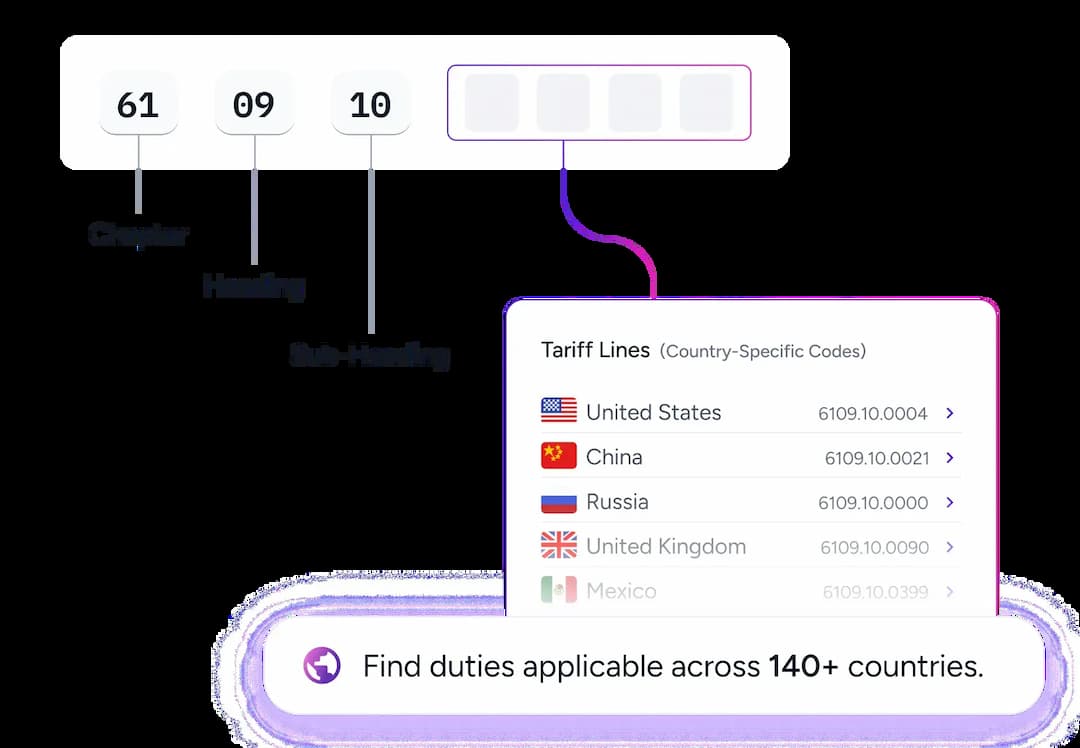
HS Code Lookup helps classify products under appropriate HS code and find duties applicable across 140+ countries. Find and discover HS classification, tariffs, taxes, controls, rulings, ECCNs, and default and preferential duties for HS code 3805.

WCO Notes for Heading 3805
38.05 ‑ Gum, wood or sulphate turpentine and other terpenic oils produced by the distillation or other treatment of coniferous woods; crude dipentene; sulphite turpentine and other crude para‑cymene; pine oil containing alpha‑terpineol as the main constituent.
3805.10 - Gum, wood or sulphate turpentine oils
3805.90 ‑ Other
This heading covers mainly products rich in terpenes (pinene, beta‑pinene, limonenes, etc.) obtained from the exudations or the resinous wood of conifers.
These products are :
(1) The volatile products of the distillation (usually by steam extraction) of the oleoresins (turpentines) exuded from pines or other coniferous trees (firs, larches, etc.). In some countries, these products are known as “gum spirits of turpentine”. In others, however, the term “spirits of turpentine” is reserved exclusively to volatile products within a certain range of boiling point and density, obtained by the distillation of the fresh oleoresins exuded from living pine trees.
They are all mobile, colourless liquids, insoluble in water, highly refractive and with a penetrating odour. They are used as solvents, particularly in the manufacture of varnishes, paints or polishes, in the preparation of medicaments, and in the manufacture of synthetic camphor, terpin hydrate, terpineol, etc.
(2) Wood turpentine, sulphate turpentine and other terpenic oils produced by the distillation or other treatment of coniferous woods.
(a) Wood turpentine is the most volatile product obtained by steam or destructive distillation of the stumps or other sufficiently resinous parts of pine trees.
(b) Sulphate turpentine is a volatile terpenic by‑product obtained during the manufacture of wood pulp from resinous woods by the sulphate process.
The products described in this paragraph are liquids rich in terpenes, and are used for the same purposes as spirits of turpentine from exuded oleoresins, particularly as solvents in the preparation of varnishes, paints, etc.
(3) Crude dipentene is a terpenic oil (containing up to about 80 % of dipentene) obtained by fractionating wood turpentine or as a by‑product from the manufacture of synthetic camphor. Pure or commercially pure dipentene is classified in heading 29.02.
(4) Sulphite turpentine is a volatile yellow liquid obtained as a by‑product of the manufacture of wood pulp by the sulphite process. It is a crude para‑cymene containing small quantities of terpenes and other products. The heading also covers all crude p‑cymene, regardless of source.
(5) Pine oil is the fraction obtained, after wood turpentine, generally during the steam or destructive distillation of the oily stumps of pine trees. It is also obtained by chemical synthesis (e.g., chemical hydration of α‑pinene). This heading covers only such pine oil containing α‑terpineol as the main constituent. Pine oil is a colourless or amber coloured liquid, rich in α‑terpineol, chiefly used in the textile industries as a wetting agent and solvent, for the manufacture of varnishes or paints, as a disinfectant, and in the concentration of metallic ores by flotation.
The heading does not cover :
(a) Pure or commercially pure terpenic hydrocarbons or terpenes, terpineol and terpin hydrate (Chapter 29).
(b) Pine needle oil, which is an essential oil of heading 33.01.
(c) Rosin oils (heading 38.06).

What is HS code 3805?

How many sub-headings are there in HS code 3805?
International Trade Compliance Simplified