















HS Code Lookup for Heading 3809
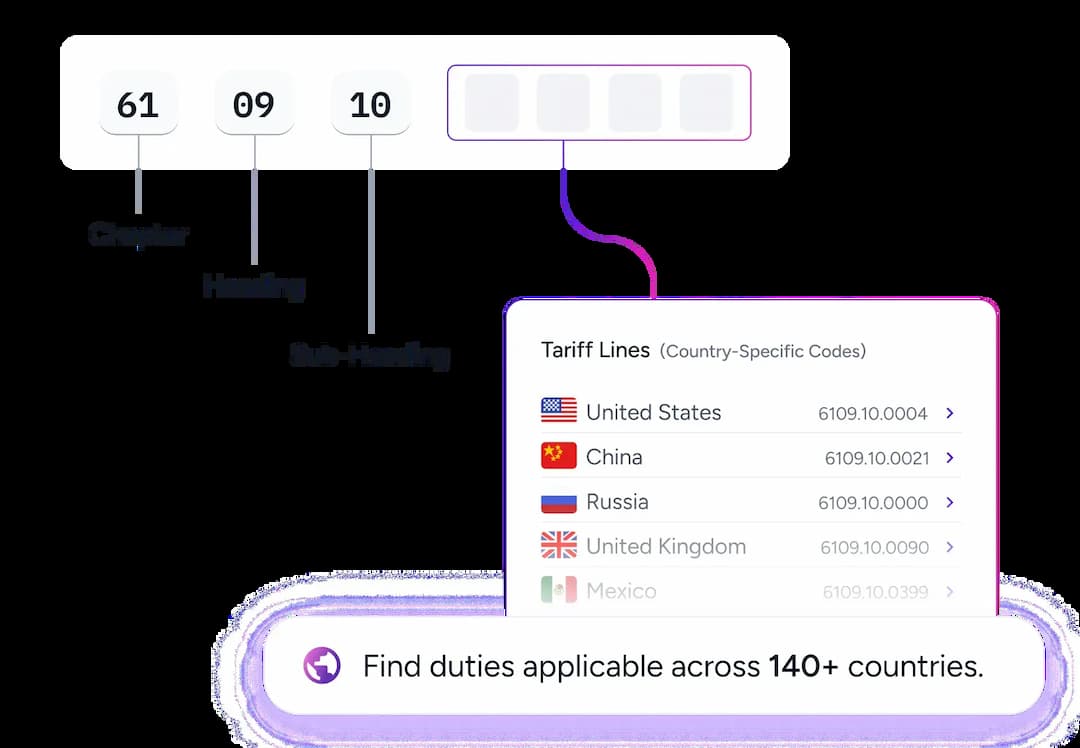
HS Code Lookup helps classify products under appropriate HS code and find duties applicable across 140+ countries. Find and discover HS classification, tariffs, taxes, controls, rulings, ECCNs, and default and preferential duties for HS code 3809.

WCO Notes for Heading 3809
38.09 ‑ Finishing agents, dye carriers to accelerate the dyeing or fixing of dyestuffs and other products and preparations (for example, dressings and mordants), of a kind used in the textile, paper, leather or like industries, not elsewhere specified or included.
3809.10 - With a basis of amylaceous substances
- Other :
3809.91 - - Of a kind used in the textile or like industries
3809.92 - - Of a kind used in the paper or like industries
3809.93 - - Of a kind used in the leather or like industries
This heading covers a wide range of products and preparations, of a kind generally used during processing or finishing of yarns, fabrics, paper, paperboard, leather or similar materials, not specified or included elsewhere in the Nomenclature.
They may be identified as falling in this heading because of their composition and presentation which give them a specific use in the industries cited in the heading and like industries, e.g., the textile floor carpeting industry, the vulcanised fibre manufacturing industry and the fur industry. Such products and preparations (e.g., textile softening agents) destined for domestic rather than industrial use are also covered by the heading.
Included here are :
(A) Products and preparations used in the textile or like industries :
(1) Preparations to modify the feel of products, for example : stiffening agents, generally based on natural starchy substances (such as starch of wheat, rice, maize (corn) or potato and dextrin), mucilaginous substances (lichens, alginates, etc.), gelatin, casein, vegetable gums (gum tragacanth, etc.) or rosin; weighting agents; softening agents, based on glycerol, imidazoline derivatives, etc.; fillers, based on natural or synthetic high molecular weight compounds.
In addition to the above‑mentioned basic constituents some of the preparations may also contain wetting agents (soaps, etc.), lubricants (linseed oil, waxes, etc.), filling agents (kaolin, barium sulphate, etc.) and preservatives (particularly zinc salts, copper sulphate and phenol).
(2) Agents to produce non‑slip and anti‑snag finishes. These products are intended to reduce the slipping of fabrics to prevent the formation of snags in hosiery and knitwear. They are generally based on polymers, natural resins or silicic acid.
(3) Agents to produce dirt‑repellent finishes. These are generally based on silicic acid, aluminium compounds or organic compounds.
(4) Anti‑crease and anti‑shrink preparations being mixtures of chemically defined compounds with at least two reactive groups (e.g., bis(hydroxymethyl) compounds, certain aldehydes and acetals).
(5) Delustring agents designed to reduce the lustre or gloss of textiles. They generally consist of suspensions of pigments (titanium oxide, zinc oxide, lithopone, etc.) stabilised by cellulose ethers, gelatin, glue, surface‑active agents, etc.
The preparations classified here should not be confused with paints (heading 32.08, 32.09 or 32.10), nor with lubricating preparations for oiling or greasing wool (heading 27.10 or 34.03).
(6) Flame‑retardant preparations based on ammonium salts, compounds of boron, nitrogen, bromine or phosphorus or on formulations based on chlorinated organic substances with antimony oxide or other oxides.
(7) Lustring agents intended to produce lustre or gloss on textiles. They are generally emulsions of paraffins, waxes, polyolefins or polyglycols.
(8) Mordants prepared for use in textile dyeing and printing processes to fix the dyestuffs. These preparations, which are soluble in water, are usually based on metallic salts (e.g., aluminium, ammonium, chromium or iron sulphates or acetates, potassium dichromate, antimony potassium tartrate) or tannin. (But see exclusion (d) at the end of this Explanatory Note.)
(9) Dye carriers which are used to accelerate dyeing and printing processes by causing swelling of the synthetic fibres. They include preparations based on biphenyl or on derivatives of benzene, phenol or hydroxytoluic acid, such as trichlorobenzenes, biphenyl‑2‑ol, methyl hydroxytoluates and mixtures thereof, whether or not containing surface‑active agents.
(10) Non‑felting agents designed to reduce the felting of animal fibres. They are often chlorinating or oxidising agents or specialised formulations of synthetic resin‑forming substances.
(11) Sizing agents which are used to make yarns more resistant during weaving operations. These preparations are generally based on starch, starch derivatives or other natural or synthetic polymer binders. These may also contain wetting agents, softening agents, fats, waxes or other materials. This group also includes emulsified warp sizing waxes and emulsified fats prepared for sizing.
(12) Oil‑repellents which are intended to produce an oil‑repellent finish in textiles. They generally are emulsions or solutions of organic fluorine compounds such as perfluorinated carboxylic acids, and may contain modified resins (extenders).
(13) Water‑repellent agents, generally consisting of aqueous emulsions of water‑repellent products (such as waxes or lanolin) stabilised by cellulose ethers, gelatin, glue, organic surface‑active agents, etc., and containing added soluble salts of, for example, aluminium or zirconium. This group of products also includes preparations based on silicones and on fluorine derivatives.
(B) Products and preparations used in the paper, paperboard or like industries :
(1) Binders used to bind the pigment particles in the coating mixture. They are preparations based on natural products such as casein, starch, starch derivatives, soya protein, animal glue, alginates or cellulose derivatives.
(2) Sizing agents or sizing additives used in paper processing to improve printability, smoothness and gloss and to impart writing properties to the paper. These preparations may be based on rosin soaps, fortified resins, wax dispersions, paraffin dispersions, acrylic polymers, starch and carboxymethylcellulose or vegetable gum.
(3) Wet‑strengthening agents. These preparations are used to increase tensile strength, tearing strength, bursting strength and resistance to abrasion of wet paper or nonwovens.
(C) Products and preparations used in the leather or like industries :
(1) Binders. Preparations which are intended to anchor the pigment colours in leather. They are specially formulated, generally on a basis of protein substances, natural resins or waxes, etc.
(2) Seasons which are specially formulated to be applied as the final surface seal in leather finishing. Their structure and composition is similar to that of the binders of (1) above.
(3) Waterproofing agents. These usually consist of (i) chromium soaps, (ii) alkylsuccinic acid or citric acid derivatives, etc., in solvents (such as isopropyl alcohol) or (iii) fluorochemicals, either in solution or in dispersion.
In addition to the products excluded above, this heading excludes :
(a) Preparations of a kind used for the oil or grease treatment of textile materials, leather, furskins or other materials (heading 27.10 or 34.03).
(b) Separate chemically defined elements or compounds (usually Chapter 28 or 29).
(c) Pigments, prepared colours, paints, etc. (Chapter 32).
(d) Organic surface‑active agents or preparations, e.g., dyeing adjuvants, of heading 34.02.
(e) Dextrins and other modified starches, and glues based on starches or on dextrins or other modified starches (heading 35.05).
(f) Insecticides and other preparations of heading 38.08.
(g) Emulsions, dispersions or solutions of polymers (heading 32.09 or Chapter 39).

What is HS code 3809?

How many sub-headings are there in HS code 3809?
International Trade Compliance Simplified