














HS Code Lookup for Heading 3812
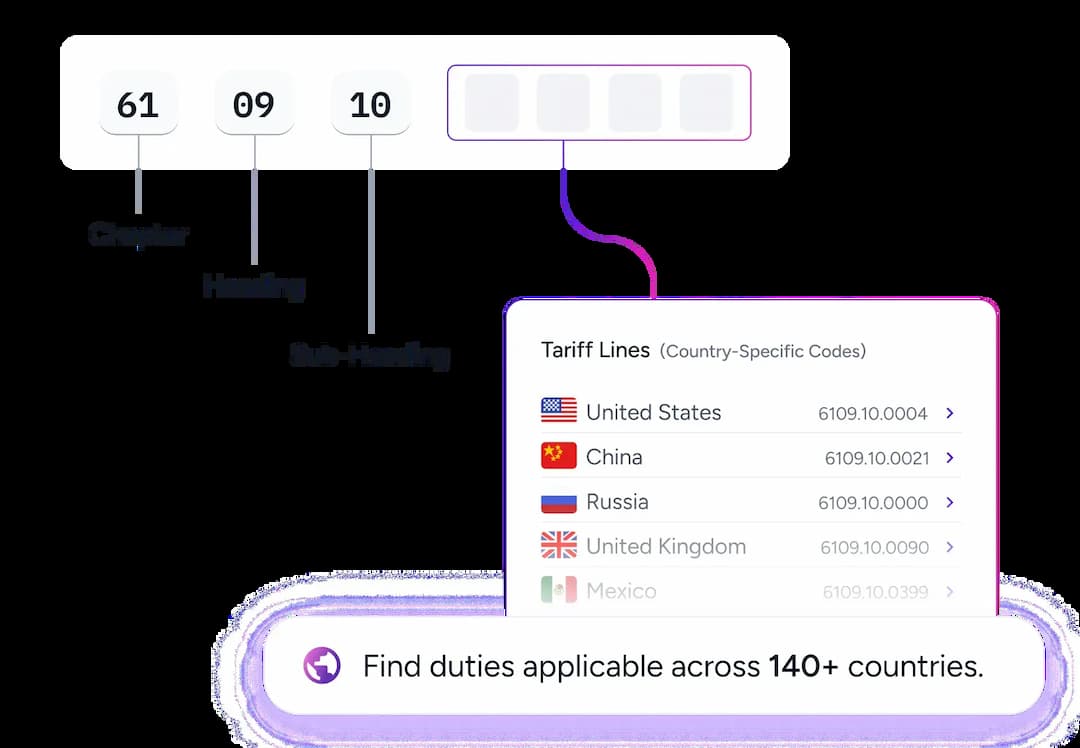
HS Code Lookup helps classify products under appropriate HS code and find duties applicable across 140+ countries. Find and discover HS classification, tariffs, taxes, controls, rulings, ECCNs, and default and preferential duties for HS code 3812.

WCO Notes for Heading 3812
38.12 ‑ Prepared rubber accelerators; compound plasticisers for rubber or plastics, not elsewhere specified or included; anti‑oxidising preparations and other compound stabilisers for rubber or plastics.
3812.10 - Prepared rubber accelerators
3812.20 - Compound plasticisers for rubber or plastics
- Anti-oxidising preparations and other compound stabilizers for rubber or plastics :
3812.31 - - Mixtures of oligomers of 2,2,4-trimethyl-1,2-dihydroquinoline (TMQ)
3812.39 - - Other
For the purpose of this heading, the terms “compound”, “prepared” and “preparation” include :
(i) deliberate mixtures and blends; and
(ii) reaction mixtures including products produced from a homologous series such as fatty acids or fatty alcohols of heading 38.23.
(A) Prepared rubber accelerators.
This category covers products which are added to rubber prior to vulcanisation to give the vulcanised articles better physical properties and reduce the time and temperature required for the vulcanising process. They sometimes also serve as plasticisers. This heading covers only such products which are mixtures.
These preparations are generally based on organic products (diphenylguanidine, dithiocarbamates, thiuram sulphides, hexamethylenetetramine, mercaptobenzothiazole, etc.) often combined with inorganic activators (zinc oxide, magnesium oxide, lead oxide, etc.).
(B) Compound plasticisers for rubber or plastics, not elsewhere specified or included.
This category covers compound plasticisers which are used to provide a desired degree of flexibility to plastics or to increase the plasticity of the rubber mix. Examples of these types of products include deliberate mixtures of two or more phthalate esters as well as mixed dialkyl phthalates produced from mixed fatty alcohols of heading 38.23. Plasticisers are used extensively with poly(vinyl chloride) and with cellulose esters.
The heading does not cover products used as or sometimes called plasticisers, which are more specifically covered by some other heading of the Nomenclature (see the exclusions at the end of this Explanatory Note).
(C) Anti‑oxidising preparations and other compound stabilisers for rubber or plastics.
This category covers anti‑oxidising preparations for rubber or plastics (used, for example, in rubber manufacture to prevent hardening or ageing), such as mixtures of oligomers of 2,2,4-trimethyl-1,2-dihydroquinoline (TMQ), mixed alkylated diphenylamines and preparations based on N‑naphthylaniline.
This category also covers other compound stabilisers for rubber or plastics. Examples of this type of product include deliberate mixtures of two or more stabilisers as well as reaction mixtures such as mixed organotin compounds obtained from mixed fatty alcohols of heading 38.23. The main use of compound stabilisers for plastics is to inhibit the dehydrochlorination of certain polymers such as poly(vinyl chloride). They may also be used as heat stabilisers for polyamides.
The heading excludes :
(a) Petroleum oils, petroleum jelly, paraffin waxes and asphalts of Chapter 27.
(b) Separate chemically defined compounds of Chapter 28 or 29, e.g., dioctyl phthalate.
(c) Anti‑oxidants prepared as additives for mineral oils or for other liquids used for the same purposes as mineral oils (heading 38.11).
(d) Peptisers for rubber processing, though known as chemical plasticisers (generally heading 38.24).
(e) Polymers of Chapter 39.

What is HS code 3812?

How many sub-headings are there in HS code 3812?
International Trade Compliance Simplified