















HS Code Lookup for Heading 4005
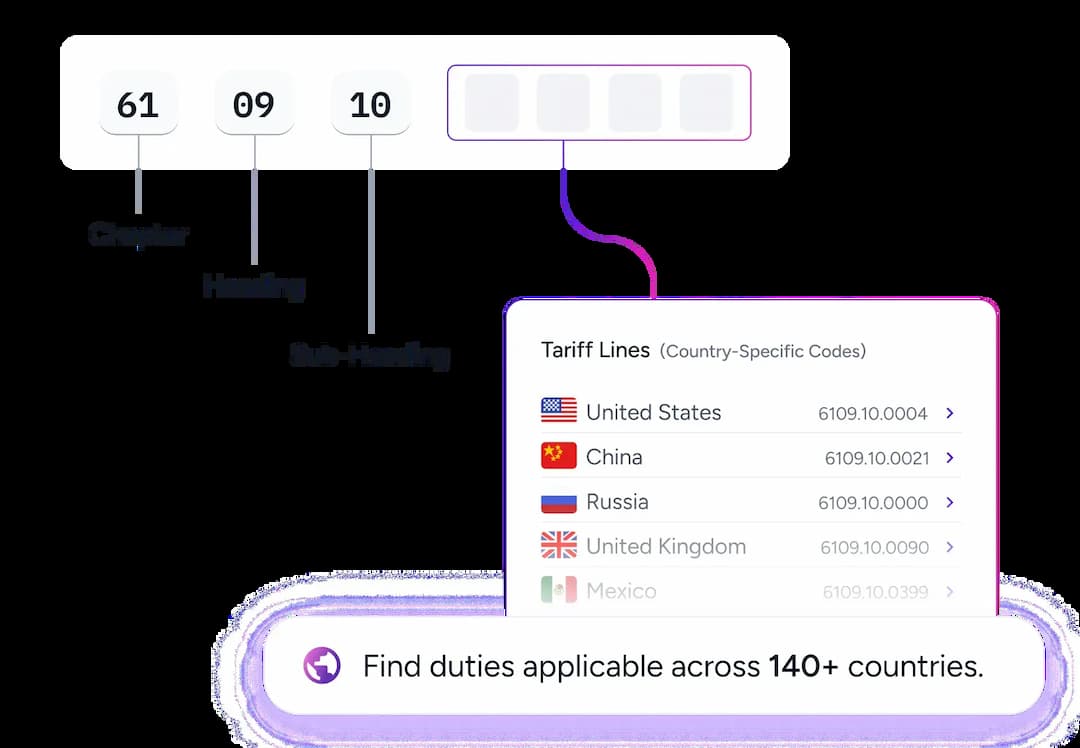
HS Code Lookup helps classify products under appropriate HS code and find duties applicable across 140+ countries. Find and discover HS classification, tariffs, taxes, controls, rulings, ECCNs, and default and preferential duties for HS code 4005.

WCO Notes for Heading 4005
40.05 ‑ Compounded rubber, unvulcanised, in primary forms or in plates, sheets or strip.
4005.10 ‑ Compounded with carbon black or silica
4005.20 ‑ Solutions; dispersions other than those of subheading 4005.10
‑ Other :
4005.91 - - Plates, sheets and strip
4005.99 ‑ ‑ Other
This heading covers compounded rubber which is unvulcanised and is in primary forms or in plates, sheets or strip.
The term “rubber” has the same meaning as in Note 1 to this Chapter. The heading therefore covers natural rubber, balata, gutta‑percha, guayule, chicle and similar natural gums, synthetic rubber, factice derived from oils, and such substances reclaimed, provided they have been compounded with other substances.
According to Note 5 (A) to the Chapter, headings 40.01 and 40.02 do not apply to any rubber or mixture of rubbers which has been compounded, before or after coagulation, with vulcanising agents, accelerators, retarders or activators (other than those added for the preparation of pre‑vulcanised rubber latex), pigments or other colouring matter (other than those added solely for the purpose of identification), plasticisers or extenders (except mineral oil in the case of oil‑extended rubber), fillers, reinforcing agents, organic solvents or any other substances, except those permitted under Note 5 (B).
The heading includes :
(A) Rubber compounded with carbon black or silica (with or without mineral oil or other ingredients).
This category includes carbon black masterbatch consisting of approximately 40‑70 parts of carbon black to 100 parts of dry rubber; it is usually marketed in bales.
(B) Compounded rubbers not containing carbon black or silica.
These contain substances such as organic solvents, vulcanising agents, accelerators, plasticisers, extenders, thickeners and fillers (other than carbon black or silica). Some of them may contain red clay or protein.
These two categories include the following types of product :
(1) Compounded rubber latex (including pre‑vulcanised latex) provided that as a result of compounding it has not acquired the character of a preparation more specifically described in another heading of the Nomenclature.
Thus, the heading excludes, inter alia, latex varnishes and paints (Chapter 32).
(2) Dispersions and solutions of unvulcanised rubber in organic solvents, used for the manufacture of dipped articles or for coating finished articles.
(3) Plates, sheets and strip, consisting of textile fabrics combined with compounded rubber, weighing more than 1,500 g/m2 and containing not more than 50 % by weight of textile material.
Such products are obtained either by calendering or by “gumming” or by a combination of both processes. They are used mainly for the manufacture of tyres, tubes, pipes, etc.
(4) Other plates, sheets and strip of compounded rubber which may be used, for example, for repairing tyres or inner tubes (hot process), for the manufacture of adhesive patches, washers for certain airtight seals, rubber granules, etc., for moulding rubber soles.
(5) Compounded rubber in the form of granules, ready for vulcanisation, and used as such for moulding purposes (e.g., in the shoe‑making industry).
The plates, sheets and strip (including blocks of regular geometric shape) of this heading may be surface‑worked (printed, embossed, grooved, channelled, ribbed, etc.) or simply cut to rectangular (including square) shape, whether or not having the character of articles, but may not be otherwise cut to shape or further worked.
This heading also excludes :
(a) Concentrated dispersions of colouring matter (including colour lakes) in rubber, used as raw materials for colouring rubber in the mass (heading 32.04, 32.05 or 32.06).
(b) More or less pasty products, with a basis of latex or other rubber, used as mastics, painters’ filling or non‑refractory surfacing preparations (heading 32.14).
(c) Prepared glues and other prepared adhesives consisting of rubber solutions or dispersions with added fillers, vulcanising agents and resins, and rubber solutions and dispersions put up for retail sale as glues or adhesives, not exceeding a net weight of 1 kg (heading 35.06).
(d) Intermixtures of any product of heading 40.01 with any product of heading 40.02 (heading 40.02).
(e) Reclaimed rubber mixed with virgin rubber or other added substances and having the essential character of reclaimed rubber (heading 40.03).
(f) Plates, sheets and strip of unvulcanised rubber, worked otherwise than by surface‑working or cut to shapes other than rectangular (including square) (heading 40.06).
(g) Plates, sheets and strip composed of parallel textile yarns agglomerated with rubber (heading 59.06).

What is HS code 4005?

How many sub-headings are there in HS code 4005?
International Trade Compliance Simplified