














HS Code Lookup for Chapter 69
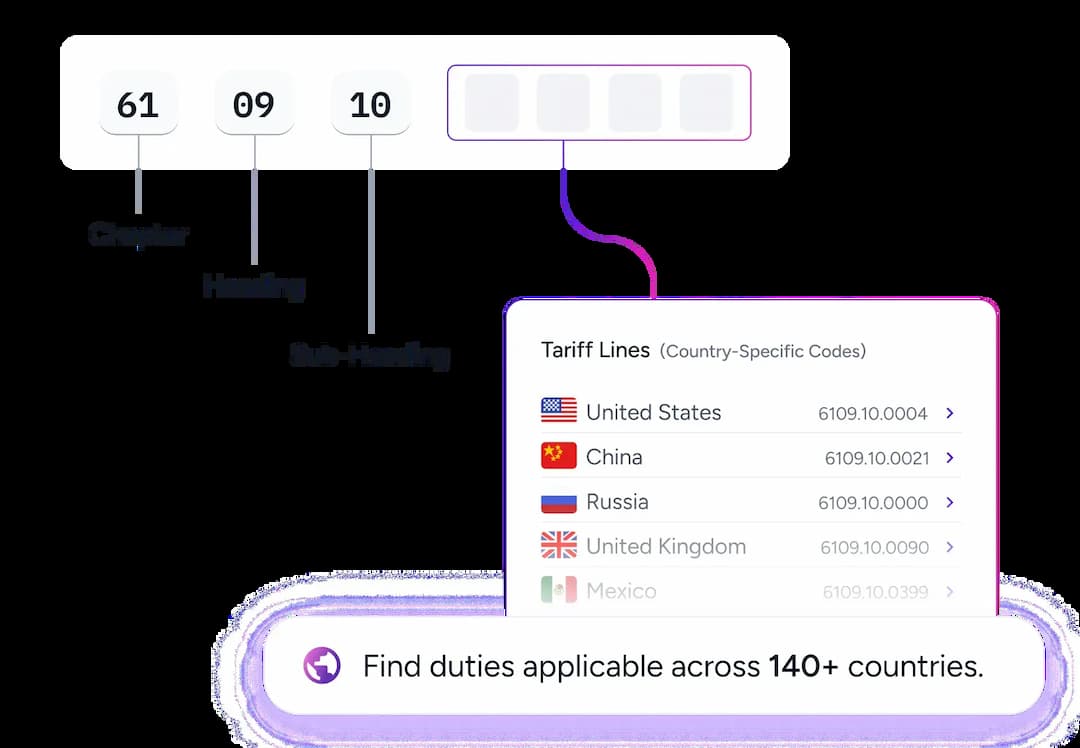
HS Code Lookup helps classify products under appropriate HS code and find duties applicable across 140+ countries. Find and discover HS classification, tariffs, taxes, controls, rulings, ECCNs, and default and preferential duties for HS code 69.

WCO Notes for Chapter 69
Chapter 69
Ceramic products
Notes.
1.- This Chapter applies only to ceramic products which have been fired after shaping :
(a) Headings 69.04 to 69.14 apply only to such products other than those classifiable in headings 69.01 to 69.03;
(b) Articles heated to temperatures less than 800 °C for purposes such as curing of resins, accelerating hydration reactions, or for the removal of water or other volatile components, are not considered to be fired. Such articles are excluded from Chapter 69; and
(c) Ceramic articles are obtained by firing inorganic, non-metallic materials which have been prepared and shaped previously at, in general, room temperature. Raw materials comprise, inter alia, clays, siliceous materials including fused silica, materials with a high melting point, such as oxides, carbides, nitrides, graphite or other carbon, and in some cases binders such as refractory clays or phosphates.
2.- This Chapter does not cover :
(a) Products of heading 28.44;
(b) Articles of heading 68.04;
(c) Articles of Chapter 71 (for example, imitation jewellery);
(d) Cermets of heading 81.13;
(e) Articles of Chapter 82;
(f) Electrical insulators (heading 85.46) or fittings of insulating material of heading 85.47;
(g) Artificial teeth (heading 90.21);
(h) Articles of Chapter 91 (for example, clocks and clock cases);
(ij) Articles of Chapter 94 (for example, furniture, luminaires and lighting fittings, prefabricated buildings);
(k) Articles of Chapter 95 (for example, toys, games and sports requisites);
(l) Articles of heading 96.06 (for example, buttons) or of heading 96.14 (for example, smoking pipes); or
(m) Articles of Chapter 97 (for example, works of art).
GENERAL
The term “ceramic products” applies to products obtained :
(A) By firing inorganic, non-metallic materials which have been prepared and shaped previously at, in general, room temperature. Raw materials comprise, inter alia, clays, siliceous materials including fused silica, materials with a high melting point, such as oxides, carbides, nitrides, graphite or other carbon, and in some cases binders such as refractory clays or phosphates.
(B) From rock (e.g., steatite), fired after shaping.
The manufacturing process of the ceramic products referred to in paragraph (A) above (whatever their constituent material) comprises the following main stages :
(i) Preparation of the paste (or body).
In some cases (e.g., manufacture of sintered alumina articles) the constituent material is used directly in powder form with the addition of a small amount of lubricant. In most cases, however, it is first made into a paste. This involves measuring and mixing the various constituents and, where necessary, milling, sieving, filter-pressing, kneading, maturing and de-airing. Some refractory products are also made from a blend of graded aggregate and fines, along with a small amount of liquid binder, which may be aqueous (e.g., tar, resin materials, phosphoric acid, lignin liquor).
(ii) Shaping.
The prepared powder or paste is then shaped as nearly as possible to the desired form.
This is done by extrusion (through an extrusion die), pressing, moulding, casting or hand-shaping, followed in some cases by some degree of machining.
(iii) Drying the resulting articles.
(iv) Firing.
In this operation, the “green ware” is heated to a temperature of 800 °C or higher according to the nature of the product. After firing, the grains are closely bound together as a result of diffusion, chemical transformation or partial fusion.
Articles heated to temperatures less than 800 °C for purposes such as curing of resins, accelerating hydration reactions, or for the removal of water or other volatile components, are not considered to be fired for the purposes of Chapter Note 1. Such articles are excluded from Chapter 69.
(v) Finishing.
The finishing processes depend on the intended use of the ceramic product. Sometimes machine finishing to a high degree of precision is necessary. Finishing may also include marking, metallising or impregnation.
Ceramic products are also very often coloured (either in the body or superficially), decorated or glazed by using, as appropriate, specially prepared colours or opacifiers, vitrifiable enamels or glazes, slips, lustres, etc.
Firing, after shaping, is the essential distinction between the goods of this Chapter and the mineral or stone articles classified in Chapter 68 which are generally not fired, and the glass articles of Chapter 70 in which the vitrifiable compound has undergone complete fusion.
According to the composition and the firing process adopted, the following products are obtained :
I. Goods of siliceous fossil meals or of similar siliceous earths and refractory goods of sub-Chapter I (headings 69.01 to 69.03).
II. Other ceramic products, consisting essentially of common pottery, stoneware, earthenware, porcelain or china, etc. constituting sub-Chapter II (headings 69.04 to 69.14).
This Chapter excludes :
(a) Broken pottery and broken pieces of brick (heading 25.30).
(b) Products of heading 28.44.
(c) Blocks, plates, bars and similar semi-manufactures of graphite or of other carbon, or metallo-graphitic or other grades, used, e.g., for cutting into electrical brushes (heading 38.01) (see corresponding Explanatory Note).
(d) Unmounted cut elements of piezo-electric ceramic materials, e.g., of barium titanate or of lead zirconate titanate (heading 38.24).
(e) Articles of heading 68.04.
(f) Glass-ceramic products (Chapter 70).
(g) Sintered mixtures of base metal powders and heterogeneous intimate base metal mixtures obtained by melting (Section XV).
(h) Cermets of heading 81.13.
(ij) Plates, sticks, tips and the like for tools, unmounted, of cermets (heading 82.09) and other articles of Chapter 82.
______________________

What is HS code 69?

How many headings are there in HS code 69?
International Trade Compliance Simplified