















HS Code Lookup for Heading 7102
HS Code Lookup helps classify products under appropriate HS code and find duties applicable across 140+ countries. Find and discover HS classification, tariffs, taxes, controls, rulings, ECCNs, and default and preferential duties for HS code 7102.

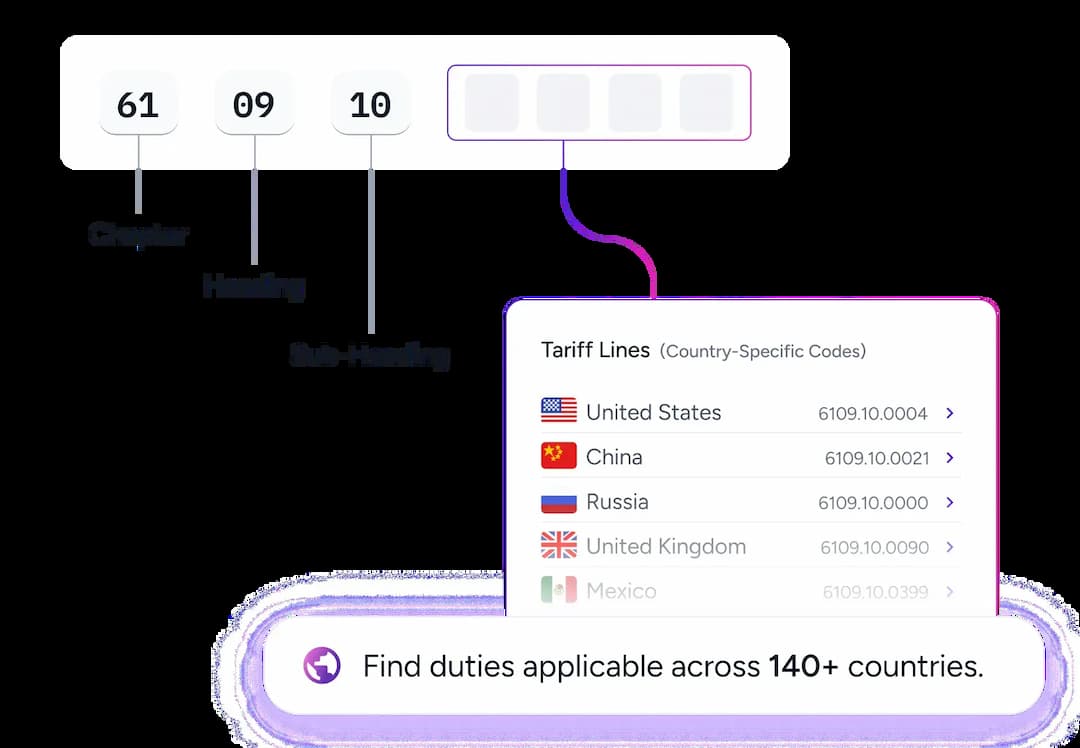
WCO Notes for Heading 7102
71.02 - Diamonds, whether or not worked, but not mounted or set (+).
7102.10 - Unsorted
- Industrial :
7102.21 - - Unworked or simply sawn, cleaved or bruted
7102.29 - - Other
- Non-industrial :
7102.31 - - Unworked or simply sawn, cleaved or bruted
7102.39 - - Other
Diamond is a crystalline and allotropic form of carbon with, in the pure state, a very high refractive index and dispersive power. It is the hardest known mineral. Because of these qualities diamond is used for making articles of adornment or ornamentation and also for industrial purposes (in particular, for wire drawing).
The heading covers unworked stones, and stones worked, e.g., by cleaving, sawing, bruting, tumbling, faceting, grinding, polishing, drilling, engraving (including cameos and intaglios), preparing as doublets, provided they are neither set nor mounted.
The heading does not cover :
(a) Dust and powder of diamonds (heading 71.05).
(b) Unmounted worked diamonds for styli (heading 85.22).
(c) Diamonds worked so as to be recognisable as parts of meters, of measuring instruments or of other goods of Chapter 90 (Chapter 90).
°
° °
Subheading Explanatory Notes.
Subheading 7102.10
Before “unworked” or rough diamonds are marketed as “industrial” or “non-industrial” they are graded and sorted in terms of technical criteria by diamond experts. The technical criteria include weight (mass) and crystallographic suitability for cutting. Account is also taken of shape, transparency, colour and clarity or quality of crystals.
This subheading covers those lots (i.e., parcels) of diamonds or single diamonds which have not been submitted to such expert examination.
This subheading also includes parcels of rough diamonds that have only been sieved and that are packaged according to size without having been submitted to further expert examination.
Subheadings 7102.21 and 7102.29
These subheadings cover the following natural diamonds :
(1) Diamonds proper, that is to say, transparent or translucent diamonds which because of their characteristic features cannot, normally be used for jewellery or for goldsmiths’ or silversmiths’ wares.
(2) Black diamonds, and other polycrystalline diamond-aggregates, including carbonados, which are harder than transparent diamonds.
(3) Bort proper, that is to say, opaque diamonds and other diamonds (including waste from working diamonds), normally unsuitable for cutting.
(4) Diamonds which because of their characteristic features (colour, clarity or quality, transparency, etc.) are destined for precise, particular uses in industrial applications (such as dressers, wire-drawing dies, or diamond anvils), but which are also suitable for use in jewellery.
These diamonds are generally intended for setting in tools (diamond cutting tools, boring tools, etc.) or fitting to machine accessories or machinery.
Subheading 7102.21 covers :
(1) Diamonds in their natural state, i.e., as they occur in deposits or extracts from the parent rock, sorted into lots or parcels.
(2) Diamonds simply sawn (e.g., into thin strips), cleaved (by splitting along the natural plane of the layers), bruted, tumbled or which have only a small number of polished facets (e.g., so-called windows, which are mostly made to allow expert examination of the internal characteristics of the rough diamond), i.e., stones which have only a provisional shape and clearly have to be further worked. The strips may also be cut into discs, rectangles, hexagons or octagons, provided that all the surfaces and ridges are rough, matt and unpolished.
(3) Tumbled diamonds of which the surface has been rendered glossy and shiny by chemical treatment, also known as chemical polishing. Chemical polishing is different from traditional abrasive polishing in that the diamonds are not mounted individually and polished on a polishing wheel, but are loaded – in bulk – into a chemical reactor.
(4) Broken or crushed diamonds.
Subheading 7102.29 covers polished or drilled diamonds, and engraved diamonds (other than diamonds engraved for identification purposes only).
Subheadings 7102.31 and 7102.39
These subheadings cover natural diamonds which, because of their characteristic features (colour, clarity or purity, transparency, etc.) are suitable for use by jewellers, goldsmiths or silversmiths.
Subheading 7102.31 covers :
(1) Diamonds in their natural state, i.e., as they occur in deposits or extracts from the parent rock, sorted into lots or parcels.
(2) Diamonds simply sawn, cleaved (by splitting along the natural plane of the layers), bruted or which have only a small number of polished facets (e.g., so-called windows, which are mostly made to allow expert examination of the internal characteristics of the rough diamond), i.e., stones which have only a provisional shape and clearly have to be further worked.
(3) Tumbled diamonds of which the surface has been rendered glossy and shiny by chemical treatment, also known as chemical polishing. Chemical polishing is different from traditional abrasive polishing in that the diamonds are not mounted individually and polished on a polishing wheel, but are loaded – in bulk – into a chemical reactor.
Subheading 7102.39 covers :
(1) Polished diamonds having multiple flat polished surfaces or facets, which do not require to be further worked before being used in jewellery.
(2) Drilled diamonds, engraved diamonds (including cameos and intaglios) and diamonds prepared as doublets or triplets.
(3) Diamonds which were subjected to polishing and drilling or engraving and were broken during these operations, as well as polished diamonds broken during their transportation or storage.
Subheading 7102.39 does not cover :
(a) Diamonds which have only a small number of polished facets (e.g., windows which are made to allow expert examination of the internal characteristics of the rough diamond) and which clearly have to be further worked;
(b) Diamonds which have only been engraved for identification purposes.

What is HS code 7102?

How many sub-headings are there in HS code 7102?
International Trade Compliance Simplified