














HS Code Lookup for Heading 7202
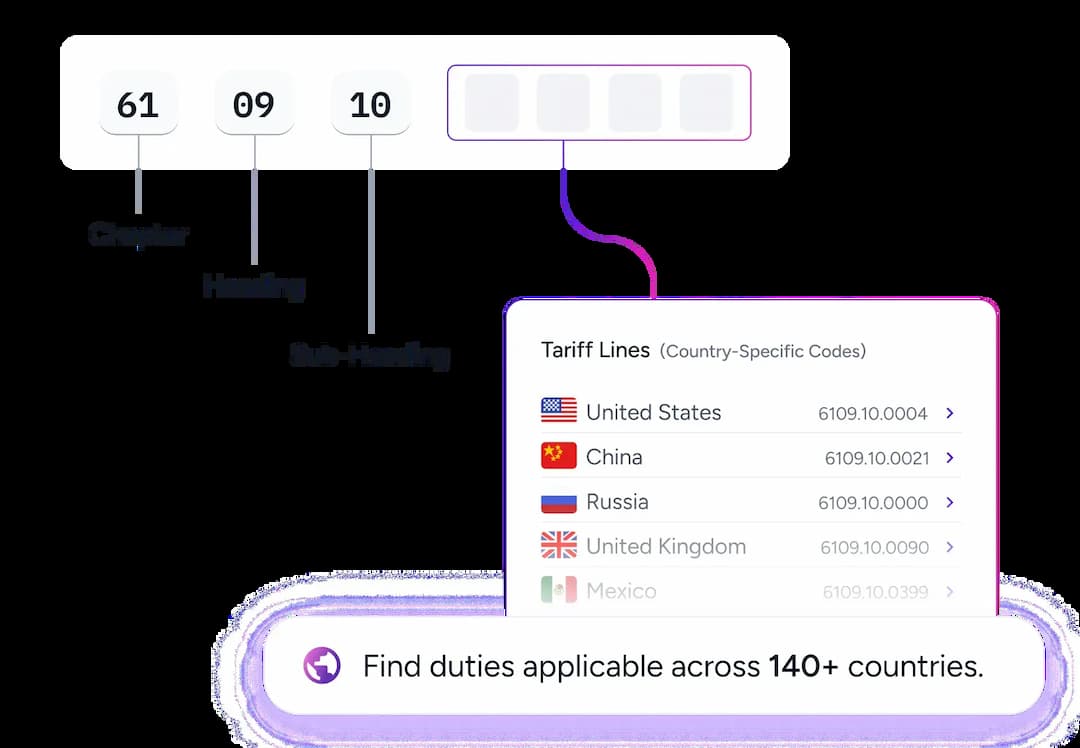
HS Code Lookup helps classify products under appropriate HS code and find duties applicable across 140+ countries. Find and discover HS classification, tariffs, taxes, controls, rulings, ECCNs, and default and preferential duties for HS code 7202.

WCO Notes for Heading 7202
72.02 ‑ Ferro-alloys.
- Ferro-manganese :
7202.11 - - Containing by weight more than 2 % of carbon
7202.19 - - Other
- Ferro-silicon :
7202.21 - - Containing by weight more than 55 % of silicon
7202.29 - - Other
7202.30 - Ferro-silico-manganese
- Ferro-chromium :
7202.41 - - Containing by weight more than 4 % of carbon
7202.49 - - Other
7202.50 - Ferro-silico-chromium
7202.60 - Ferro-nickel
7202.70 - Ferro-molybdenum
7202.80 - Ferro-tungsten and ferro-silico-tungsten
- Other :
7202.91 - - Ferro-titanium and ferro-silico-titanium
7202.92 - - Ferro-vanadium
7202.93 - - Ferro-niobium
7202.99 - - Other
Ferro‑alloys are defined in Note 1 (c) to this Chapter.
Ferro-alloys differ from pig iron in that they contain a smaller proportion of iron which merely acts as a “solvent” for large proportions of alloy elements (e.g., manganese, chromium, tungsten (wolfram), silicon, boron or nickel) and in that they may contain 2 % or less of carbon.
Ferro-alloys are not normally used for rolling, forging or other working, at least not for industrial purposes, even though some are malleable. They are used in the iron or steel industry mainly to add definite proportions of alloying elements to steel or pig iron in order to obtain special qualities, generally in those cases where the use of the pure elements themselves would be impracticable or uneconomic. Some are also used as de‑oxidants, de‑sulphurisers or de‑nitrating agents or for killing steel, while others are used in welding or for metal deposition.
Certain ferro‑alloys can be used directly for casting. To fall in the heading, ferro‑alloys must be in the form of pigs, blocks, lumps or similar primary forms, in granules or powder forms or in forms obtained by continuous casting (e.g., billets).
Ferro‑silicon is also used, in the form of sphericalgranule powders the surface of which has been hardened by a special process, as a dense medium (“ pulp ”) in gravimetric separation (selective flotation) of metal ores; however, it remains in this heading.
The heading also covers products of this type previously reduced to granules or powder and agglomerated into briquettes, cylinders, thin slabs, etc., by means of cement or other binders and, in certain cases, with exothermic additives.
Though some ferro‑alloys (e.g., ferro‑manganese or ferro‑silicon) can be produced in blast furnaces, they are more usually prepared in electric furnaces, or in crucibles by the “ thermit ” process, etc.
The principal varieties are :
(1) Ferro‑manganese
(2) Ferro‑silicon
(3) Ferro‑silico‑manganese
(4) Ferro‑chromium
(5) Ferro‑silico‑chromium
(6) Ferro‑nickel
(7) Ferro‑molybdenum
(8) Ferro‑tungsten (ferro‑wolfram) and ferro‑silico‑tungsten
(9) Ferro‑titanium and ferro‑silico‑titanium
(10) Ferro‑vanadium
(11) Ferro‑niobium
(12) Ferro‑silico‑magnesium and ferro‑silico‑calcium.
The heading excludes :
(a) Chemical products used for the same purposes and in the same way as ferro‑alloys, such as molybdenum oxide, calcium molybdate and silicon carbide, and also, if they contain less than 4 % by weight of iron, calcium silicide and manganese silicide (Chapter 28).
(b) Ferro‑uranium (heading 28.44).
(c) Ferro‑cerium and other pyrophoric ferrous alloys in all forms (heading 36.06).
(d) Products which in some countries are sometimes known as ferro‑nickels or ferro‑nickel‑chromes, and which are malleable and are not normally used as “ addition materials ” in iron and steel metallurgy (headings 72.18 to 72.29 or Chapter 75).

What is HS code 7202?

How many sub-headings are there in HS code 7202?
International Trade Compliance Simplified