















HS Code Lookup for Chapter 75
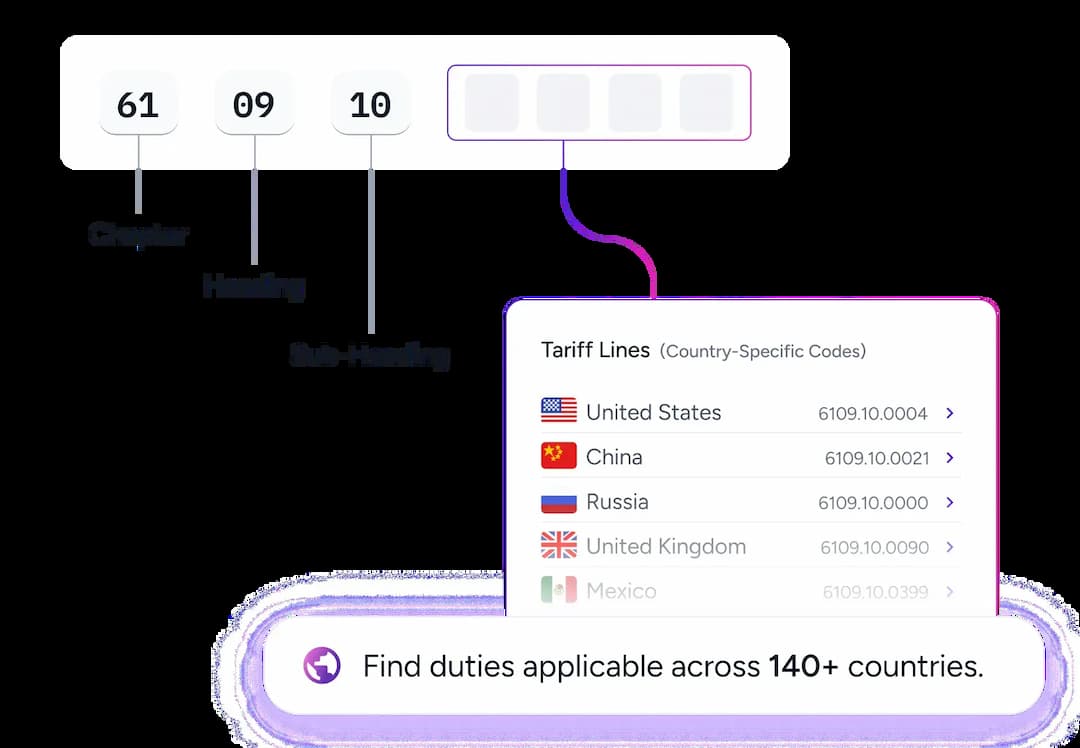
HS Code Lookup helps classify products under appropriate HS code and find duties applicable across 140+ countries. Find and discover HS classification, tariffs, taxes, controls, rulings, ECCNs, and default and preferential duties for HS code 75.

WCO Notes for Chapter 75
Chapter 75
Nickel and articles thereof
Subheading Notes.
1.- In this Chapter the following expressions have the meanings hereby assigned to them :
(a) Nickel, not alloyed
Metal containing by weight at least 99 % of nickel plus cobalt, provided that :
(i) the cobalt content by weight does not exceed 1.5 %, and
(ii) the content by weight of any other element does not exceed the limit specified in the following table :
TABLE ‑ Other elements
Element | Limiting content % by weight |
Fe Iron O Oxygen Other elements, each | 0.5 0.4 0.3 |
(b) Nickel alloys
Metallic substances in which nickel predominates by weight over each of the other elements provided that :
(i) the content by weight of cobalt exceeds 1.5 %,
(ii) the content by weight of at least one of the other elements is greater than the limit specified in the foregoing table, or
(iii) the total content by weight of elements other than nickel plus cobalt exceeds 1 %.
2.- Notwithstanding the provisions of Note 9 (c) to Section XV, for the purposes of subheading 7508.10 the term “wire” applies only to products, whether or not in coils, of any cross-sectional shape, of which no cross-sectional dimension exceeds 6 mm.
GENERAL
This Chapter covers nickel and its alloys, and certain articles thereof.
Nickel is a relatively hard, greyish‑white metal melting at 1453 °C. It is ferro‑magnetic, malleable, ductile, strong and resistant to corrosion and oxidation.
*
* *
Nickel is used mainly in the production of many alloys especially alloy steels, for coating other metals usually by electrodeposition and as a catalyst in many chemical reactions. Unalloyed wrought nickel is also extensively used in the manufacture of chemical plant. In addition nickel and nickel alloys are used for coinage.
*
* *
The principal nickel alloys which may fall in this Chapter under the provisions of Note 5 to Section XV include the following :
(1) Nickel‑iron alloys. These include materials used in submarine cables, induction coil cores, magnetic shielding, etc., because of their high magnetic permeability and low hysteresis.
(2) Nickel‑chromium or nickel‑chromium‑iron alloys. These include a variety of commercial materials featuring good strength and excellent resistance to oxidation at high temperature and scaling as well as to many corrosive environments. These materials are employed for the heater element in electrical resistance heating devices and are also used for components such as muffles and retorts used in the heat treatment of steels and other metals or in the form of pipe and tubing for high temperature chemical or petrochemical processing. Also in this group are special alloys known as “super alloys” which have been developed specifically for high strength at the elevated temperatures prevailing in aircraft turbines where they are used for turbine blades and vanes, combustion liners, transition sections, etc. Often these alloys contain molybdenum, tungsten, niobium, aluminium, titanium, etc., which are effective in significantly improving the strength of the nickel‑base composition.
(3) Nickel‑copper alloys. These alloys, which in addition to corrosion resistance have good strength, are used in such applications as propeller shafts and fasteners and are also used in pumps, valves, tubing and other forms of equipment exposed to certain mineral or organic acids or alkalis and salts.
*
* *
This Chapter includes :
(A) Nickel mattes, nickel oxide sinters and other intermediate products of nickel metallurgy and unwrought nickel, and nickel waste and scrap (headings 75.01 to 75.03).
(B) Nickel powders and flakes (heading 75.04).
(C) Products generally obtained by rolling, forging, drawing or extruding the unwrought nickel of heading 75.02 (headings 75.05 and 75.06).
(D) Tubes, pipes and fittings (heading 75.07), and electroplating anodes and other articles of heading 75.08, which covers all nickel articles, other than those covered by Note 1 to Section XV or included in Chapter 82 or 83, or more specifically covered elsewhere in the Nomenclature.
*
* *
Products and articles of nickel may be subjected to various treatments to improve the properties or appearance of the metal, etc. These treatments are generally those referred to at the end of the General Explanatory Note to Chapter 72, and do not affect the classification of the goods. (See, however, the special case of electroplating anodes (heading 75.08).)
*
* *
The classification of composite articles is explained in the General Explanatory Note to Section XV.

What is HS code 75?

How many headings are there in HS code 75?
International Trade Compliance Simplified