














HS Code Lookup for Chapter 76
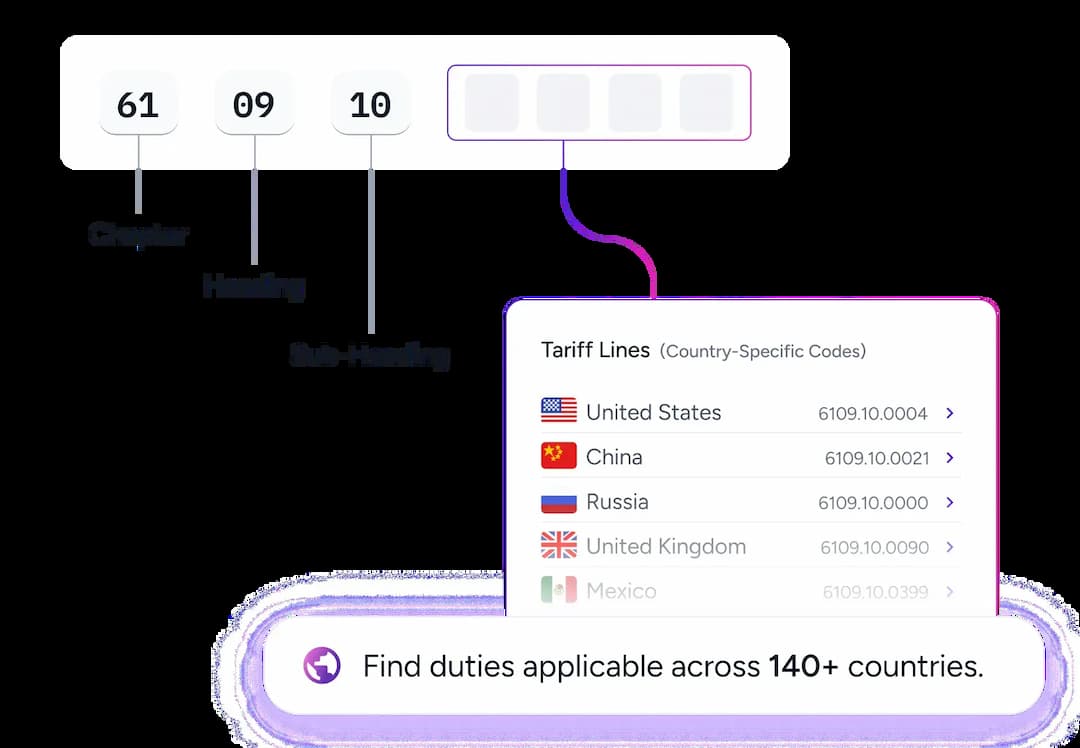
HS Code Lookup helps classify products under appropriate HS code and find duties applicable across 140+ countries. Find and discover HS classification, tariffs, taxes, controls, rulings, ECCNs, and default and preferential duties for HS code 76.

WCO Notes for Chapter 76
Chapter 76
Aluminium and articles thereof
Subheading Notes.
1.‑ In this Chapter the following expressions have the meanings hereby assigned to them :
(a) Aluminium, not alloyed
Metal containing by weight at least 99 % of aluminium, provided that the content by weight of any other element does not exceed the limit specified in the following table :
TABLE ‑ Other elements
Element | Limiting content % by weight |
Fe + Si (iron plus silicon) Other elements(1), each | 1 0.1(2) |
(1) Other elements are, for example Cr, Cu, Mg, Mn, Ni, Zn. (2) Copper is permitted in a proportion greater than 0.1 % but not more than 0.2 %, provided that neither the chromium nor manganese content exceeds 0.05 %. | |
(b) Aluminium alloys
Metallic substances in which aluminium predominates by weight over each of the other elements, provided that :
(i) the content by weight of at least one of the other elements or of iron plus silicon taken together is greater than the limit specified in the foregoing table; or
(ii) the total content by weight of such other elements exceeds 1 %.
2.- Notwithstanding the provisions of Note 9 (c) to the Section XV, for the purposes of subheading 7616.91 the term “wire” applies only to products, whether or not in coils, of any cross-sectional shape, of which no cross-sectional dimension exceeds 6 mm.
GENERAL
This Chapter covers aluminium and its alloys, and certain articles thereof.
Aluminium is obtained principally from bauxite, a crude hydrated alumina (see the Explanatory Note to heading 26.06). The first stage of the extraction is designed to convert the bauxite into pure aluminium oxide (alumina). For this purpose the ground ore is calcined and then treated with sodium hydroxide to produce a solution of sodium aluminate; this is then filtered to eliminate insoluble impurities (iron oxide, silica, etc.). The aluminium is then precipitated as aluminium hydroxide, which is calcined to give pure aluminium oxide in the form of a white powder. However, aluminium hydroxide and aluminium oxide are classified in Chapter 28.
In the second stage, the metal is extracted by electrolytic reduction of the alumina dissolved in fused cryolite (the latter is sodium aluminium fluoride, but it acts solely as a solvent). This electrolysis is carried out in carbon lined baths which act as the cathode; carbon bars are used as anodes. The aluminium is deposited in the bottom of the baths from where it is syphoned. It is then cast in the form of blocks, ingots, billets, slabs, wire bars, etc., usually after refining. By repeated electrolysis, aluminium can be obtained almost completely pure.
Aluminium may also be obtained by the treatment of certain other ores such as leucite (double silicate of aluminium and potassium), by re‑melting aluminium waste and scrap or by processing residues (slag, dross, etc.).
*
* *
Aluminium is a bluish‑white metal characterised by its lightness. It is very ductile and easily rolled, drawn, forged, stamped, and may be cast, etc. Like other soft metals, aluminium is also very suitable for extrusion and die‑casting. In modern practice it can be soldered. Aluminium is an excellent conductor of heat and electricity and is a very good reflector. Since the oxide film which forms naturally on its surface protects the metal, it is often produced artificially in greater depth by anodising or chemical treatment; the surface is also sometimes coloured during these processes.
*
* *
The hardness, toughness, etc., of aluminium can be very substantially increased by alloying with other elements such as copper, magnesium, silicon, zinc or manganese. Certain of the alloys may be improved by age‑hardening treatments. These processes may be followed by tempering.
The principal aluminium alloys which may be classified in this Chapter under the provisions of Note 5 to Section XV (see the General Explanatory Note to that Section) are :
(1) Aluminium‑copper alloys. These are aluminium based alloys with a low copper content.
(2) Aluminium‑zinc‑copper alloys.
(3) Aluminium‑silicon alloys (e.g., “alpax”, “silumin”).
(4) Aluminium‑manganese‑magnesium alloys.
(5) Aluminium‑magnesium‑silicon alloys (e.g., “almelec”, “aldrey”).
(6) Aluminium‑copper‑magnesium‑manganese alloys (e.g., “duralumin”).
(7) Aluminium‑magnesium alloys (e.g., “magnalium”).
(8) Aluminium‑manganese alloys.
(9) Aluminium‑zinc‑magnesium alloys.
Most of these alloys may also contain small quantities of iron, nickel, chromium, etc.; they are often marketed under trade names which vary according to the country of origin.
*
* *
The special properties of aluminium and its alloys favour their wide use : in the aircraft, automobile or shipbuilding industries; in the building industry; in the construction of railway or tramway rolling‑stock; in the electrical industry (e.g., as cables); for all types of containers (reservoirs and vats of all sizes, transport casks, drums, etc.); for household or kitchen utensils; for the manufacture of foil; etc.
*
* *
The Chaptercovers :
(A) Unwrought aluminium, and waste and scrap (headings 76.01 and 76.02).
(B) Aluminium powders and flakes (heading 76.03).
(C) Products generally obtained by rolling, extruding, drawing or forging the unwrought aluminium of heading 76.01 (headings 76.04 to 76.07).
(D) Various articles specified in headings 76.08 to 76.15, and other articles of the residual heading 76.16 which covers all other aluminium articles other than those included in Chapter 82 or 83, or more specifically covered elsewhere in the Nomenclature.
Products obtained by sintering aluminium and alumina are considered as cermets and are excluded from this Chapter (heading 81.13).
*
* *
Products and articles of aluminium are frequently subjected to various treatments to improve the properties or appearance of the metal, to protect it from corrosion, etc. These treatments are generally those referred to at the end of the General Explanatory Note to Chapter 72, and do not affect the classification of the goods.
*
* *
The classification of composite goods, particularly made up articles, is explained in the General Explanatory Note to Section XV.

What is HS code 76?

How many headings are there in HS code 76?
International Trade Compliance Simplified