















HS Code Lookup for Heading 8404
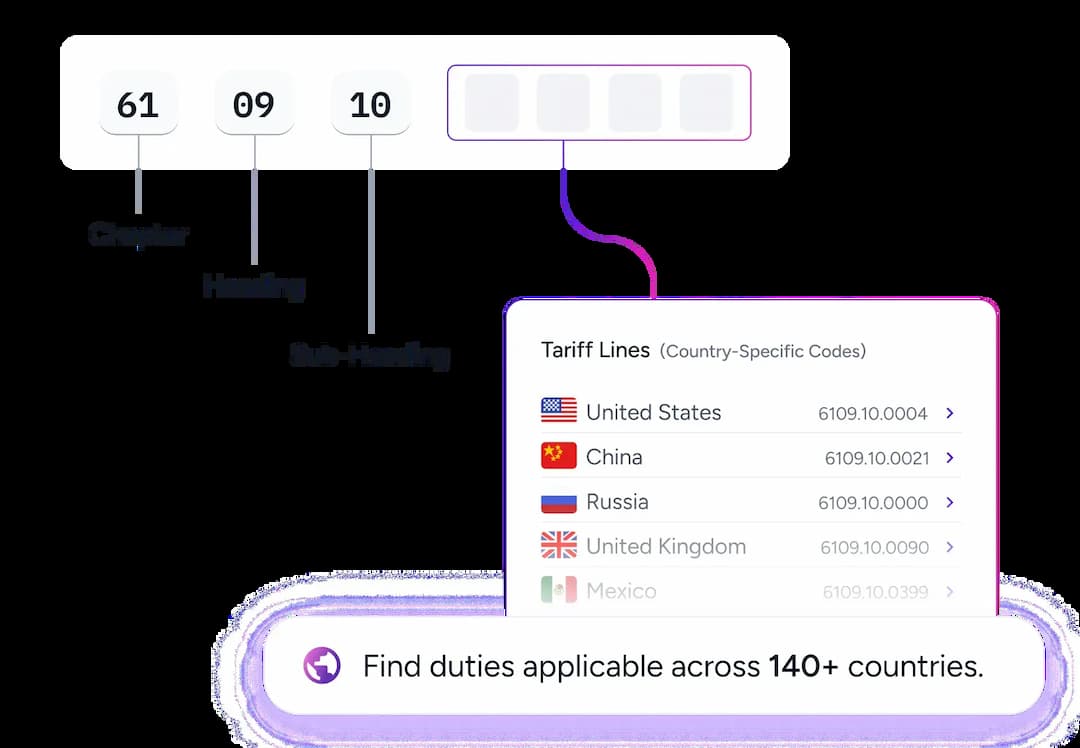
HS Code Lookup helps classify products under appropriate HS code and find duties applicable across 140+ countries. Find and discover HS classification, tariffs, taxes, controls, rulings, ECCNs, and default and preferential duties for HS code 8404.

WCO Notes for Heading 8404
84.04 - Auxiliary plant for use with boilers of heading 84.02 or 84.03 (for example, economisers, super-heaters, soot removers, gas recoverers); condensers for steam or other vapour power units.
8404.10 - Auxiliary plant for use with boilers of heading 84.02 or 84.03
8404.20 - Condensers for steam or other vapour power units
8404.90 - Parts
(A) AUXILIARY PLANT FOR USE WITH BOILERS
OF HEADING 84.02 OR 84.03
These include :
(1) Economisers for pre-heating the boiler feed water by utilising the waste heat of the flue gases or, in some types, exhaust steam. They usually consist of headers fitted with a system of cast iron or steel gilled tubing, sometimes contained within a separate chamber of sheet metal into which the flue gases or exhaust steam are discharged. In the mixing type economiser waste steam is passed directly into a chamber containing the feed water.
(2) Air pre-heaters. These also make use of the waste heat. They consist of air chambers with heat-exchange systems of varying types, e.g., tubular types through which the hot flue gases circulate thus heating the air in the chamber; plate-type in which air and smoke gases circulate separately in adjoining narrow compartments. Certain types incorporate rotating baffle plates.
(3) Super-heaters. These consist of headers with a high-pressure steel tube system in which the saturated steam from the boiler is further heated to remove moisture and to produce steam at high temperature. Super-heaters are often part of the main boiler assembly, but in some cases have a separate flue system.
(4) De-super-heaters. These are used to prevent the development of too high a temperature in the super-heaters. Normally they are placed between two sections of the super-heater, and generally consist of a cast iron body into which the steam is passed and cooled by a flow of water.
(5) Steam collectors. Cylindrical bodies for collecting the steam from a group of boilers.
(6) Steam accumulators. Large insulated cylindrical steel high-pressure reservoirs for the storage of a reserve of steam.
(7) Thermic or heat accumulators. These are used to store the surplus heat from steam boilers.
(8) Tubular furnace-walls, i.e., a system of vertical tubing connected to conduits in which the feed water circulates, and designed to be mounted in front of the interior surface of the furnace walls. They serve the double function of preventing the over-heating of the furnace walls and at the same time pre-heating the feed water.
(9) Soot removers (soot blowers), automatic or not. These remove soot and similar deposits from the tubular parts of the steam-generating installation (e.g., super-heaters, watertubes, firetubes and economisers) by the use of jets of steam or compressed air. They consist of a tube (fixed or retractable) with a number of jets controlled by a valve and coupled to the steam or compressed air conduit. In other cases soot removers take the form of retractable jets.
(10) Gas recoverers. These are devices by which the exhaust gases are returned to the furnace for combustion of unburnt particles.
(11) Sludge scrapers.
(B) CONDENSERS FOR STEAM OR OTHER VAPOUR POWER UNITS
These include steam condensers of various kinds, whose function is to reduce the back pressure in steam engines by cooling and condensing the exhaust steam, thus increasing the power of the engine. They include :
(1) Surface-condensers. These consist of a cylindrical shell enclosing a system of tubes. The steam is led into the cylinder, and cold water circulates through the pipes (or occasionally vice versa) thus condensing the steam.
(2) Mixing condensers. In these the steam is mixed directly with water. The heading includes ejector condensers in which a partial vacuum is created in the condenser chamber by a jet of water (acting in the same way as the jet in an ejector pump).
(3) Air-cooled condensers. These consist of gilled steam tubing cooled by a forced current of air.
PARTS
Subject to the general provisions regarding the classification of parts (see the General Explanatory Note to Section XVI), the heading also covers parts of the above apparatus and appliances.
Metal tubes or pipes which have been bent or curved but not otherwise worked, presented unassembled, are not identifiable as parts of goods of this heading and are therefore to be classified in Section XV.
*
* *
The heading excludes the following, whether or not for use in boiler-houses :
(a) Pumps (including water-injectors for force-feeding the boiler), blowers, fans and other machinery of heading 84.13 or 84.14.
(b) Furnace burners, mechanical grates, mechanical stokers and the like (heading 84.16).
(c) Distillation and other condensers of heading 84.19.
(d) Filters and purifiers for water, gases, etc. (heading 84.21).

What is HS code 8404?

How many sub-headings are there in HS code 8404?
International Trade Compliance Simplified