















HS Code Lookup for Heading 8407
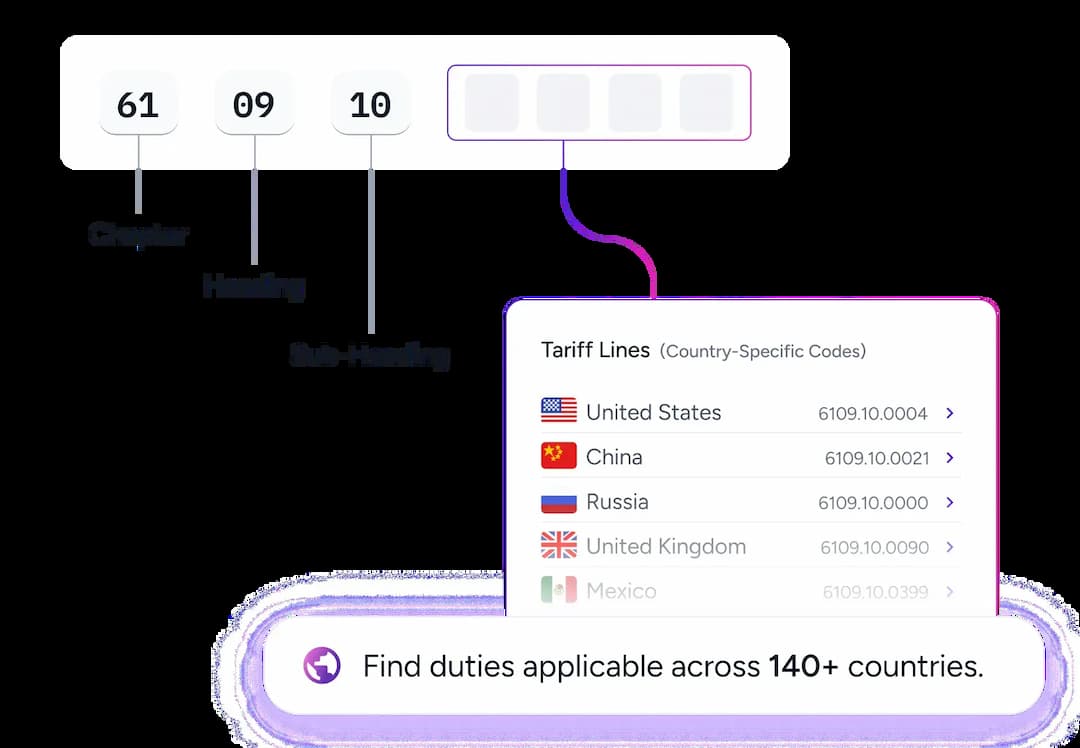
HS Code Lookup helps classify products under appropriate HS code and find duties applicable across 140+ countries. Find and discover HS classification, tariffs, taxes, controls, rulings, ECCNs, and default and preferential duties for HS code 8407.

WCO Notes for Heading 8407
84.07 - Spark-ignition reciprocating or rotary internal combustion piston engines (+).
8407.10 - Aircraft engines
- Marine propulsion engines :
8407.21 - - Outboard motors
8407.29 - - Other
- Reciprocating piston engines of a kind used for the propulsion of vehicles of Chapter 87 :
8407.31 - - Of a cylinder capacity not exceeding 50 cc
8407.32 - - Of a cylinder capacity exceeding 50 cc but not exceeding 250 cc
8407.33 - - Of a cylinder capacity exceeding 250 cc but not exceeding 1,000 cc
8407.34 - - Of a cylinder capacity exceeding 1,000 cc
8407.90 - Other engines
This heading covers spark-ignition reciprocating internal combustion piston engines and rotary internal combustion piston engines (Wankel engines having a trilobal disc type “piston”), other than those of Chapter 95. It includes such engines for motor vehicles.
These engines generally have the following elements : cylinder, piston, connecting-rod, crank shaft, flywheel, inlet and exhaust valves, etc. They make use of the expansion force of a charge of inflammable gas or vapour burned inside a cylinder.
The characteristic feature of these engines is that they are equipped with sparking plugs fitted into the cylinder head and with electrical devices (such as magnetos, coils and contact breakers) synchronised with the motor, for supplying high tension current.
In the more common types the fuel and air are mixed (e.g., in a carburettor) before induction into the cylinder by the suction stroke of the piston, but in some cases (e.g., certain aircraft engines and motor car engines) the fuel is introduced into the cylinder head directly by an injector.
The most usual fuel is petrol, but others include kerosene, alcohol, hydrogen, coal gas, methane, etc.
Gas engines are most frequently fed by producer gas generators which are sometimes integral with the engine, but are more often independent. In the latter case the generators are always classified in heading 84.05.
*
* *
These engines may have one or several cylinders. In the latter case the connecting-rods are coupled to a single crank shaft, and the cylinders, fed separately, may be arranged in various ways, e.g., in a vertical line (upright or inverted), in two symmetrical obliquely opposed rows (V-engines), horizontally opposed on opposite sides on the crank shaft or, for certain aircraft engines, radially. The rotary piston engine (Wankel engine) operates on the same general principle as the conventional piston engines described above. However, instead of a crank shaft turned by an oscillating piston and connecting rod, the rotary piston engine has a trilobal disc (“piston”) in a specially shaped housing (epitrochoid), which directly rotates a driving shaft.
The “piston” divides the housing (combustion chamber) into several compartments and each complete rotation corresponds for each lobe to a four-stroke cycle. These engines may have one or more housings with “pistons”.
The engines of this heading are suitable for very many uses, e.g., in agricultural machines; for driving electric generators, pumps or compressors; for propelling aircraft, motorcars, motorcycles, autocycles, tractors or boats.
The engines of this heading may be equipped with fuel injection pumps, ignition parts, fuel or oil reservoirs, water radiators, oil coolers, water, oil or fuel pumps, blowers, air or oil filters, clutches or power drives, or starting devices (electric or other). Change speed gears may also be fitted. The engines may also be equipped with a flexible shaft.
The heading includes “outboard motors” for the propulsion of small boats, consisting of a motor of this heading, a propeller and a steering device, the whole constituting a single, indivisible unit. These motors, designed to be attached to the outside of the hull of the boat, are detachable, that is they can be attached and removed easily and are adjustable, the unit turning on the point of attachment. However, motors designed to be fixed to the inside of the hull at the rear of the boat combined with a block holding a steering propeller fixed to the exterior of the boat at the corresponding place are not regarded as outboard motors.
It also covers mobile motors consisting of engines mounted on a wheeled chassis or on runners, including those with driving mechanisms permitting their self-propulsion to a certain extent (but not constituting vehicles of Chapter 87).
*
* *
The heading excludes variable compression motors of the spark-ignition internal combustion piston engine type designed specially for determination of the octane and cetane value of motor fuels (Chapter 90).
PARTS
Subject to the general provisions regarding the classification of parts (see the General Explanatory Note to Section XVI), parts of the engines of this heading are classified in heading 84.09.
°
° °
Subheading Explanatory Notes.
Subheading 8407.10
The expression “aircraft engines” means engines designed or modified for fitting with a propeller (airscrew) or rotor.
Subheadings 8407.31, 8407.32, 8407.33 and 8407.34
For engines with cylinders, the cylinder capacity is equal to the volume of that part of a cylinder swept by the piston between bottom dead centre and top dead centre, multiplied by the number of cylinders.

What is HS code 8407?

How many sub-headings are there in HS code 8407?
International Trade Compliance Simplified