















HS Code Lookup for Heading 8446
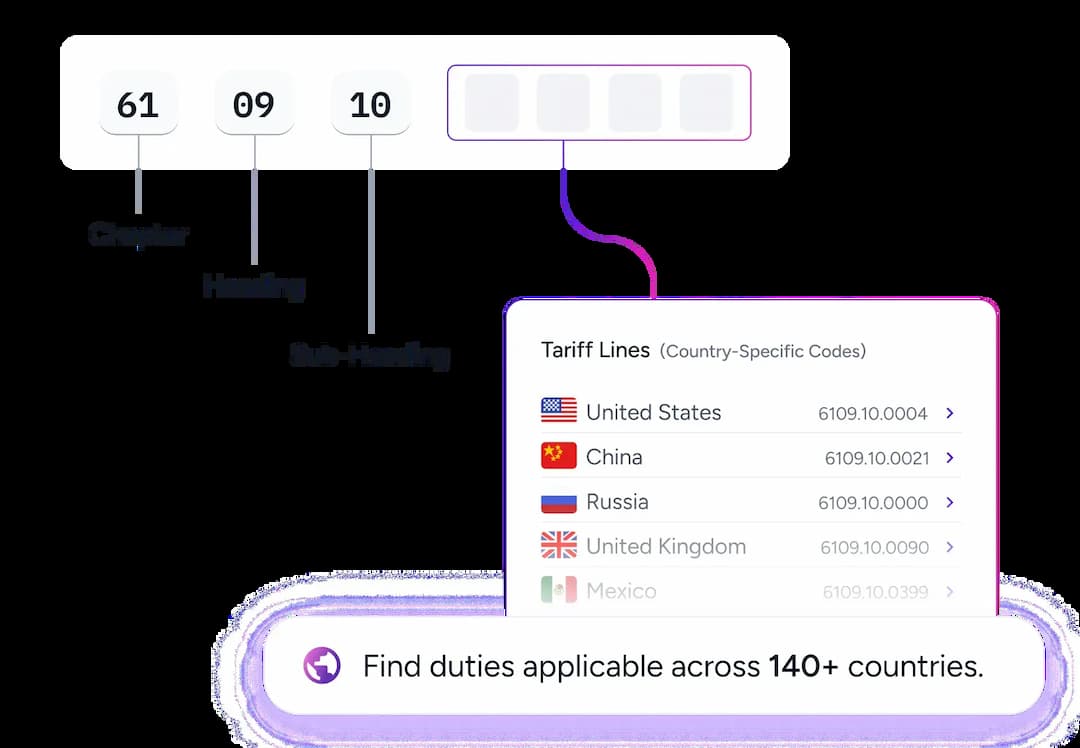
HS Code Lookup helps classify products under appropriate HS code and find duties applicable across 140+ countries. Find and discover HS classification, tariffs, taxes, controls, rulings, ECCNs, and default and preferential duties for HS code 8446.

WCO Notes for Heading 8446
84.46 ‑ Weaving machines (looms).
8446.10 - For weaving fabrics of a width not exceeding 30 cm
- For weaving fabrics of a width exceeding 30 cm, shuttle type :
8446.21 - - Power looms
8446.29 - - Other
8446.30 - For weaving fabrics of a width exceeding 30 cm, shuttleless type
This heading covers weaving machines for the production of fabrics by weaving, using textile (including peat fibre) yarns or other yarns (e.g., of metal, glass or asbestos).
In these machines the warp and weft yarns are interlaced at right angles to form a fabric.
In the simplest weave, the sheet of warp yarns from the warp beam divides into two groups of alternate yarns, each group being controlled by a harness; these harnesses alternately raise and lower their warp yarns to form an angle (known as the shed) between the two groups of yarns through which passes the weft yarn (in conventional looms carried by a shuttle) which is immediately beaten up against the preceding weft by the reed; the raising or lowering of the groups of warp yarn is then reversed by the harnesses, entrapping the weft and forming a new shed for the next line of weft. On ordinary looms up to eight harnesses can be used to vary the order in which the warp yarns are raised and so produce a certain variation in the weave.
More complex looms can execute more complicated weaves. For example, some looms have a special system for controlling the raising of the warp (dobbies, Jacquards, etc.) so as to control a greater number of groups of warp threads or even single warp threads; or special devices can be used to produce certain special fabrics (leno mechanisms, warp pile (or Terry) attachments, swivel shuttle attachments for broché work). Other looms have devices for changing the shuttles (or the bobbins in the shuttles), thus introducing wefts of different colours or different yarns; Looms often include certain other mechanical or electrical devices (e.g., for replenishing the bobbins in the shuttles when necessary, or for stopping the loom if a warp or weft thread breaks).
Most of these special devices may either form an integral part of the loom, or be mounted on an ordinary loom as auxiliary removable attachments; the latter type of attachment is classified here provided it is presented with the loom for which it is intended, but if presented separately it is excluded (generally heading 84.48).
Looms usually produce a flat fabric but there are circular looms which produce a tubular fabric; in these one or more shuttles, moved either mechanically or by electro‑magnets, interlace a weft with a vertical series of warp threads arranged in a circle.
Different types of looms may be named according to their type of mechanism or according to the type of fabric they produce, for example, dobby looms, Jacquard looms, automatic box motion looms, shuttleless looms in which the weft is inserted either by compressed air or a water jet or by a long needle, or drawn across from a fixed bobbin by a series of projectiles, ribbon looms (e.g., bar looms, Zurich looms and drum looms), pile fabric looms, carpet looms including knotted pile carpet looms.
The heading also includes :
(1) Hand looms.
(2) Looms for weaving cloth of wire or metallised yarn provided they are of the same type as textile weaving looms. Such looms must have all the essential mechanical parts characteristic of textile weaving looms, i.e., a warp beam, frame harnesses for forming the shed, the mechanism which passes the weft wire or yarn through the shed at right angles and entraps it in the warp yarns and a cloth beam for winding the cloth as it is produced.
However, the heading excludes machines designed for interlacing wire, by various processes, to form heavy wire grill or netting (see Explanatory Note to heading 84.63).
PARTS AND ACCESSORIES
Subject to the general provisions regarding the classification of parts (see the General Explanatory Note to Section XVI), parts and accessories of weaving machines of this heading are classified in heading 84.48.

What is HS code 8446?

How many sub-headings are there in HS code 8446?
International Trade Compliance Simplified