















HS Code Lookup for Heading 8501
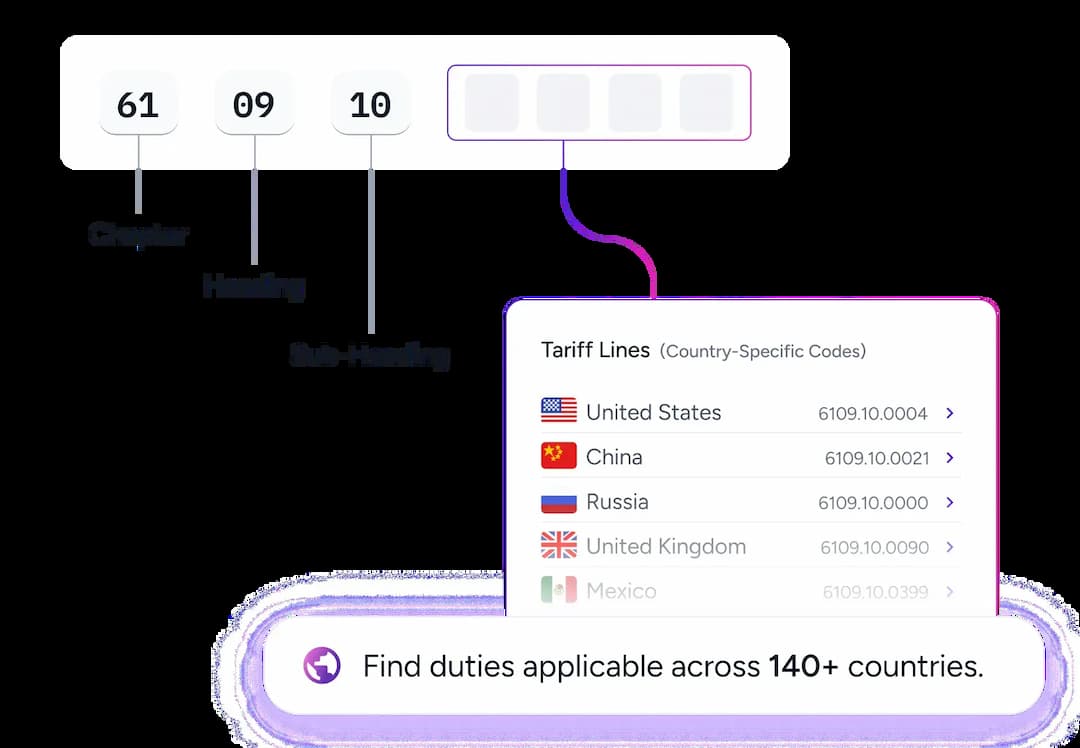
HS Code Lookup helps classify products under appropriate HS code and find duties applicable across 140+ countries. Find and discover HS classification, tariffs, taxes, controls, rulings, ECCNs, and default and preferential duties for HS code 8501.

WCO Notes for Heading 8501
85.01 ‑ Electric motors and generators (excluding generating sets).
8501.10 ‑ Motors of an output not exceeding 37.5 W
8501.20 ‑ Universal AC/DC motors of an output exceeding 37.5 W
‑ Other DC motors; DC generators, other than photovoltaic generators :
8501.31 ‑ ‑ Of an output not exceeding 750 W
8501.32 ‑ ‑ Of an output exceeding 750 W but not exceeding 75 kW
8501.33 ‑ ‑ Of an output exceeding 75 kW but not exceeding 375 kW
8501.34 ‑ ‑ Of an output exceeding 375 kW
8501.40 ‑ Other AC motors, single‑phase
‑ Other AC motors, multi‑phase :
8501.51 ‑ ‑ Of an output not exceeding 750 W
8501.52 ‑ ‑ Of an output exceeding 750 W but not exceeding 75 kW
8501.53 ‑ ‑ Of an output exceeding 75 kW
‑ AC generators (alternators) :
8501.61 ‑ ‑ Of an output not exceeding 75 kVA
8501.62 ‑ ‑ Of an output exceeding 75 kVA but not exceeding 375 kVA
8501.63 ‑ ‑ Of an output exceeding 375 kVA but not exceeding 750 kVA
8501.64 ‑ ‑ Of an output exceeding 750 kVA
‑ Photovoltaic DC generators :
8501.71 ‑ ‑ Of an output not exceeding 50 W
8501.72 ‑ ‑ Of an output exceeding 50 W
8501.80 ‑ Photovoltaic AC generators
(I) ELECTRIC MOTORS
Electric motors are machines for transforming electrical energy into mechanical power. This group includes rotary motors and linear motors.
(A) Rotary motors produce mechanical power in the form of a rotary motion. They are of many types and sizes according to whether they operate on DC or AC, and according to the use or purpose for which they are designed. The motor housing may be adapted to the circumstances in which the motor will operate (e.g., dust proof, drip proof or flame proof motors; non‑rigid mountings for belt driven motors, or for motors which will be subject to much vibration).
Many motors may incorporate a fan or other device for keeping the motor cool during running.
With the exception of starter motors for internal combustion engines (heading 85.11), the heading covers electric motors of all types from low power motors for use in instruments, clocks, time switches, sewing machines, toys, etc., up to large powerful motors for rolling mills, etc.
Motors remain classified here even when they are equipped with pulleys, with gears or gear boxes, or with a flexible shaft for operating hand tools.
The heading includes “outboard motors”, for the propulsion of boats, in the form of a unit comprising an electric motor, shaft, propeller and a rudder.
Synchronous motors for clock movements are classified here even if equipped with gears; however such synchronous motors also associated with a clock train are excluded (heading 91.09).
(B) Linear motors produce mechanical power in the form of a linear motion.
Linear induction motors consist essentially of one or more primary members composed of magnetic circuits, generally laminated (stack of magnetic laminations), on which coils are arranged and of a secondary member, usually in the form of a plate or profile of copper or aluminium.
These motors generate a propulsive force when the primary member is energised by applying an alternating current in the presence of the secondary. The two members are separated by an airgap, and the translational motion (one member remaining stationary while the other moves) is produced without mechanical contact.
The characteristic features of linear induction motors vary according to the purpose for which they are designed : driving hovertrains (the primary members are carried in the vehicles and straddle a rail (secondary member) secured to the track); powering bulk‑handling equipment (a secondary plate mounted underneath a wheeled trolley travels over a series of primary coils located between the rails); operating overhead conveyors (bogies fitted with primary members travel underneath a secondary profile); positioning vehicles in car parks or stores (secondary pallets are displaced by primary members set into the floor); controlling, e.g., piston pumps and valves (this function may be performed by “polysolenoid” linear motors in which the shaft (secondary member) moves to and fro inside an annular primary member); positioning on machine‑tools; etc.
DC linear motors, whose operation uses the interaction of electro‑magnets or of electro‑magnets and permanent magnets, can be used as alternating or oscillating motors (e.g., for reciprocating pumps, weaving shuttle drives), stepper motors (e.g., small conveyors), etc.
This group also includes :
(1) Servomotors, presented separately, consisting essentially of an electric motor with speed‑reducing gears and equipped with a power transmission device (e.g., lever, pulley) designed to adjust the variable position of a regulating control in a boiler, in a furnace or in other plant (and possibly provided with an emergency hand‑wheel).
(2) Self‑synchronising units, with a stator carrying three windings angled at 120° and a rotor carrying a single winding connected to two slip rings, for use in pairs (synchrotransmitter and synchroreceiver), e.g., in telemetering or remote control systems.
(3) Valve actuators, electrical, consisting of an electric motor with reducing gear and drive shaft and, in some cases, with various devices (electric starter, transformer, hand‑wheel, etc.) to operate the valve plug.
(II) ELECTRIC GENERATORS
Machines that produce electrical power from various energy sources (mechanical, solar, etc.) are classified here, provided they are not more specifically covered by any other heading of the Nomenclature.
There are two main classes, direct current (DC) generators (dynamos), and alternating current (AC) generators (alternators). In general, both consist essentially of a stator mounted in a housing, and a rotating member (the rotor) mounted inside the stator on a shaft driven by the prime mover. In the case of DC generators a commutator with segments is mounted on the rotorshaft. The current produced is collected by a system of carbon brushes which rub the commutator segments, and is transferred to the external circuit. AC generators are in most cases brushless and the current which they produce is led off directly to the external circuit. In other AC generators the current is collected by slip rings mounted on a rotorshaft and is transferred by a system of carbon brushes which rub the slip rings.
The stator usually consists of a system of electromagnets, but for certain DC generators (magneto‑electric generators) a system of permanent magnets is used. The rotor usually consists of a system of coils of wire mounted on a laminated iron core; this system is known as the armature. In some AC generators the revolving portion is the field system.
Electric generators may be hand‑ or pedal‑operated, but usually they have prime movers (e.g., hydraulic turbines, steam turbines, wind engines, reciprocating steam engines, internal combustion piston engines). However, this heading only covers generators when presented without prime movers.
The heading also covers photovoltaic generators consisting of panels of photocells combined with other apparatus, e.g., storage batteries and electronic controls (voltage regulator, inverter, etc.) and panels or modules equipped with elements, however simple (for example, diodes to control the direction of the current), which supply the power directly to, for example, a motor, an electrolyser.
In these devices, electricity is produced by means of solar cells which convert solar energy directly into electricity (photovoltaic conversion).
The heading covers all electric generators including large generators for power stations; small auxiliary generators used for exciting the windings of other generators; generators of various sizes and types used for supplying current for a variety of purposes (e.g., on ships, on farms not connected to an external supply, in chemical industries for electrolysis, and in diesel‑electric trains).
The heading also excludes :
(a) Drums or rollers incorporating an electric motor for belt or roller conveyors (heading 84.31).
(b) Vibrator motors and electro‑magnetic vibrators of heading 84.79 (see the Explanatory Note to that heading).
(c) Electric generators combined with prime movers (heading 85.02).
(d) High tension generators (heading 85.04).
(e) Primary cells and primary batteries (heading 85.06).
(f) Generators (dynamos and alternators) used in conjunction with internal combustion engines, or for electrical lighting or signalling equipment of a kind used for cycles or motor vehicles (headings 85.11 and 85.12, respectively).
(g) Solar cells whether or not assembled in modules or made up into panels but not equipped with elements, however simple, which supply the power directly to, for example, a motor, an electrolyser (heading 85.41).
(h) Certain electrical apparatus sometimes known as generators which do not in fact produce electric energy, e.g., signal generators (heading 85.43).
(ij) The generators of Chapter 90, for example, X‑ray generators (heading 90.22); generators designed for demonstrational purposes and unsuitable for other uses (heading 90.23).
PARTS
Subject to the general provisions regarding the classification of parts (see the General Explanatory Note to Section XVI), parts of the machines of this heading are classified in heading 85.03.

What is HS code 8501?

How many sub-headings are there in HS code 8501?
International Trade Compliance Simplified