















HS Code Lookup for Heading 8504
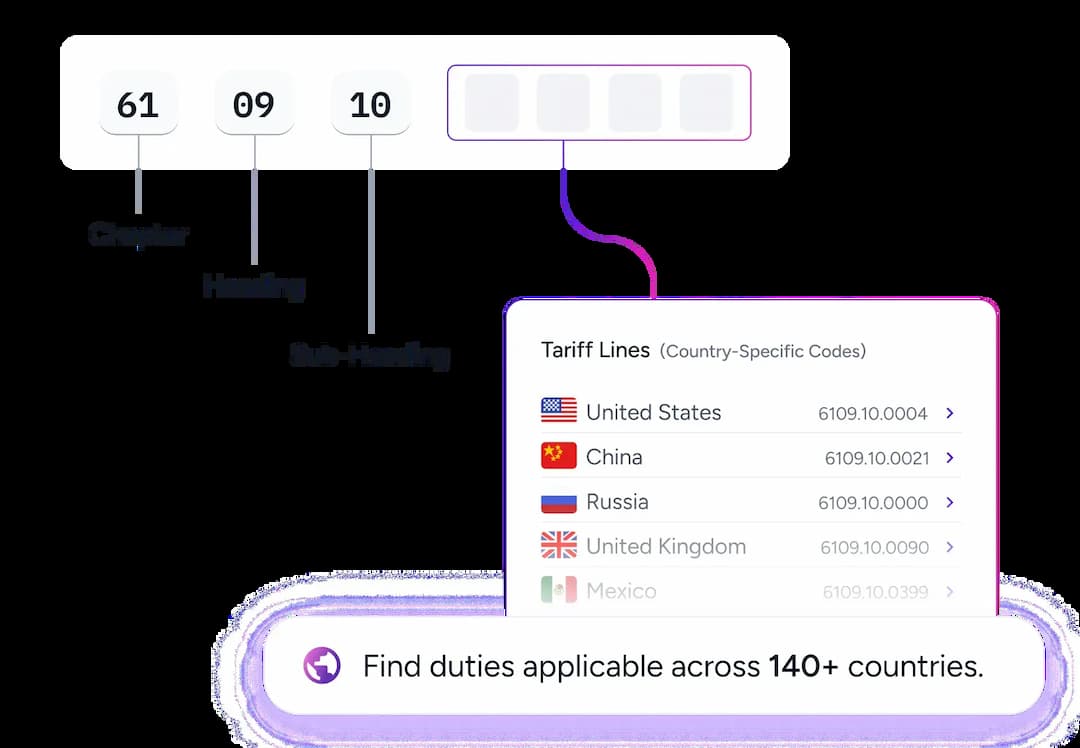
HS Code Lookup helps classify products under appropriate HS code and find duties applicable across 140+ countries. Find and discover HS classification, tariffs, taxes, controls, rulings, ECCNs, and default and preferential duties for HS code 8504.

WCO Notes for Heading 8504
85.04 ‑ Electrical transformers, static converters (for example, rectifiers) and inductors.
8504.10 ‑ Ballasts for discharge lamps or tubes
‑ Liquid dielectric transformers :
8504.21 ‑ ‑ Having a power handling capacity not exceeding 650 kVA
8504.22 ‑ ‑ Having a power handling capacity exceeding 650 kVA but not exceeding 10,000 kVA
8504.23 ‑ ‑ Having a power handling capacity exceeding 10,000 kVA
‑ Other transformers :
8504.31 ‑ ‑ Having a power handling capacity not exceeding 1 kVA
8504.32 ‑ ‑ Having a power handling capacity exceeding 1 kVA but not exceeding 16 kVA
8504.33 ‑ ‑ Having a power handling capacity exceeding 16 kVA but not exceeding 500 kVA
8504.34 ‑ ‑ Having a power handling capacity exceeding 500 kVA
8504.40 ‑ Static converters
8504.50 ‑ Other inductors
8504.90 ‑ Parts
(I) ELECTRICAL TRANSFORMERS
Electrical transformers are apparatus which, without having any moving parts, transform, by means of induction and using a preset or adjustable system, an alternating current into another alternating current of different voltage, impedance, etc. These usually consist of two or more coils of insulated wire wound in various configurations on laminated iron cores, although in some cases (e.g., radio‑frequency transformers) there may be no magnetic core, or the core may be of agglomerated iron dust, ferrite, etc. An AC in one coil (the primary circuit) induces an AC usually at different values of current and voltage in the others (the secondary circuit). In certain cases (auto transformers) there is only a single coil, part of the winding of which is common to the primary and secondary circuits. In shell type transformers, there is a shell of laminated iron round the transformer.
Certain transformers are designed for particular purposes, e.g., matching transformers for matching the impedance of one circuit with that of another, and instrument transformers (current or voltage transformers, combined instrument transformers) used to step down or step up voltages or currents to the level of the connected equipment, e.g., measuring instruments, electricity meters or protective relays.
The heading covers all transformers. They vary from ballasts for the control of the amount of current that flows through discharge lamps or tubes, small types used in wireless sets, instruments, toys, etc., to large types enclosed in oil tanks or equipped with radiators, fans, etc., for cooling purposes. The large types are used in electricity stations, stations for interconnecting mains, distributing stations or sub‑stations. The frequency may vary from mains frequencies up to very high radio frequencies. The heading includes baluns (balancing units) which reduce electro-magnetic interference by balancing the impedance in paired lines.
The power‑handling capacity of a transformer is the kilovolt‑ampere (kVA) output based on continual use at the rated secondary voltage (or amperage, when applicable) and at the rated frequency without exceeding the rated temperature limitations.
Transformers for electric welding equipment presented separately without their welding heads or welding appliances are classified in this heading. However, they are excluded (heading 85.15) when presented together with their welding heads or welding appliances.
The heading also covers induction coils, a kind of transformer in which an intermittent or fluctuating direct current in the primary induces a corresponding current in the secondary. They can be used either to step up the voltage to a higher value or, in the case of telephony, to reproduce in the secondary circuits a small fluctuating current corresponding to the fluctuation imposed on a steady DC in the primary. The heading covers induction coils of all kinds, other than ignition equipment for internal combustion engines (heading 85.11).
(II) ELECTRICAL STATIC CONVERTERS
The apparatus of this group are used to convert electrical energy in order to adapt it for further use. They incorporate converting elements (e.g., valves) of different types. They may also incorporate various auxiliary devices (e.g., transformers, induction coils, resistors, command regulators, etc.). Their operation is based on the principle that the converting elements act alternately as conductors and non‑conductors.
The fact that these apparatus often incorporate auxiliary circuits to regulate the voltage of the emerging current does not affect their classification in this group, nor does the fact that they are sometimes referred to as voltage or current regulators.
This group includes :
(A) Rectifiers by which alternating current (single or polyphase) is converted to direct current, generally accompanied by a voltage change.
(B) Inverters by which direct current is converted to alternating current.
(C) Alternating current converters and cycle converters by which alternating current (single or polyphase) is converted to a different frequency or voltage.
(D) Direct current converters by which direct current is converted to a different voltage.
Electrical static converters may be divided into the following principal categories according to the type of converting element with which they are equipped :
(1) Semiconductor converters based on the one‑way conductivity between certain crystals. Such converters consist of a semiconductor as the converting element and various other devices (e.g., coolers, tape conductors, drives, regulators, control circuits).
These include :
(a) Monocrystalline semiconductor rectifiers using, as a converting element, a device containing silicon or germanium crystals (diode, thyristor, transistor).
(b) Polycrystalline semiconductor rectifiers using a selenium disc.
(2) Gas discharge converters, such as :
(a) Mercury arc rectifiers. Their converting element consists of a glass envelope or a metal tank having a vacuum and containing a mercury cathode and one or more anodes through which the current to be rectified passes. They are equipped with auxiliary devices, e.g., for priming, charging, cooling, and sometimes to maintain the vacuum.
There are two categories of gas discharge rectifiers identifiable according to the mechanism of the primer, viz., “excitrons” (with charging anodes) and “ignitrons” (with igniters).
(b) Thermo‑ionic rectifiers with incandescent cathodes. Their converting element (e.g., a thyratron) is similar to that of mercury arc rectifiers except that it contains an incandescent cathode in place of the mercury cathode.
(3) Converters with a mechanical converting element based on the one‑way conductivity of various contacts, such as :
(a) Contact rectifiers (e.g., those using camshafts) with a device whose metal contacts open and close in synchronisation with the frequency of the alternating current to be rectified.
(b) Mercury‑jet turbine rectifiers with a rotating jet of mercury, synchronised with the frequency of the alternating current, which strikes a fixed contact.
(c) Vibrator rectifiers with a thin metal tongue, oscillating at the frequency of the alternating current, which touches a contact so placed that the current is drawn from the source.
(4) Electrolytic rectifiers based on the principle that the combination of certain products used as electrodes in combination with certain liquids used as electrolytes will only allow current to flow in a single direction.
Electrical static converters may be used for different purposes, e.g. :
(1) Converters to supply electricity to drive stationary machines or electric traction vehicles (e.g., locomotives).
(2) Supply converters, such as accumulator chargers (which consist essentially of rectifiers with associated transformer and current control apparatus), converters for galvanising and electrolysis, emergency power packs, converters for installations which supply high‑tension direct current, converters for heating purposes and for the current supply to electro‑magnets.
Also classified here are converters known as high‑tension generators (used particularly with radio apparatus, emission tubes, microwave tubes, ion‑beam tubes) which convert the current from any source, usually the mains, into the direct high‑tension current necessary for feeding the equipment concerned by means of rectifiers, transformers, etc.
This heading also includes stabilised suppliers (rectifiers combined with a regulator), e.g., uninterruptible power supply units for a range of electronic equipment.
However, high‑tension generators (or transformers) specifically designed for supplying radiological apparatus fall in heading 90.22. Automatic voltage regulators are classified in heading 90.32.
(III) INDUCTORS
These consist essentially of a single coil of wire which, inserted in an AC circuit, limits or prevents by its self‑induction the flow of the AC. They vary from small chokes used in wireless circuits, instruments, etc., to large coils often mounted in concrete, used in power circuits (e.g., for limiting the flow of current in the event of a short circuit).
Inductors or inductances obtained in the form of individual components by a printing process remain classifiable in this heading.
Deflection coils for cathode‑ray tubes are classified in heading 85.40.
PARTS
Subject to the general provisions regarding the classification of parts (see the General Explanatory Note to Section XVI), parts of the goods of this heading are also classified here. In particular, metal tank mercury arc rectifiers, with or without a pump, are always classified as parts.
However, most of the electric components of the devices of this heading are to be found in other headings of the Chapter, for example :
(a) Various switches of heading 85.36 (for example, those used with multiple contact transformers).
(b) Vacuum or mercury vapour rectifying tubes and valves (other than the metal tank type) and thyratrons (heading 85.40).
(c) Semiconductor diodes, transistors, and thyristors (heading 85.41).
(d) Articles of heading 85.42.

What is HS code 8504?

How many sub-headings are there in HS code 8504?
International Trade Compliance Simplified