















HS Code Lookup for Heading 8512
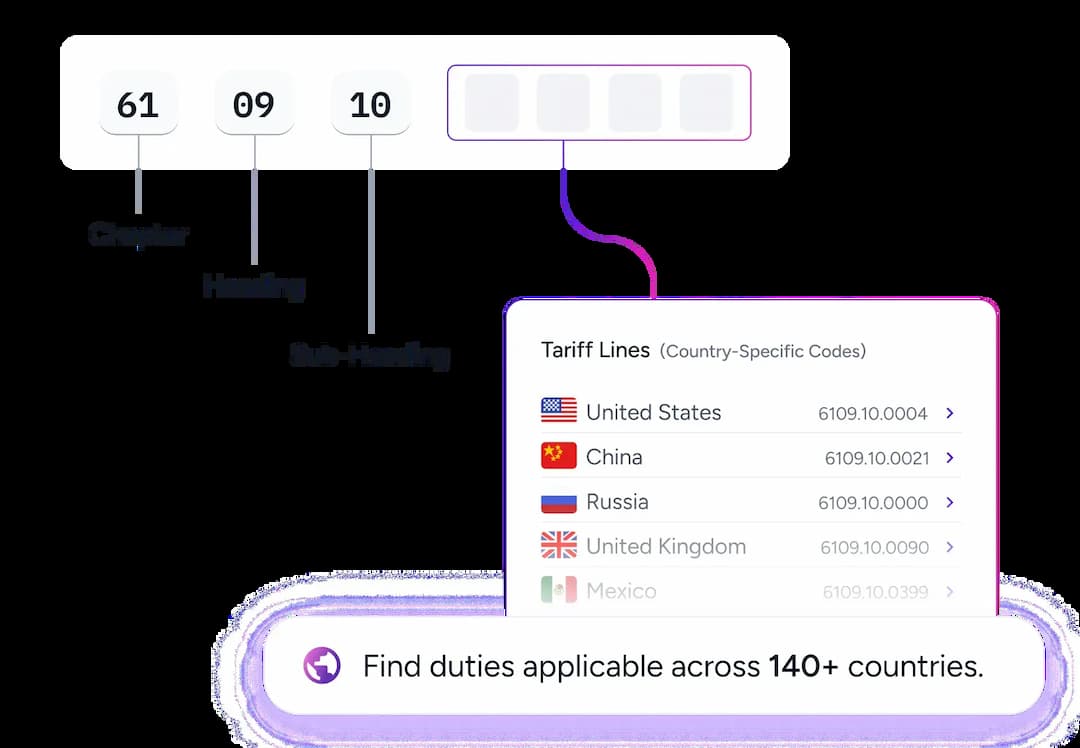
HS Code Lookup helps classify products under appropriate HS code and find duties applicable across 140+ countries. Find and discover HS classification, tariffs, taxes, controls, rulings, ECCNs, and default and preferential duties for HS code 8512.

WCO Notes for Heading 8512
85.12 ‑ Electrical lighting or signalling equipment (excluding articles of heading 85.39), windscreen wipers, defrosters and demisters, of a kind used for cycles or motor vehicles.
8512.10 ‑ Lighting or visual signalling equipment of a kind used on bicycles
8512.20 ‑ Other lighting or visual signalling equipment
8512.30 ‑ Sound signalling equipment
8512.40 ‑ Windscreen wipers, defrosters and demisters
8512.90 ‑ Parts
This heading covers electrical apparatus and appliances specialised for use on cycles or motor vehicles for lighting or signalling purposes. It does not, however, cover, dry batteries (heading 85.06), electric accumulators (heading 85.07) or dynamos and magneto‑dynamos of heading 85.11. The heading also includes electrical windscreen wipers, defrosters and demisters for motor vehicles.
The heading includes, inter alia :
(1) Dynamos for generating electric current by means of a friction wheel running on one of the tyres or wheel rims of a bicycle or, in some rare cases, of a motor‑cycle.
(2) Battery holders, equipped with a switch, terminals, contacts, etc., for cycle lighting equipment; battery‑operated lamps, designed for mounting on cycles.
(3) Headlamps of all kinds including lamps fitted with dimming or dipping attachments; diffused driving lamps; anti‑fog lamps; spot‑lights; search‑lamps of a kind used on police cars or the like (including those which, attached to a length of cable, can be used as hand lamps or can be placed on the road).
(4) Side lamps; tail lamps; parking lamps; licence plate lamps.
(5) Braking lights, direction indication lights, reversing lamps and the like.
(6) Combinations of some of the above‑mentioned lamps, assembled in one casing.
(7) Interior lighting lamps, such as dome lamps, wall lamps, step indicating lamps, door frame lamps and instrument panel lamps.
(8) Luminous overtaking signals, transmitting to the driver automatically (sometimes by means of a photoelectric cell) a signal indicating the presence of an overtaking vehicle.
(9) Other electrical visual signalling apparatus, e.g., illuminated triangles for vehicles with trailers , illuminated indicators (of the revolving dome type or the "lightbar" type) for taxis, police vehicles, fire engines, etc.
(10) Parking equipment operated by means of external feelers, which, when they touch the curb or other object, cause a light or other signal to warn the driver.
(11) Anti-theft alarms which emit visual or audio signals to warn of attempts to break in to a vehicle.
(12) Horns, sirens and other electrical sound signalling appliances.
(13) Electrical apparatus which emit audio signals to warn the driver of the proximity of vehicles or other objects behind the vehicle when reversing. These apparatus usually comprise ultrasonic sensors, an electronic control unit, a buzzer or beeper and associated wiring.
(14) Electrical apparatus of a kind used in a motor vehicle to warn the driver, by visual or audio signals, that a speed detection device, such as a radar gun or a laser gun, is operating in the vicinity.
(15) Windscreen wipers, including dual windscreen wipers, driven by an electric motor.
(16) Defrosters and demisters. These consist of a resistance wire mounted in a frame for fitting to the windscreen.
PARTS
Subject to the general provisions regarding the classification of parts (see the General Explanatory Note to Section XVI), parts of the goods of this heading are also classified here.
*
* *
The heading also excludes :
(a) Glass lenses (heading 70.14).
(b) Air conditioning machinery or apparatus (heading 84.15).
(c) Electric sound amplifier sets, consisting of a microphone, audio‑frequency amplifier and loudspeaker, used for transmitting to the driver of a towing vehicle the warning hoot or other road sounds behind his trailer (heading 85.18).
(d) Boards, panels and other bases, equipped with two or more apparatus of heading 85.36 (e.g., an assembly of switches for mounting on the steering column) (heading 85.37).
(e) Electric lamps, including sealed beam lamp units, of heading 85.39.
(f) Insulated electric wire and cable, whether or not cut to length or fitted with connectors or made up in sets (e.g., ignition wiring sets) (heading 85.44).
(g) Non‑electric car heating apparatus which also acts as defroster or demister (heading 73.22 or 87.08).

What is HS code 8512?

How many sub-headings are there in HS code 8512?
International Trade Compliance Simplified