















HS Code Lookup for Heading 8519
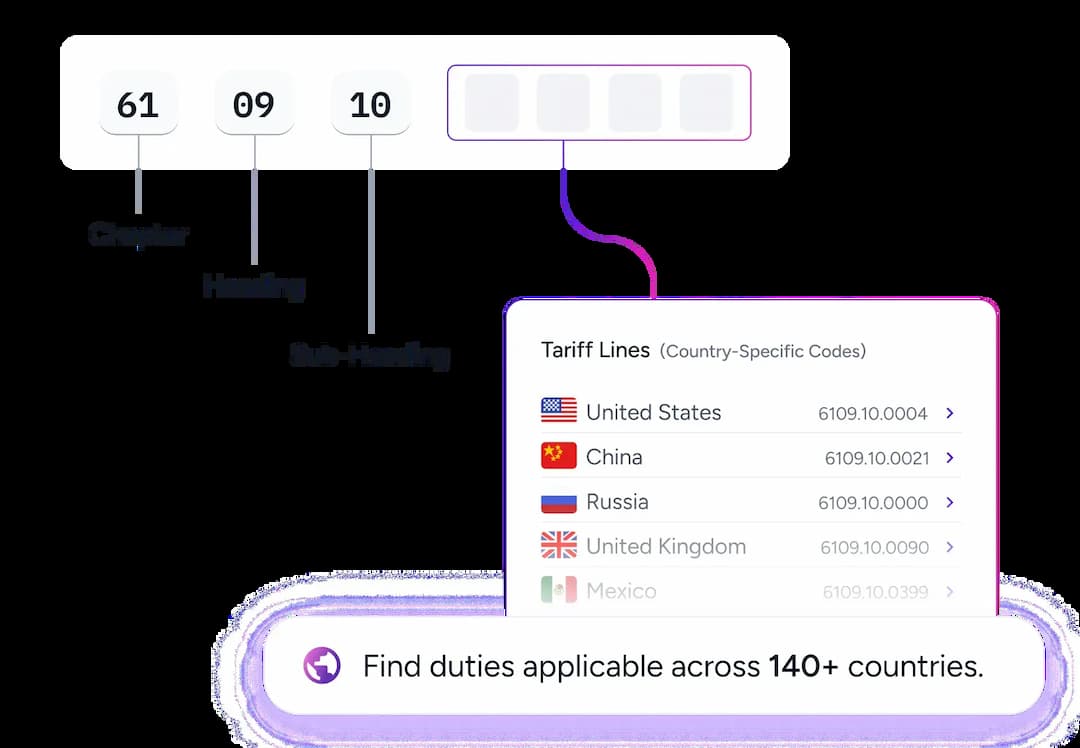
HS Code Lookup helps classify products under appropriate HS code and find duties applicable across 140+ countries. Find and discover HS classification, tariffs, taxes, controls, rulings, ECCNs, and default and preferential duties for HS code 8519.

WCO Notes for Heading 8519
85.19 - Sound recording or reproducing apparatus (+).
8519.20 - Apparatus operated by coins, banknotes, bank cards, tokens or by other means of payment
8519.30 - Turntables (record-decks)
- Other apparatus :
8519.81 - - Using magnetic, optical or semiconductor media
8519.89 - - Other
This heading covers apparatus for recording sound, apparatus for reproducing sound and apparatus that is capable of both recording and reproducing sound. Generally, sound is recorded onto or reproduced from an internal storage device or media (e.g., magnetic tape, optical media, semiconductor media or other media of heading 85.23).
Sound recording apparatus modify a recording medium so that sound reproducing apparatus can subsequently reproduce the original sound-wave (speech, music, etc.). This includes recording based on the receipt of a sound-wave or by other methods, e.g., by recording data sound files, downloaded from an Internet page or a compact disc by an automatic data processing machine, onto the internal memory (e.g., flash memory) of a digital audio device (e.g., MP3 player). Devices which record sound as digital code generally are not capable of reproducing sound unless they incorporate a means for converting the recording from digital code to an analogue signal.
(I) APPARATUS OPERATED BY COINS, BANKNOTES, BANK CARDS,
TOKENS OR BY OTHER MEANS OF PAYMENT
These apparatus operate by coins, banknotes, bank cards, tokens or other means of payment and allow for the selection and playing of audio recordings in a chosen sequence or randomly. They are commonly referred to as “juke boxes”.
(II) TURNTABLES (RECORD-DECKS)
These apparatus rotate the discs mechanically or electrically. They may or may not incorporate a sound-head, but they do not include an acoustic device nor electrical means of amplifying sound (see “record players” below). They may be fitted with an automatic device enabling a series of records to be played in succession.
(III) TELEPHONE ANSWERING MACHINES
These apparatus are designed to operate in conjunction with a telephone set (but not forming an integral part of the set). They transmit a previously recorded message and may have the capability to record incoming messages left by callers.
(IV) OTHER APPARATUS USING MAGNETIC, OPTICAL OR SEMICONDUCTOR MEDIA
The apparatus of this group may be portable. They may also be equipped with, or designed to be attached to acoustic devices (loudspeakers, earphones, headphones) and an amplifier.
(A) Apparatus using magnetic media
This group includes apparatus which use tapes or other magnetic media. Sound is recorded by altering the magnetic properties of the media. The sound is reproduced by passing the medium in front of a magnetic sound-head. Examples include cassette-players, tape recorders and cassette recorders.
(B) Apparatus using optical media
This group includes apparatus which use optical media. Sound is recorded as digital code converted from amplified currents of variable intensity (analogue signal) onto the surface of the recording medium. Sound is reproduced using a laser to read such medium. Examples include compact disc players and minidisc players. These types also cover apparatus which uses media combining magnetic and optical technologies. An example of such an apparatus uses magneto-optical discs, on which the areas of varying reflectivity are created using a magnetic technology but are read using an optical (e.g., laser) beam.
(C) Apparatus using semiconductor media
This group includes apparatus which use semiconductor (e.g., solid-state non- volatile) media. Sound is recorded as digital code converted from amplified currents of variable intensity (analogue signal) on the recording medium. Sound is reproduced by reading such medium. The semiconductor media may be permanently installed in the apparatus or may be in the form of removable solid-state non-volatile storage media. Examples include flash memory audio players (e.g., certain MP3 players) which are portable battery operated apparatus consisting essentially of a housing incorporating a flash memory (internal or removable), a microprocessor, an electronic system including an audio-frequency amplifier, an LCD screen and control buttons. The microprocessor is programmed to use MP3 or similar file formats. The apparatus can be connected to an automatic data processing machine for downloading MP3 or similar files.
(D) Apparatus using any combination of magnetic, optical or semiconductor media
These apparatus incorporate devices which are capable of recording or reproducing by using any two or all of magnetic, optical or semiconductor media.
(V) OTHER SOUND RECORDING OR SOUND REPRODUCING APPARATUS
This group includes :
(1) Record players. These apparatus produce sound from records (grooved discs) by electric amplifiers and loudspeakers, mechanical vibrations being converted into electrical vibrations by a sound-head (pick-up cartridge). They may be fitted with an automatic device enabling a series of records to be played in succession.
(2) Cinematographic sound recording apparatus which record sound by photoelectrical methods. Sound may be photoelectrically recorded on film as a strip, either (a) of variable area or (b) of variable density.
Cinematographic sound recording apparatus comprises, in addition to the sound recording head, a magazine for holding the film, a motor driving mechanism for synchronising the speed of the film with that of the cinematographic camera working with it, and a film transport mechanism.
(3) Cinematographic sound reproducers. These are equipped with a reader which incorporates a photoelectric sound-head and a charge-coupled device.
(4) Re-recording apparatus, for cinematography, used, for example, for photoelectric or digital rerecording of sound tracks recorded by other means, e.g., magnetically, optically, or electronically.
*
* *
PARTS AND ACCESSORIES
Subject to the general provisions regarding the classification of parts (see the General Explanatory Note to Section XVI), parts and accessories of the apparatus of this heading are classified in heading 85.22.
*
* *
The heading excludes :
(a) Presses or injection moulding machinery for replicating recorded optical discs of plastics (heading 84.77).
(b) Telephone answering machines forming an integral part of a telephone set (heading 85.17).
(c) Separately presented microphones, loudspeakers, audio-frequency electric amplifiers and electric sound amplifier sets (heading 85.18).
(d) Video recording or reproducing apparatus of heading 85.21.
(e) Sound recording or reproducing apparatus combined in the same housing with reception apparatus for radio-broadcasting (heading 85.27).
(f) Sound recording or reproducing apparatus combined with television receivers (heading 85.28).
(g) Cinematographic cameras and projectors combined with sound recording or reproducing apparatus (heading 90.07).
°
° °
Subheading Explanatory Note.
Subheading 8519.81
This subheading covers apparatus using one or more of the following : magnetic, optical or semiconductor media.

What is HS code 8519?

How many sub-headings are there in HS code 8519?
International Trade Compliance Simplified