















HS Code Lookup for Heading 8532
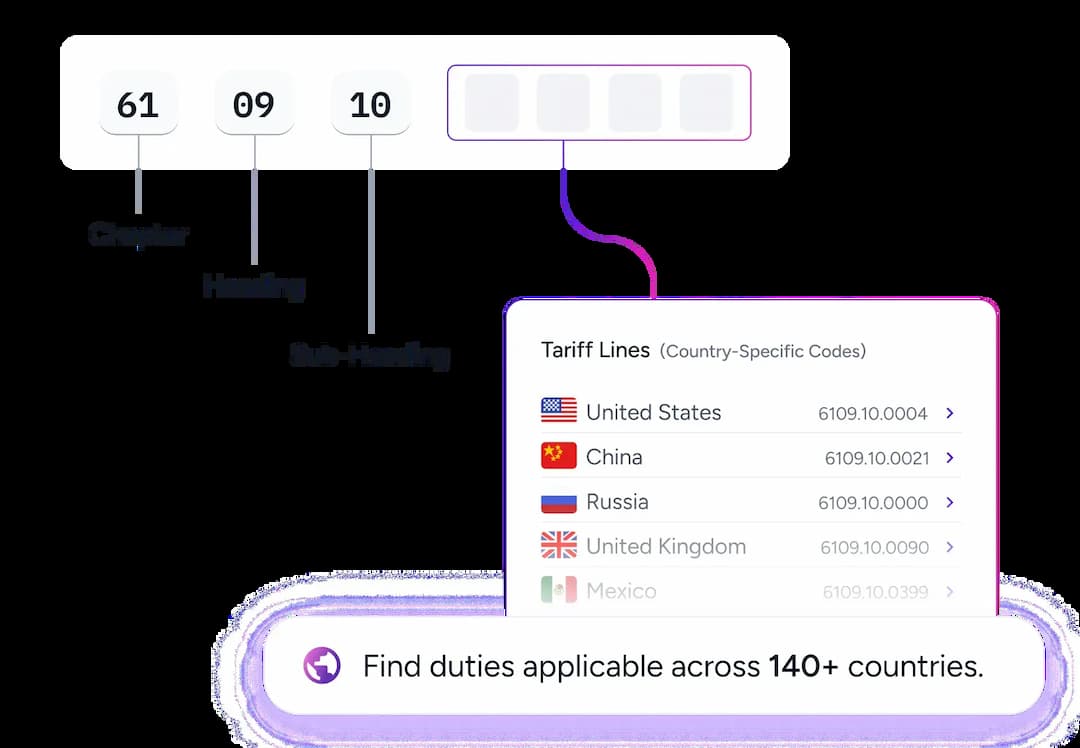
HS Code Lookup helps classify products under appropriate HS code and find duties applicable across 140+ countries. Find and discover HS classification, tariffs, taxes, controls, rulings, ECCNs, and default and preferential duties for HS code 8532.

WCO Notes for Heading 8532
85.32 ‑ Electrical capacitors, fixed, variable or adjustable (pre-set) (+).
8532.10 ‑ Fixed capacitors designed for use in 50/60 Hz circuits and having a reactive power handling capacity of not less than 0.5 kvar (power capacitors)
‑ Other fixed capacitors :
8532.21 ‑ ‑ Tantalum
8532.22 ‑ ‑ Aluminium electrolytic
8532.23 ‑ ‑ Ceramic dielectric, single layer
8532.24 ‑ ‑ Ceramic dielectric, multilayer
8532.25 ‑ ‑ Dielectric of paper or plastics
8532.29 ‑ ‑ Other
8532.30 ‑ Variable or adjustable (pre‑set) capacitors
8532.90 ‑ Parts
Electrical capacitors (or condensers) consist, in principle, of two conducting surfaces separated by an insulating material (dielectric), e.g., air, paper, mica, oil, resins, rubber and plastics, ceramics or glass.
They are used for various purposes in many branches of the electrical industry (e.g., to improve the power factor of AC circuits, to produce phase‑shifted currents for rotating fields in induction motors, to protect electrical contacts from the effects of arcing, for storing and releasing given quantities of electricity, in oscillating circuits, in frequency filters, and very widely in the radio, television or telephone industries or for industrial electronic equipment).
Their characteristics (shape, size, capacitance, nature of dielectric, etc.) vary according to their intended use. The heading, however, covers all capacitors irrespective of their type and method of manufacture and whatever their intended use (including standard capacitors used in laboratories or in numerous measuring instruments, specially made within fine limits and designed to remain constant during use).
The heading also covers capacitors grouped together on a chassis or in a container (e.g., certain large power factor capacitors and capacitor boxes consisting of a number of standard capacitors with means of connecting them together, in series or in parallel, to obtain any required capacitance).
(A) FIXED CAPACITORS
Fixed capacitors are those in which the capacitance cannot be varied. The main types are : dry capacitors, “oil” impregnated capacitors, “gas” impregnated capacitors, “oil” filled capacitors and electrolytic capacitors.
(1) In dry capacitors the plates and dielectric are usually in the form of superimposed plates or rolled strip or foil. In certain dry capacitors a metal covering is applied by a chemical or thermic process to a fixed dielectric. Dry capacitors may be enclosed in a clamp‑equipped box or be used without a box.
(2) “Oil” impregnated capacitors are similar to dry capacitors but the dielectric, usually of plastic film or plastic film and paper, is impregnated with oil or other liquid.
(3) “Gas” impregnated capacitors are capacitors consisting of two or more electrodes separated by a gas, other than air, which serves as a dielectric.
(4) In some cases the capacitor (“oil filled capacitor”) is enclosed in a container filled with oil or other suitable liquid, and many incorporate accessory devices such as pressure gauges and safety valves.
(5) In electrolytic capacitors, one of the plates is generally of aluminium or tantalum while the role of the other is fulfilled by a suitable electrolyte to which the current is led by means of an electrode, sometimes similar in form to the aluminium or tantalum plate. The electrolytic action produces on the aluminium or tantalum a thin layer of complex chemical compounds which thereafter constitutes the dielectric. The capacitor is sometimes enclosed in a container, but generally the outer electrode itself constitutes the container; these capacitors are often fitted with a pin base similar to that of a valve. Certain capacitors of this type containing a pasty form of electrolyte are also called “dry electrolytic capacitors”.
(B) VARIABLE CAPACITORS
Variable capacitors are those in which the capacitance can be varied at will. In most cases air is the dielectric, and the plates usually consist of two groups of metal plates, one group fixed while the other, mounted on an axis, can be turned so that its plates can pass between the fixed plates. The degree to which the mobile plates (rotors) are turned and overlap with the fixed plates (stators) varies the capacitance of the capacitor.
(C) PRE‑SET OR ADJUSTABLE CAPACITORS
Pre‑set or adjustable capacitors (including trimming capacitors) are those in which the capacitance can be adjusted within narrow limits to a precise value. This adjustment can be made in different ways. In certain types the distance between the plates may be varied by means of a screw. Other types consist of two metal cylinders, one of which can be moved to a variable extent within the other or of two mutually moved semicircles. Usually, the dielectrics used are, for example, mica, ceramics, plastics or air.
PARTS
Subject to the general provisions regarding the classification of parts (see the General Explanatory Note to Section XVI), parts of capacitors are also classified here.
*
* *
The heading does not cover certain synchronous motors used for power factor improvement, even though they are often called “synchronous capacitors” (heading 85.01).
°
° °
Subheading Explanatory Notes.
Subheading 8532.23
This subheading covers single layer ceramic dielectric fixed capacitors, which are in the form of discs or tubes.
Subheading 8532.24
This subheading covers multilayered ceramic dielectric fixed capacitors, which have connecting leads or are in the form of chips.

What is HS code 8532?

How many sub-headings are there in HS code 8532?
International Trade Compliance Simplified