















HS Code Lookup for Heading 8534
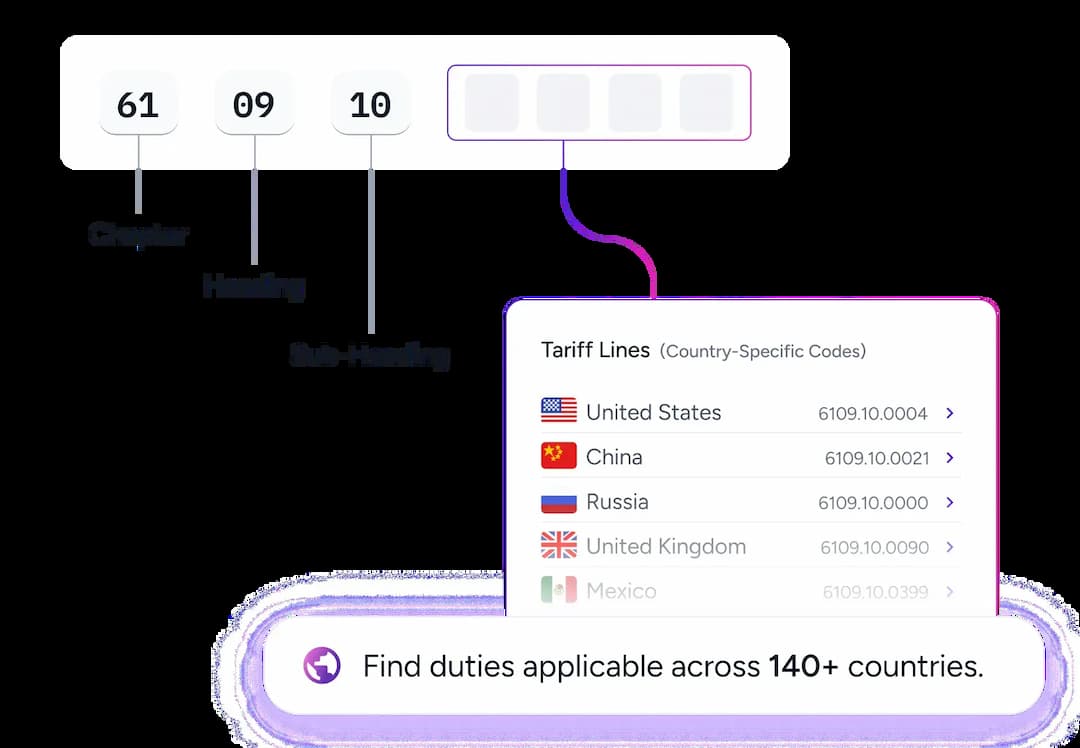
HS Code Lookup helps classify products under appropriate HS code and find duties applicable across 140+ countries. Find and discover HS classification, tariffs, taxes, controls, rulings, ECCNs, and default and preferential duties for HS code 8534.

WCO Notes for Heading 8534
85.34 ‑ Printed circuits.
In accordance with Note 8 to this Chapter, this heading covers the circuits which are made by forming on an insulating base, by any printing process (conventional printing or embossing, plating‑up, etching, etc.), conductor elements (wiring), contacts or other printed components such as inductances, resistors and capacitors (“passive” elements), other than elements which can produce, rectify, detect, modulate or amplify electric signals, such as diodes, triodes or other “active” elements. Some basic or “blank” circuits may comprise only printed conductor elements generally consisting of thin uniform strips or wafers with, if appropriate, connectors or contact devices. Others combine several of the above elements according to a pre‑established pattern.
The insulating base material is generally flat but may also be in the shape of a cylinder, a truncated cone, etc. The circuit may be printed on one or both sides (double circuits). Several printed circuits may be assembled in multiple layers and interconnected (multiple circuits).
The heading also covers thin‑ or thick‑film circuits consisting solely of passive elements.
Thin‑film circuits are formed by the deposition on glass or ceramic plates of specific patterns of metallic and dielectric film, by vacuum evaporation, cathode sputtering or chemical methods. The patterns may be formed by deposition through masks or by deposition of a continuous sheet with subsequent selective etching.
Thick‑film circuits are formed by screen printing onto ceramic plates of similar patterns, using pastes (or inks) containing mixtures of powdered glass, ceramics and metals with suitable solvents. The plates are then furnace‑fired.
Printed circuits may be provided with holes or fitted with non‑printed connecting elements either for mounting mechanical elements or for the connection of electrical components not obtained during the printing process. Film circuits are generally supplied in metallic, ceramic or plastic capsules which are fitted with connecting leads or terminals.
Individual passive components such as inductances, capacitors and resistors obtained by any printing process are not regarded as printed circuits of this heading but are classifiable in their own appropriate headings (e.g., heading 85.04, 85.16, 85.32 or 85.33).
Circuits on which mechanical elements or electrical components have been mounted or connected are not regarded as printed circuits within the meaning of this heading. They generally fall to be classified in accordance with Note 2 to Section XVI or Note 2 to Chapter 90, as the case may be.

What is HS code 8534?

How many sub-headings are there in HS code 8534?
International Trade Compliance Simplified